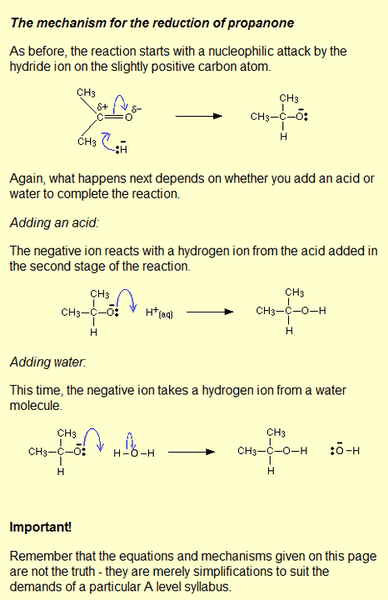
This is the gist of what happens. However, there are a few ways in which it is simplified.
For one, all of those individual reactions are equilibrium processes and some are very reversible, especially the formation of the tetrahedral intermediate that results from the nucleophilic attack of hydride on the carbonyl group.
Also, the hydride ion is not floating around in solution. Hydride comes from some hydride reducing agent such as lithium aluminum hydride (LAH), sodium borohydride, sodium cyanoborohydride, etc. In the case of lithium aluminum hydride, the lithium or aluminum ion will stabilize the charge density on oxygen atom in the tetrahedral intermediate. Also, in the case of the LAH reduction, the resulting lithium alkoxide salt needs to be hydrolyzed to liberate the alcohol.
Furthermore, there is no mention of what solvents are used in these reactions. For example, the LAH reduction is typically done in ether or THF, while sodium borohydride and sodium cyanoborohydride reductions are done in aqueous solutions.
Finally, a note about water chemistry: in acidic solution, there is a high concentration of hydronium ion. There are never free protons floating around in solution, although in most introductory courses, it's perfectly acceptable to simply write "H+(aq)" as opposed to "H3O+(aq)."
Really, it could be a lot more complicated than this depending on how deep and quantitative you'd like to go! Organic Chemistry might seem like a very "fuzzy" or "squishy" branch of chemistry, but it actually depends on some cold, hard, physical laws.
 Well, after doing quantum chemistry full-time for the past 7 years, I've done a few. The largest would be on systems of >200 atoms, if you count Kohn-Sham MOs. Otherwise, it'd depends on the level of theory.
  (My first postgrad degree was in phys chem) Did you intend to address the original poster?