- 2,765
- 12,133
Almost all vertebrates have a tail (part of the body axis that extends posterior of the anus. A post-anal tail is often listed as a characteristic of vertebrate (many animals have their anus at the end of the body, no post-anal axial structures). The most obvious exception to this are the ape/human clade of primates, founded by animals that lacked an external tail.
This paper and this Science mag news article explain why:
A mobile element (an Alu sequence) in the ape/human predecessor seems to have jumped to a new place in the genome near the encoding brachyury gene, changing its regulation and resulting in a no tail developed phenotype. Brachyury is a mouse regulatory gene with a short tail phenotyps. In zebrafish the same mutation is called no tail because it has a no tail phenotype (ntl below, wt = wild type).
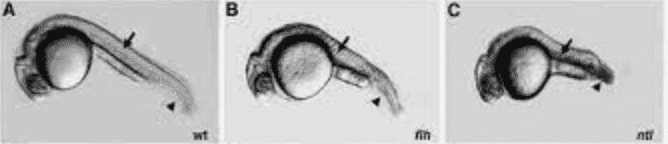
The tail is posterior to the anus, which will be at the end of the tube of yoke extending from that big ball of yolk. This area is developmentally different from more anterior parts of the body axis because it is no longer in contact with the main body of the egg where some developmental signals, not found in the tail, come from.
The insertion of the second Alu sequence is thought to cause a loop in the DNA by binding in some way with a second pre-existing Alu sequence near by the brachyury encoding gene. This DNA that results from the second Alu sequence alters the expression of the gene, which alters axial development (development of anterior-posterios axis) in the tail region.
This is an interesting, but not really surprising finding.
Genetically modified mice have been made with a second Alu sequence near the brachyury gene which have shorter tails.
Its also not clear what the selective advantage of not having a tail might be. A locomotion benefit was proposed but not well supported.I like how an indirect change in the genome leads to the phenotype that results from a complex developmental process (several other genes produce similar phenotypes.
This also highlights that being a gene is not limited to gene encoding protein products(one of my favorite rants):
In Darwin's day, there was no understanding of what a gene was (or the name I believe). There were inherited traits, but no real theory of genetics to explain or help understand them. Not until Mendel was rediscovered were genes mapped to linear collections, which later turned out to be chromosomes. Even then, they were abstract markers of differences, that have an effect through unknown mechanisms. Darwinian evolution could be argued to involve changes in these abstract factors of inheritance, which NeoDarwinian evolution involved changes in more concrete abstractions. It took 30-40 years for the molecular biology to explain what was going on (inmost cases of inheritance).
This paper and this Science mag news article explain why:
A mobile element (an Alu sequence) in the ape/human predecessor seems to have jumped to a new place in the genome near the encoding brachyury gene, changing its regulation and resulting in a no tail developed phenotype. Brachyury is a mouse regulatory gene with a short tail phenotyps. In zebrafish the same mutation is called no tail because it has a no tail phenotype (ntl below, wt = wild type).
The tail is posterior to the anus, which will be at the end of the tube of yoke extending from that big ball of yolk. This area is developmentally different from more anterior parts of the body axis because it is no longer in contact with the main body of the egg where some developmental signals, not found in the tail, come from.
The insertion of the second Alu sequence is thought to cause a loop in the DNA by binding in some way with a second pre-existing Alu sequence near by the brachyury encoding gene. This DNA that results from the second Alu sequence alters the expression of the gene, which alters axial development (development of anterior-posterios axis) in the tail region.
This is an interesting, but not really surprising finding.
Genetically modified mice have been made with a second Alu sequence near the brachyury gene which have shorter tails.
The genetically modified mice also had unusually high levels of neural tube problems, defects in the developing spinal cord. Such birth defects, which produce spina bifida, where the spinal cord doesn’t close, and anencephaly, where parts of the brain and skull are missing, are fairly common in humans, affecting as many as one in 1000 newborns.
Its also not clear what the selective advantage of not having a tail might be. A locomotion benefit was proposed but not well supported.I like how an indirect change in the genome leads to the phenotype that results from a complex developmental process (several other genes produce similar phenotypes.
This also highlights that being a gene is not limited to gene encoding protein products(one of my favorite rants):
- a mutation does not have to directly affect an protein encoding gene (some people think this is the only way to think of a gene) to produce a phenotype. In this case it is a change in regulation that causes the phenotype.
- The gene affected is part of a bunch of genes all affection tail development through a complex developmental mechanism. The same mutation can have different effects in other areas of the body because different genes are involved in the different area's developmental processes.
- Not in this case, but other mutations causing phenotypes could be affecting RNA genes (no translation required).
- Similarly, changes in spacing of regulatory elements can also cause new phenotypes (many examples in the bithorax complex of genes in Drosophila).
In Darwin's day, there was no understanding of what a gene was (or the name I believe). There were inherited traits, but no real theory of genetics to explain or help understand them. Not until Mendel was rediscovered were genes mapped to linear collections, which later turned out to be chromosomes. Even then, they were abstract markers of differences, that have an effect through unknown mechanisms. Darwinian evolution could be argued to involve changes in these abstract factors of inheritance, which NeoDarwinian evolution involved changes in more concrete abstractions. It took 30-40 years for the molecular biology to explain what was going on (inmost cases of inheritance).