Why Are Differential Equations So Confusing?

Click For Summary
SUMMARY

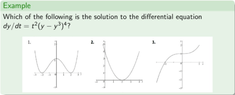
The discussion centers on the confusion surrounding the differential equation $$\d{y}{t}=t^2\left(y-y^3\right)^4$$ and the conditions under which $$\d{y}{t}=0$$. Participants identify that $$\d{y}{t}=0$$ when y is a constant function of t, specifically at values t = 0, y = 0, y = -1, and y = 1. The conversation emphasizes the importance of analyzing turning points on the graph and the implications of extraneous roots, particularly regarding the solution y = -1, which does not satisfy the criteria for graph #1. Ultimately, graph #3 is eliminated based on the positive slope at y = 0, leaving graph #1 as the viable solution.

PREREQUISITES
  • Understanding of differential equations, specifically first-order equations.
  • Familiarity with the zero-factor property in algebra.
  • Knowledge of graph analysis and turning points.
  • Concept of extraneous roots in polynomial equations.
NEXT STEPS
  • Study the implications of constant solutions in differential equations.
  • Learn about the zero-factor property and its applications in solving equations.
  • Explore graphing techniques for analyzing differential equations and their solutions.
  • Investigate the concept of extraneous roots and how they affect the validity of solutions.
USEFUL FOR

Students and educators in mathematics, particularly those focusing on differential equations, algebra, and graph analysis. This discussion is beneficial for anyone seeking to clarify concepts related to turning points and solution validity in differential equations.

MermaidWonders
Messages
112
Reaction score
0
View attachment 7900

I'm so confused about this question :(
 

Attachments

  • Screen Shot 2018-03-03 at 13.35.49.png
    Screen Shot 2018-03-03 at 13.35.49.png
    8.4 KB · Views: 114
Physics news on Phys.org
What can cause:

$$\d{y}{t}=0$$ ?
 
I'm not sure what kind of answer you're looking for, but all I know is that $\d{y}{t}$ = 0 when y is a constant function of t... 😢
 
MermaidWonders said:
I'm not sure what kind of answer you're looking for, but all I know is that $\d{y}{t}$ = 0 when y is a constant function of t... 😢

Let's look at what we're given:

$$\d{y}{t}=t^2\left(y-y^3\right)^4$$

Now, the reason I asked to consider where $$\d{y}{t}=0$$, is twofold...It is easy to identify on the given graph where there are turning points, and it is easy to use to zero-factor property. So, we then have:

$$t^2\left(y-y^3\right)^4=0$$

What values of $t$ and $y$ satisfy the above?
 
t = 0, y = 0, y = -1, y = 1?
 
MermaidWonders said:
t = 0, y = 0, y = -1, y = 1?

Good, yes. Now, let's look at $t=0$...can we eliminate any of the choices based on the fact that the slope of the solution must be zero when $t=0$?
 
Eliminate #2!
 
MermaidWonders said:
Eliminate #2!

Okay, how about $y=0$? Which, if any of the remaining two choices, can you eliminate with that?
 
MarkFL said:
Okay, how about $y=0$? Which, if any of the remaining two choices, can you eliminate with that?

Now that's a bit tricky, here. Would it be #3, since #3 has a positive slope at y = 0? If so, this would leave us with #1 as the answer, then...

And the other thing is, since y = -1 is one of the solutions to $t^2$$(y - y^3)^4 = 0$, nothing happens at y = -1 for graph #1 since this graph doesn't even extend to y = -1 (with the lowest y value being 0)? Like if graph #1 is the answer to this question, it doesn't really satisfy all of the criteria (solutions)... Unless... we treat y = -1 as an extraneous root to this equation, but does that make sense?
 
Last edited:
  • #10
MermaidWonders said:
Now that's a bit tricky, here. Would it be #3, since #3 has a positive slope at y = 0? If so, this would leave us with #1 as the answer, then...

And the other thing is, since y = -1 is one of the solutions to $t^2$$(y - y^3)^4 = 0$, nothing happens at y = -1 for graph #1 since this graph doesn't even extend to y = -1 (with the lowest y value being 0)? Like if graph #1 is the answer to this question, it doesn't really satisfy all of the criteria (solutions)... Unless... we treat y = -1 as an extraneous root to this equation, but does that make sense?

Anyone??
 
  • #11
MermaidWonders said:
Now that's a bit tricky, here. Would it be #3, since #3 has a positive slope at y = 0? If so, this would leave us with #1 as the answer, then...

And the other thing is, since y = -1 is one of the solutions to $t^2$$(y - y^3)^4 = 0$, nothing happens at y = -1 for graph #1 since this graph doesn't even extend to y = -1 (with the lowest y value being 0)? Like if graph #1 is the answer to this question, it doesn't really satisfy all of the criteria (solutions)... Unless... we treat y = -1 as an extraneous root to this equation, but does that make sense?

Yes, graph #3 can be eliminated with $y=0$, leaving only #1 which fits the other criteria. We can ignore the fact that $y\ne-1$.
 
  • #12
OK, thanks for confirming! :)
 

Similar threads

  • · Replies 3 ·
Replies
3
Views
1K
  • · Replies 3 ·
Replies
3
Views
3K
  • · Replies 14 ·
Replies
14
Views
5K
  • · Replies 52 ·
2
Replies
52
Views
8K
  • · Replies 5 ·
Replies
5
Views
3K
  • · Replies 5 ·
Replies
5
Views
3K
  • · Replies 3 ·
Replies
3
Views
2K
  • · Replies 1 ·
Replies
1
Views
2K
  • · Replies 11 ·
Replies
11
Views
2K
  • · Replies 2 ·
Replies
2
Views
4K