Why are my force equations giving me incorrect answers?

  • Thread starter Thread starter cwill53
  • Start date Start date
  • Tags Tags
    Electric Lamp
Click For Summary

Homework Help Overview

The discussion revolves around force equations in a physics problem involving tension forces in a system. The original poster presents equations for forces in both the x-direction and y-direction, expressing confusion over the results they yield.

Discussion Character

  • Exploratory, Assumption checking, Problem interpretation

Approaches and Questions Raised

  • Participants question the correctness of the original equations, particularly the signs and components of the forces involved. There are discussions about whether the equations should include negative signs and how to properly represent vector components.

Discussion Status

Participants are actively engaging with the original poster's equations, offering insights and corrections regarding the setup. There is a focus on clarifying the assumptions behind the equations and ensuring that the representation of forces aligns with physical principles.

Contextual Notes

Some participants note the importance of correctly identifying the direction of forces and the implications of equal opposing forces in the context of the problem. There is also mention of the need for clear diagrams to support the understanding of the forces at play.

cwill53
Messages
220
Reaction score
40
Homework Statement
An electric lamp weighing 5lbs is suspended by a cord AB from the ceiling and pulled towards the wall by the cord BC. Determine the tensions ##T_{A}## in the cord AB and ##T_{C}## in the cord BC if the angles ##\alpha## and ##\beta## are ##60^{\circ}## and ##135^{\circ}##, respectively. Neglect the weight of the cords.

Ans. ##T_{A}##= 3.65 lbs ##T_{C}##==2.6 lbs
Relevant Equations
$$\sum \vec{F}=m\vec{a}$$
I had made equations for the forces in the x-direction and y-direction, but when solving them they yielded the wrong answers, which makes me think that they were incorrect:##(T_{A}cos60^{\circ}+T_{C}cos45^{\circ})=0##
##(T_{A}sin60^{\circ}+T_{C}sin45^{\circ})=5lbs##

Here's the diagram for the problem:
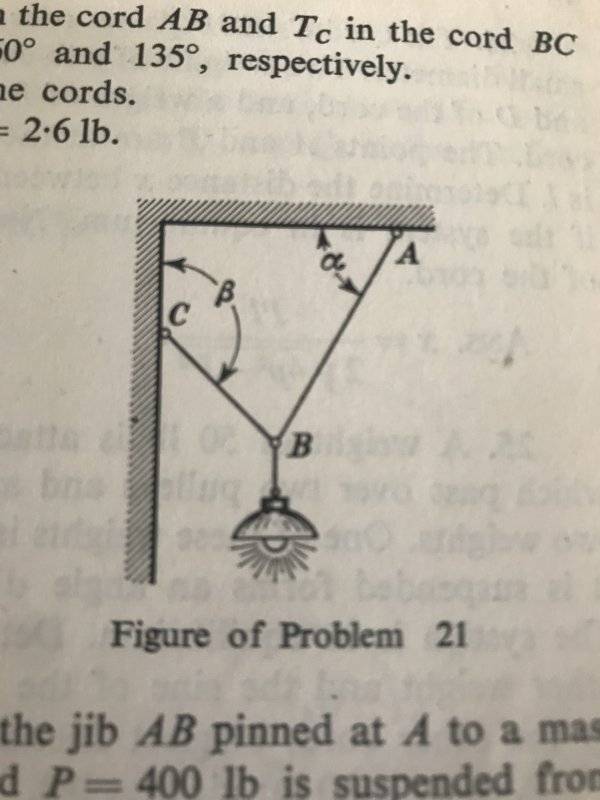
IMG_6891.jpg
 
Last edited:
Physics news on Phys.org
cwill53 said:
but when solving them
Can't see where you go wrong if you don't post your work.

Question: in $$T_{A}\cos60^{\circ}+T_{C}\cos45^{\circ}= 0$$ I see four things that are positive. How can that give 0 ?
 
  • Like
Likes   Reactions: cwill53
cwill53 said:
##(T_{A}cos60^{\circ}+T_{C}cos45^{\circ})\hat{x}=0##
##(T_{A}sin60^{\circ}+T_{C}sin45^{\circ})\hat{y}=5lbs##

Best not to write that; you've got vectors on the LHS and scalars on the RHS. Also, as @BvU pointed out, the first equation should be setting off alarm bells!

Look at your first equation. You know that ##\sum F_x = ma_x = 0## here. What is the ##x## component of the force exerted by the member BC?
 
  • Like
Likes   Reactions: cwill53
BvU said:
Can't see where you go wrong if you don't post your work.

Question: in $$T_{A}\cos60^{\circ}+T_{C}\cos45^{\circ}= 0$$ I see four things that are positive. How can that give 0 ?

I don't see any other forces in the x-direction.
IMG_6892.jpg
 
Should it be ##(T_{A}cos60^{\circ}-T_{C}cos45^{\circ})=0##?
 
  • Like
Likes   Reactions: BvU
If I pull to the left and you pull to the right, and we pull with equal forces, will something in the middle accelerate twice as fast as when I pull alone ? Or will it stay in place ?

Nice drawing, but physics sketches should be restricted to the bare essentials
 
cwill53 said:
Should it be ##(T_{A}cos60^{\circ}-T_{C}cos45^{\circ})=0##?
Yees. Why ?
 
BvU said:
Yees. Why ?
Because that's the only way that makes sense if the system isn't accelerating. You can't add two positive numbers and get 0.
 
cwill53 said:
Should it be ##(T_{A}cos60^{\circ}-T_{C}cos45^{\circ})\hat{x}=0##?

Pretty much, but it should be either

##(T_{A}cos60^{\circ}-T_{C}cos45^{\circ})\hat{x}=\vec{0}##

or

##T_{A}cos60^{\circ}-T_{C}cos45^{\circ} = 0##.

As for the trouble with signs, ##\vec{T}_C = \vec{T}_{Cx} + \vec{T}_{Cy} = T_{Cx} \hat{x} + T_{Cy} \hat{y}##. If you draw the component vectors in the ##x## and ##y## directions, you know that ##\vec{T}_{Cx} = T_{Cx} \hat{x}## has to point to the left (i.e. in the ##-\hat{x}## direction). This should give you some clues as to the required sign of ##T_{Cx}##...
 
  • Like
Likes   Reactions: cwill53
  • #10
BvU said:
If I pull to the left and you pull to the right, and we pull with equal forces, will something in the middle accelerate twice as fast as when I pull alone ? Or will it stay in place ?

Nice drawing, but physics sketches should be restricted to the bare essentials
It will stay in place because the forces will cancel out.

I like to draw the pictures for reference in the future; this book is long out of print.
 
  • Like
Likes   Reactions: BvU
  • #11
cwill53 said:
I like to draw the pictures for reference in the future; this book is long out of print.

I mean it seems you've got the knack for it... just make sure not to spend too long on the shading...

It might also help to draw the unit vectors you're using on the diagram as well. Just so that when you see the force is acting in the negative ##x## direction, you can go 'aha', the coefficient of ##\hat{x}## has to be negative so ##F_x < 0##.
 
  • Like
Likes   Reactions: BvU and cwill53
  • #12
etotheipi said:
I mean it seems you've got the knack for it... just make sure not to spend too long on the shading...

It might also help to draw the unit vectors you're using on the diagram as well. Just so that when you see the force is acting in the negative ##x## direction, you can go 'aha', the coefficient of ##\hat{x}## has to be negative so ##F_x < 0##.
Thanks, I'll do that from now on.

@BvU @etotheipi Thanks for the help, that fix did the trick.
 
  • Like
Likes   Reactions: etotheipi

Similar threads

  • · Replies 7 ·
Replies
7
Views
4K
  • · Replies 20 ·
Replies
20
Views
2K
  • · Replies 15 ·
Replies
15
Views
2K
Replies
14
Views
883
  • · Replies 13 ·
Replies
13
Views
2K
  • · Replies 1 ·
Replies
1
Views
2K
  • · Replies 17 ·
Replies
17
Views
4K
Replies
11
Views
17K
  • · Replies 6 ·
Replies
6
Views
2K
  • · Replies 2 ·
Replies
2
Views
5K