Why are there more zeros in a sine wave than 1s and -1s?

Click For Summary

Discussion Overview

The discussion revolves around the frequency of zeros in a sine wave compared to its maximum and minimum amplitude values. Participants explore the implications of the sine function's behavior, particularly in relation to probability density and the distribution of values over one cycle of the wave.

Discussion Character

  • Exploratory
  • Technical explanation
  • Conceptual clarification
  • Debate/contested

Main Points Raised

  • One participant suggests that the frequency of zeros in a sine wave should be the highest, as they believe zeros occur more frequently than the maximum and minimum values.
  • Another participant clarifies that the zeros of the sine function are indeed more frequent than the peaks, but the function spends more time near the maximum and minimum values than near zero.
  • A different participant points out that the graph of the sine function indicates it spends longer in the vicinity of 1 and -1, which may not be surprising.
  • Concerns are raised about the interpretation of probability density functions (pdf) in relation to the sine wave, with one participant expressing confusion about why zeros would be less frequent than peaks.
  • One participant explains that while the sine wave intersects the y=0 line at specific points, it does not spend much time in that vicinity compared to the peaks, leading to a lower probability density at zero.
  • Another participant emphasizes that the pdf does not indicate how often a specific value is taken but rather the likelihood of values in a small range around that point.

Areas of Agreement / Disagreement

Participants express differing views on the interpretation of the frequency of zeros versus peaks in a sine wave. There is no consensus on the initial question, and confusion remains regarding the relationship between the sine wave's behavior and probability density.

Contextual Notes

Some participants note limitations in their understanding of calculus and probability density functions, which may affect their interpretations of the sine wave's characteristics.

Who May Find This Useful

This discussion may be useful for individuals interested in the mathematical properties of sine waves, probability density functions, and those seeking clarification on the behavior of periodic functions.

dexterdev
Messages
194
Reaction score
1
Hello guys,
From a layman's viewpoint when we count occurrences of different amplitude values, then frequency of zeros must be maximum is not it? but it is as below:
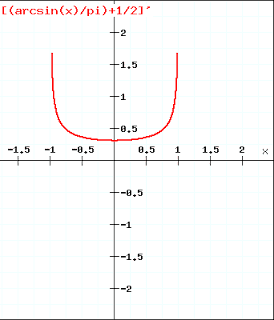
pdf.png


why so? zeoros must be maximum, 1s and -1s are lesser than 0 isn't it?
 
Physics news on Phys.org
"frequency of zeros must be maximum"?

The zeros of a function are the roots.
Positions x: f(x)=0.

In f(t)=sin(wt) the frequency is w, the amplitude is 1, and the zeros are twice as frequent as that.

The values that |sin(wt|=1 is the same frequency as the the frequency of the zeros ... but the peaks and the troughs appear only as frequently as w.

This what you are saying?
I think you need to revisit, carefully, how the graph was derived and what it actually means. I'm not sure it is telling you what you think it does.
eg. I think the frequency of occurrence of the number of points of intersection between y=f(x) and y=k is the same for every k except for |k|=1 - where it is half.
 
Your question is very unclear, but your graph illustrates that a sine function spends much longer vicinity of 1 and -1 rather than in the vicinity of 0. Is that surprising?
 
Remember the slope of the inverse is reciprocal of slope of the function.
what you state is true for derivative of sine, it will be opposite for derivative of arcsine.
Especially slope of sine is 0 at (pi/2,1) so slope of arcsine approaches infinity at (1,pi/2).
 
haruspex said:
Your question is very unclear, but your graph illustrates that a sine function spends much longer vicinity of 1 and -1 rather than in the vicinity of 0. Is that surprising?
Oh is that what it is - illustrating hang-time?!
 
The probability density of a steady sine-wave ' Asin (wt) ' is not
bell-shaped, since it spends more time near the peaks than near x = 0; it extends
only over -A ≤ x ≤ +A (it is zero outside that range) and spikes at the maximum
positive and negative values. (lines from moretti.ceat.okstate.edu/MAE5073/Prob1801.pdf)

but how?


These are the lines of confusion for me. My idea of pdf is that it gives peaks for higher probability values. But for a sine wave why is zeros lesser, it must be maximum. consider one cycle of sine wave. We have one peak A, one negative peak -A and 2 zeroes (3rd zero for next cycle). Is my calculus bad? If my basic idea is wrong , please can anyone kindly explain it to me (in very simple english). You people are my strength, truely.

TIA
 
dexterdev said:
The probability density of a steady sine-wave ' Asin (wt) ' is not bell-shaped, since it spends more time near the peaks than near x = 0; it extends
only over -A ≤ x ≤ +A (it is zero outside that range) and spikes at the maximum
positive and negative values. (lines from moretti.ceat.okstate.edu/MAE5073/Prob1801.pdf)

My idea of pdf is that it gives peaks for higher probability values. But for a sine wave why is zeros lesser, it must be maximum. consider one cycle of sine wave. We have one peak A, one negative peak -A and 2 zeroes (3rd zero for next cycle).
For a continuous distribution, the value of the pdf at some point x cannot be interpreted as how often it takes the value x. The probability of getting exactly x is zero. Instead, think of it as the probability of getting a value in a small range about x.
If you take a thin horizontal band through a sine wave around the y=0 line, the curve doesn't spend long in the band. It enters the band every pi, but passes through quickly. A similar band at y=1 is entered half as often, but the curve spends much longer in the band each time.
 
Thankyou sir, you saved my life. I don't why doubts are haunting me like this.

Thanks again
 

Similar threads

  • · Replies 77 ·
3
Replies
77
Views
6K
  • · Replies 31 ·
2
Replies
31
Views
3K
  • · Replies 2 ·
Replies
2
Views
2K
  • · Replies 2 ·
Replies
2
Views
2K
  • · Replies 3 ·
Replies
3
Views
1K
  • · Replies 12 ·
Replies
12
Views
13K
  • · Replies 6 ·
Replies
6
Views
2K
  • · Replies 6 ·
Replies
6
Views
2K
  • · Replies 4 ·
Replies
4
Views
6K
  • · Replies 4 ·
Replies
4
Views
2K