Why can "dx" in integration be multiplied?

  • Context: High School 
  • Thread starter Thread starter Kelly333
  • Start date Start date
  • Tags Tags
    Dx Integration
Click For Summary

Discussion Overview

The discussion revolves around the interpretation and role of "dx" in integration, particularly in the context of calculus. Participants explore its meaning as it relates to infinitesimal changes, variable notation, and its application in definite and indefinite integrals.

Discussion Character

  • Exploratory
  • Technical explanation
  • Conceptual clarification
  • Debate/contested

Main Points Raised

  • Some participants assert that "dx" represents an infinitesimally small change in x, while others challenge the idea that it can be equated to "Δx," which they argue is a finite quantity.
  • There is a discussion about the role of "dx" as a notation indicating the variable with respect to which integration is performed, with some emphasizing that it is not merely a symbol but has significance in the context of integration.
  • One participant explains that in definite integration, "dx" corresponds to the infinitesimal width of a rectangular strip, contributing to the area under the curve.
  • Another participant questions the multiplication of "dx" by a constant, seeking clarification on its meaning in different contexts, such as in variable substitution during integration.
  • Some participants mention that "dx" should not appear alone but rather in conjunction with an integral or another differential, indicating its role in expressing relationships between variables.
  • There is a reference to standard change-of-variable formulas in integration, which involve transforming "dx" appropriately when changing variables.

Areas of Agreement / Disagreement

Participants express differing views on the interpretation of "dx," with some agreeing on its role as a notation while others contest its equivalence to "Δx." The discussion remains unresolved regarding the implications of multiplying "dx" by constants and the broader significance of "dx" in integration.

Contextual Notes

Some participants highlight the importance of understanding the transformation of "dx" during variable changes in integration, indicating that this is a standard procedure rather than a matter of belief.

Who May Find This Useful

This discussion may be of interest to students learning calculus, educators seeking to clarify concepts of integration, and individuals exploring the foundational aspects of mathematical notation in calculus.

Kelly333
Messages
4
Reaction score
0
Hi,
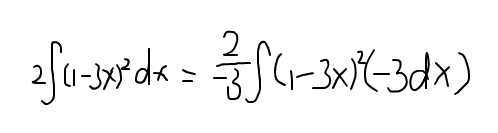
This is an example in "Barron AP calculus"
Snapshot.jpg

I learned from some past threads that "dx" in integration either means △x which is a infinite number or indicates the variable with respect to which you're integrating.
In the equation above, it seems that dx is multiplied by (1-3x)^2. Isn't dx just a notation?

I haven't learned definite integrals so far so please explain in detail if your answer is related to that.

Thanks.
 
Physics news on Phys.org
Kelly333 said:
△x which is a infinite number
I don't understand what you mean here by infinite number. It is an infinitesimally small change in x. If you refer definite integration expressed as a limit of sum, you'll see that dx is actually the infinitesimal width of the rectangular strip(area element) and y is the height of of the strip. Hence, it's area becomes y*dx and when you sum the areas of all such strips having width dx and height y over an interval, you get the total area under the curve. This sum is nothing but integration of y w.r.t x in that interval i.e.∫y⋅dx.
 
In this problem, "dx" is simply a symbol telling us which variable this is to be integrated with respect to. It never "means \Delta x which is a infinite number"- I don't know where you got that! But it is not "multiplied by (1- 3x)^2". The notation here is just asking you to integrate the function 2(1- 3x)^2 with respect to x.
 
HallsofIvy said:
In this problem, "dx" is simply a symbol telling us which variable this is to be integrated with respect to. It never "means \Delta x which is a infinite number"- I don't know where you got that! But it is not "multiplied by (1- 3x)^2". The notation here is just asking you to integrate the function 2(1- 3x)^2 with respect to x.
Thanks for your answer! If dx is just a symbol telling us which variable this is to be integrated with respect to, what does (-3*dx) actually means?
 
cnh1995 said:
I don't understand what you mean here by infinite number. It is an infinitesimally small change in x. If you refer definite integration expressed as a limit of sum, you'll see that dx is actually the infinitesimal width of the rectangular strip(area element) and y is the height of of the strip. Hence, it's area becomes y*dx and when you sum the areas of all such strips having width dx and height y over an interval, you get the total area under the curve. This sum is nothing but integration of y w.r.t x in that interval i.e.∫y⋅dx.
Thanks for correcting that error! But in antidifferentiation, does dx also mean delta x?
 
Kelly333 said:
Thanks for correcting that error! But in antidifferentiation, does dx also mean delta x?

No. Typically, we use the notation ##\Delta x## when writing finite sums such as ##\sum_{i=1}^n f(x_i) \Delta x_i##, and ##dx## in the limit as we take ##n \to \infty## and each ##\Delta x_i \to 0##. Of course, "##dx##" is just notation; it is not really "zero".

Now let's look in more detail at your little example. First, do you agree that initially we want to integrate ##(1-3x)^2## with respect to ##x##? We can indicate this fact by introducing the ##dx## notation, but that is not really necessary. In some computer-algebra systems we drop the ##dx## altogether; for example, in Maple we can write "int((1-3*x)^2,x)" to indicate the integrand (before the ",") and the integration variable (after the ","). In Wolfram Alpha you can just enter "integrate (1-3*x)^2 with respect to x".

Anyway, we want to change variables to ##y = 3x##, so the integrand involves the simpler-looking expression ##(1-y^2)##. However, if we write ##I_1 = \text{x-integral}\; (1-3x)^2## and ##I_2 = \text{y-integral}\; (1-y)^2##, we DO NOT have ##I_1 = I_2##; in fact, we have ##I_1 = \frac{1}{3} I_2##. Understanding this last equality is where the ##dx, dy## notation becomes helpful: if ##y = 3 x## then ##dy = 3 dx## and so ##dx = \frac{1}{3} dy##. Now when we erase the ##dx## and ##dy## we are still left with the factor 1/3.
 
No, ##\Delta x## is not ##d\,x##.
 
Ray Vickson said:
No. Typically, we use the notation ##\Delta x## when writing finite sums such as ##\sum_{i=1}^n f(x_i) \Delta x_i##, and ##dx## in the limit as we take ##n \to \infty## and each ##\Delta x_i \to 0##. Of course, "##dx##" is just notation; it is not really "zero".

Now let's look in more detail at your little example. First, do you agree that initially we want to integrate ##(1-3x)^2## with respect to ##x##? We can indicate this fact by introducing the ##dx## notation, but that is not really necessary. In some computer-algebra systems we drop the ##dx## altogether; for example, in Maple we can write "int((1-3*x)^2,x)" to indicate the integrand (before the ",") and the integration variable (after the ","). In Wolfram Alpha you can just enter "integrate (1-3*x)^2 with respect to x".

Anyway, we want to change variables to ##y = 3x##, so the integrand involves the simpler-looking expression ##(1-y^2)##. However, if we write ##I_1 = \text{x-integral}\; (1-3x)^2## and ##I_2 = \text{y-integral}\; (1-y)^2##, we DO NOT have ##I_1 = I_2##; in fact, we have ##I_1 = \frac{1}{3} I_2##. Understanding this last equality is where the ##dx, dy## notation becomes helpful: if ##y = 3 x## then ##dy = 3 dx## and so ##dx = \frac{1}{3} dy##. Now when we erase the ##dx## and ##dy## we are still left with the factor 1/3.
Thanks!Your points are clear and easy to understand. Now I grasp the idea that dx is just a symbol but is also crucial in some equations.
But I don't believe it makes sense to multiply dx by (-3) in this equation in my example. Can you explain that?
 
Kelly333 said:
Thanks for your answer! If dx is just a symbol telling us which variable this is to be integrated with respect to, what does (-3*dx) actually means?
By itself it doesn't mean anything! With an \int, \int -3dx it would mean "integrate -3 x". Or, it could be a "differential". "dy= -3 dx" means that however x increases, y will decrease by three times that much. You should never see something like "f(x)dx" by itself. It should either be inside an integral, as \int f(x) dx, or in connection with some other differential, as dy= f(x)dx.
 
  • #10
Kelly333 said:
Thanks!Your points are clear and easy to understand. Now I grasp the idea that dx is just a symbol but is also crucial in some equations.
But I don't believe it makes sense to multiply dx by (-3) in this equation in my example. Can you explain that?

If you change variables to ##y = 3x## you get ## \frac{1}{3} \int (1-y)^2 \; dy##, but if you change to ##y = -3x## you get ##-\frac{1}{3} \int (1+y)^2 \, dy##.

You say " I don't believe it makes sense to multiply dx by (-3) in this equation in my example". Belief has nothing to do with it; there are standard change-of-variable formulas for integration, and they give you the 1/3 or -1/3 factor. What I mean is this: if we want to evaluate
I = \text{x-integral} \; f(x)
we may find it easier to change variables from ##x## to ##y##, where ##x = g(y)##, so that in the integral we will have ##h(y) = f(g(y))## instead of ##f(x)##. However, that is not the end of the story: we also need to "transform the ##dx##", giving
I = \text{y-integral} \; h(y) g'(y)
This is a provable theorem, not something subject to belief or dis-belief.
 
Last edited:

Similar threads

  • · Replies 27 ·
Replies
27
Views
3K
  • · Replies 11 ·
Replies
11
Views
2K
  • · Replies 4 ·
Replies
4
Views
3K
  • · Replies 13 ·
Replies
13
Views
2K
  • · Replies 1 ·
Replies
1
Views
3K
  • · Replies 17 ·
Replies
17
Views
5K
  • · Replies 19 ·
Replies
19
Views
5K
  • · Replies 15 ·
Replies
15
Views
4K
  • · Replies 4 ·
Replies
4
Views
2K
  • · Replies 8 ·
Replies
8
Views
3K