Why Define a Bound Vector for Position and Velocity?

  • Context: High School 
  • Thread starter Thread starter jonlg_uk
  • Start date Start date
  • Tags Tags
    Direction Vector
Click For Summary

Discussion Overview

The discussion revolves around the necessity of defining a bound vector for position and velocity in vector equations, particularly in the context of a line in 3D space. Participants explore the roles of direction vectors and their significance in visualizing motion and changes in position.

Discussion Character

  • Exploratory
  • Technical explanation
  • Conceptual clarification
  • Debate/contested

Main Points Raised

  • Jon questions the need for a direction vector, v, in the vector equation for position, suggesting that vector a might suffice.
  • Some participants seek clarification on the purpose of defining the position vector r and its relationship with vectors v and a.
  • mathman points out a potential misunderstanding regarding the magnitudes and directions of vectors v and a, asking for their significance.
  • Another participant explains that parallel vectors can be expressed as multiples of each other and introduces a parameter t that allows the position vector r to move along the line.
  • A participant elaborates on the concept of free vectors and bound vectors, stating that bound vectors provide a clearer geometric representation of vector components and facilitate visualization of motion and velocity.

Areas of Agreement / Disagreement

Participants express varying levels of understanding regarding the necessity and purpose of bound vectors, with some seeking clarification and others providing explanations. The discussion remains unresolved, with no consensus on the fundamental question posed by Jon.

Contextual Notes

There are limitations in the clarity of definitions and assumptions regarding the vectors involved, as well as the specific context of the line being discussed. The significance of the parameter t and its implications for the position vector are also not fully resolved.

jonlg_uk
Messages
141
Reaction score
0
When constructing the vector equation for the position vector r (finishing at point P) in the drawing below. Why is it necessary to use a "direction vector", v ? Couldn't one just use vector a and have done with it??

Why do we need to define this new vector r??What is the point.
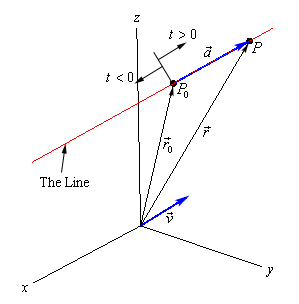

image004.gif


I would appreciate it if you guys could reply in simple laymans english.


I thank you in advance.

Jon
 
Physics news on Phys.org
You need to clarify what is known and what you are trying to find.
 
Please expand on this. Can you give me an explicit reason for its purpose?
 
jonlg_uk said:
When constructing the vector equation for the position vector r (finishing at point P) in the drawing below. Why is it necessary to use a "direction vector", v ? Couldn't one just use vector a and have done with it??

Why do we need to define this new vector r??What is the point.


image004.gif


I would appreciate it if you guys could reply in simple laymans english.


I thank you in advance.

Jon

jonlg_uk said:
Please expand on this. Can you give me an explicit reason for its purpose?

mathman is saying that we do not understand your question. Are the vectors "v" and "a" meant to have the same magnitude and direction? And what is the significance of "The Line"?
 
berkeman said:
mathman is saying that we do not understand your question. Are the vectors "v" and "a" meant to have the same magnitude and direction? And what is the significance of "The Line"?

The Line is just a line in 3D space that I wish to find the equation of. the line may represent the direction of the greatest rate of increase of the scalar field. e.g the direction of the greatest increase in electric field.

Vectors a and v are parallel. Therefore and there is a parameter t such that:

eq0030M.gif


and

eq0027M.gif
 
Two vectors are parallel if they are multiples of each other

ie \vec{a}= <1,2,3> is parallel to \vec{b}=<2,4,6> and \vec{c}=<3,6,9> and so on

So the parameter t in \vec{a} = \vec{v}t just allows the vector \vec{r} to move along the line, where \vec{r} is the position vector of a point on the line.

When you change the value of t, you change your position the line.
 
A vector whose tail (the non-arrow end) doesn't begin at the origin ( a so-called "free vector") has a head that doesn't inform us of the components of the vector. For example if your position at time t0 is (4,5) and your position at time t1 is (6,9) then the algebraic calculation of the change in position is (6-4,9-5) = (2,4). But if you look at the vector whose tail is at (4,5) and whose head is at (6,9) the head of that vector obviously can't be interpreted as indicating (2,4). To have a geometric picture of a vector whose head is (2,4), you must draw a "bound vector". This amounts to "moving" the free vector so its tail is (0,0).

The reason for using bound vectors is to have a clear visualization of the magnitude of the components of the vector.

You can plot a curve showing the 2D path of an object and you can indicate time by making tick marks on that curve. The object also has a vector velocity. If you want to visualize that velocity clearly, you need to draw the path of a vector whose head informs you of the velocity. To do that, you must plot the value of a "bound" vector indicating the velocity.
 

Similar threads

  • · Replies 3 ·
Replies
3
Views
3K
  • · Replies 5 ·
Replies
5
Views
2K
  • · Replies 4 ·
Replies
4
Views
4K
  • · Replies 5 ·
Replies
5
Views
13K
  • · Replies 8 ·
Replies
8
Views
3K
  • · Replies 1 ·
Replies
1
Views
1K
  • · Replies 30 ·
2
Replies
30
Views
8K
  • · Replies 8 ·
Replies
8
Views
2K
  • · Replies 14 ·
Replies
14
Views
3K
  • · Replies 2 ·
Replies
2
Views
2K