Garen
- 28
- 0
Homework Statement
The Attempt at a Solution
I thought I could take the second derivative and get the angular acceleration from which I could use
Garen said:Homework Statement
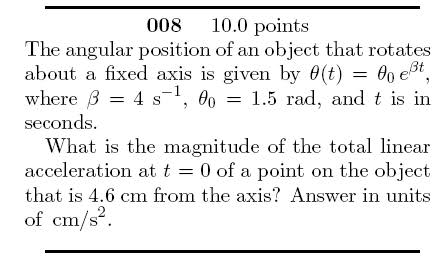
The Attempt at a Solution
I thought I could take the second derivative and get the angular acceleration from which I could usewhere ω is the angular velocity, is the linear tangential acceleration, and r is the radius of curvature. But for some reason, it didn't give me the right answer, anyone know where I went wrong?
alphysicist said:Hi Garen,
Are you saying that you put in the tangential acceleration as your answer? If so, remember that they are asking for the total linear acceleration, and there is more to the total acceleration than just the tangential part.
Garen said:Oh, I thought that total linear acceleration was only the tangential acceleration...Would I have to include centripetal acceleration? If so, how?
alphysicist said:What is the formula for centripetal acceleration? (And remember that you have already found the angular velocity!)
Once you have found both components (the tangential and centripetal), the total is just the vector sum.
Garen said:I got it! Thanks a lot for your help.