Discussion Overview
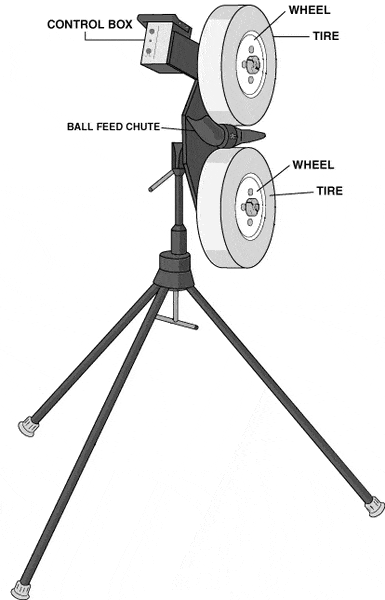
The discussion centers on the design of baseball and tennis ball launchers, specifically the use of two spinning wheels instead of one. Participants explore the reasons behind this design choice, including spin control and stability issues, while also considering alternative designs.
Discussion Character
- Exploratory, Technical explanation, Conceptual clarification, Debate/contested
Main Points Raised
- One participant questions why two wheels are used instead of one, suggesting that a wall could potentially replace one wheel.
- Another participant proposes that using two wheels helps to control spin and addresses stability issues, as a single wheel might cause the ball to bounce off a stationary surface.
- A different viewpoint emphasizes that the primary goal of a ball launcher is to simulate realistic play, and that a single wheel could impart unrealistic spin, making practice less effective.
- A participant mentions encountering machines with only one wheel and inquires about methods to reduce spin in such designs, indicating an interest in alternative approaches.
- Another suggestion is made about using a paddle wheel that slaps the ball instead of rolling it, as a potential method for reducing spin in a one-wheel machine.
Areas of Agreement / Disagreement
Participants express differing views on the necessity and functionality of two wheels versus one, indicating that multiple competing ideas remain without a clear consensus.
Contextual Notes
Some assumptions about the mechanics of ball launchers and the implications of spin and stability are not fully explored, leaving room for further discussion on design alternatives.
Who May Find This Useful
Individuals interested in mechanical design, sports engineering, or those exploring the physics of ball dynamics may find this discussion relevant.