Why do I1+I2+U1 simplify the whole circuit?

8 replies · 2K views · last reply
dontwannatellyou
Messages
5
Reaction score
0
[ Mod Note: relocated to homework forum so template is missing ]

Hi
Iwas soving a problem and the question is to simplify the circuit . Ididnt understand how the whole circuit is the same as the sum of I1 and I2 and U1 (which is a voltage source ) and I3 and R1 don't play a role
Thank you
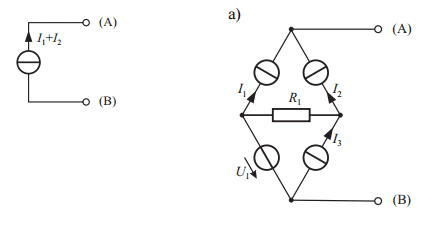
Left: a current source labelled I1+I2 between terminals (A) and (B). Right: circuit a) with current sources I1 and I2 from terminal (A), resistor R1 in the middle, voltage source U1 and current source I3 down to terminal (B).
 
Last edited by a moderator:
This is similar to some of our homework questions, so I'll move this to the homework forum.

Imagine there is an external load, represented by an additional resistor R (not shown) between A and B.

Looking at these sources (and their ghastly non-standard symbols) can you say how much current is leaving this circuit to flow into resistor R via the wire at A?
 
But I have a problem where its not clear
 
Attachments
  • Circuit schematic labelled b) with terminals (C) at top right and (D) at bottom right; branches contain voltage sources U2, U3, U4 and current source I4, with resistor R2 in the middle.
    3.png
    3.9 KB · Views: 582
dontwannatellyou said:
true its equal to i1 + i2
[We're not finished yet.]

So that's the current leaving at A and going into the top of the load resistor, R.

Next, what would be an expression for current leaving the lower end of R to reenter the circuit at point B?
 
dontwannatellyou said:
But I have a problem where its not clear
What things have you explored in simplifying this next arrangement?

Circuit schematic labelled b) with a diamond-shaped network: voltage sources U2 and U3 on the upper branches, resistor R2 across the middle, voltage source U4 on the lower left branch, current I4 on the lower right branch, and terminals (C) at the top and (D) at the bottom.
 
Have you studied Kirchhoff's Current Law?
 
NascentOxygen said:
[We're not finished yet.]

So that's the current leaving at A and going into the top of the load resistor, R.

Next, what would be an expression for current leaving the lower end of R to reenter the circuit at point B?
also I1 +I2
 
dontwannatellyou said:
also I1 +I2
So what is the voltage across the load resistor, R?

◉ Now, as a learning exercise, deduce what must be the voltage across the top left current source (the source supplying I1 ).