Why do LEDs in a circuit need resistors in series?

Click For Summary
SUMMARY

LEDs require resistors in series to limit current and ensure consistent brightness across multiple diodes. Using separate resistors for each LED is essential, especially for standard jellybean LEDs, as they often have varying forward voltages. Connecting multiple LEDs in parallel with a single resistor can lead to uneven brightness and potential runaway current issues. Well-matched LEDs, such as those used in lighting fixtures, can be connected in series or parallel without significant brightness discrepancies.

PREREQUISITES
  • Understanding of LED forward voltage and current characteristics
  • Basic knowledge of circuit design and breadboarding
  • Familiarity with Arduino and PWM (Pulse Width Modulation)
  • Experience with electronic components like resistors and diodes
NEXT STEPS
  • Research the differences between series and parallel LED configurations
  • Learn about LED current limiting techniques and resistor calculations
  • Explore the use of constant current LED drivers for optimal performance
  • Investigate the characteristics of well-matched LEDs for parallel connections
USEFUL FOR

Electronics hobbyists, Arduino enthusiasts, circuit designers, and anyone looking to optimize LED performance in their projects.

Borek
Mentor
Messages
29,169
Reaction score
4,593
I am playing with Arduino and LEDs at the moment. LED needs a resistor to limit current, that's clear. However, all examples I see use separate resistor for each diode. As far as I can tell electrically (in terms of limiting current) it shouldn't matter much whether we use single resistor for all LEDs, or separate resistor for each one (see the picture). I already tried to discuss it with a friend of mine, and he told me it is better to use separate resistors, but TBH his explanation (different diodes may have different forward voltages, if they are connected through a single resistor they can have different brightness) wasn't convincing.

So, is there a reason why we use multiple resistors?
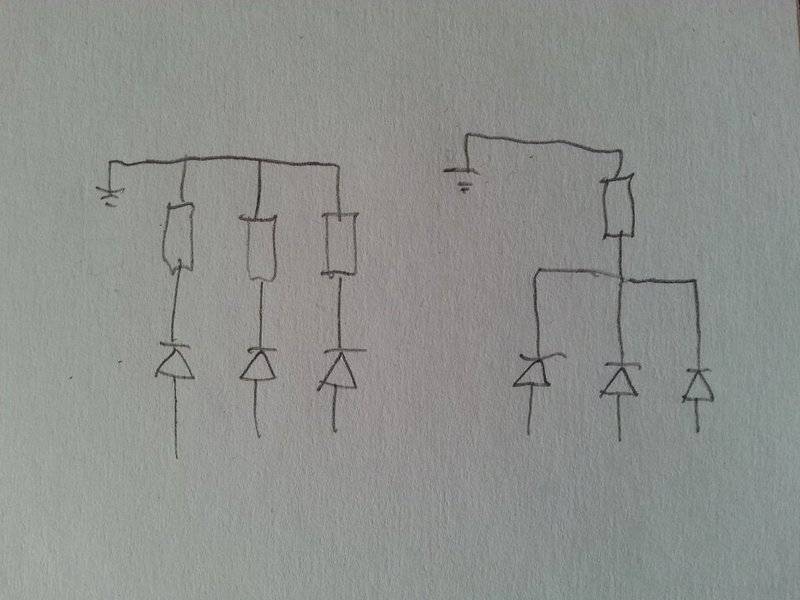
diody_rezystory.jpg
 
Engineering news on Phys.org
You can model a diode as a voltage source (the forward voltage) and a very small resistance in series with the source.

You're friend is right. If you put all the diodes in parallel then they must have the same applied voltage. If the built-in voltages are slightly different among the diodes then the lower ones will have to draw more current across their internal resistance to account for the applied voltage.

You can even have a runaway current. The diode that draws the most current gets warmer which lowers its resistance. That makes it draw more current which makes it even warmer and so on.
 
  • Like
Likes   Reactions: donpacino and berkeman
If the LEDs are very well matched, then you can use one resistor (or current driver circuit). But for general batches of jellybean LEDs you get from the local electronics supply, they are not well matched, so only 1 or 2 out of the several hooked in parallel to a single resistor will be full brightness. The others will be dimmer. So for jellybean LEDs, it's best to use separate resistors.

Better LEDs like the ones used in LED lightiing fixtures are well-matched so they can be connected in series or parallel and have the same brightness.

EDIT -- beaten out by Aaron! :smile:
 
  • Like
Likes   Reactions: davenn and cnh1995
Because the voltage seen by the LEDs would vary depending on whether 1, 2, or 3 are lit. You want each LED to get all the voltage it needs no matter what the other LED are doing.
 
Aaron Crowl said:
You can even have a runaway current.
That's a good point. So it may only be practical to connect well-matched LEDs in series, not in parallel.
 
OK, you have convinced me :wink:

No, seriously, it is not that I didn't believe, it is that I want to understand why instead of just parroting the solution. And I think I get it now.

Yesterday I managed to measure the PWM from my model receiver, tonight I plan to do the same, just displaying the result using a shift register. Eventually I want to show the pulse width on a display (that I don't have yet) though.

 
  • Like
Likes   Reactions: berkeman
anorlunda said:
Because the voltage seen by the LEDs would vary depending on whether 1, 2, or 3 are lit. You want each LED to get all the voltage it needs no matter what the other LED are doing.

Is this why it's necessary for LEDs in a circuit to have resistors in series? The answer to this probably depends upon the type of circuit. This is the circuit I'm referring to on a breadboard:


Similar threads

  • · Replies 5 ·
Replies
5
Views
3K
  • · Replies 14 ·
Replies
14
Views
2K
  • · Replies 3 ·
Replies
3
Views
2K
  • · Replies 9 ·
Replies
9
Views
2K
  • · Replies 3 ·
Replies
3
Views
1K
  • · Replies 8 ·
Replies
8
Views
4K
Replies
3
Views
2K
Replies
93
Views
8K
  • · Replies 15 ·
Replies
15
Views
2K
  • · Replies 25 ·
Replies
25
Views
8K