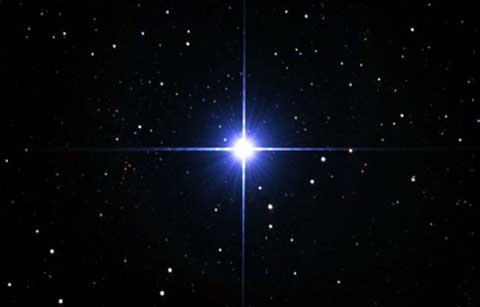
Both objects in the sky are bright, circular discs. The light from a star enters the pupil of our eye and comes to a focus as a point at the back of the eye. If that light is followed backwards to the star, it forms a cylindrical bundle the size of the pupil but gradually widening as it nears the star. But so gradual is this widening that even at the edge of the atmosphere, 100 km up, the bundle is still about the same as the pupil, say half a cm across. This is so narrow that wind currents of different temperature and refractive index can disturb the light and cause the star to twinkle. A planet is so much nearer that at the edge of the atmosphere the bundle is a disc metres across. The light from the planet that forms our image of it comes from hundreds of different pathways in this bundle and it is unlikely that many will be disrupted at the same time. The amount of disturbance is therefore much less and the planet appears as a steady point.