Why Do Voids Form at the Thin-Film Substrate Interface After Annealing?

  • Context: Graduate 
  • Thread starter Thread starter lamejane
  • Start date Start date
Click For Summary
SUMMARY

The discussion centers on the formation of voids at the thin-film substrate interface after post-deposition annealing of a Pd/Ti/Pd/Au metal stack on a GaAs substrate. The annealing was conducted using a hotplate at 390°C for 60 minutes and 350°C for an additional 70 minutes, leading to void formation attributed to factors such as tensile stress, solid-state diffusion, oxidation, and arsenic out-diffusion. The optimal annealing conditions for achieving good ohmic contacts typically involve rapid thermal annealing (RTA) in a forming gas atmosphere at temperatures between 300°C and 450°C for 10 to 100 seconds, which minimizes defects compared to prolonged exposure.

PREREQUISITES
  • Understanding of thin-film deposition techniques, specifically PVD (Physical Vapor Deposition).
  • Knowledge of post-deposition annealing processes, particularly rapid thermal annealing (RTA).
  • Familiarity with the properties and behaviors of metal-semiconductor interfaces.
  • Basic concepts of solid-state diffusion and its effects on material integrity.
NEXT STEPS
  • Research the effects of rapid thermal annealing (RTA) on metal layer stability and performance.
  • Investigate the role of oxidation and arsenic out-diffusion in thin-film metal stacks.
  • Study the mechanical properties of thin films under thermal stress conditions.
  • Explore advanced characterization techniques for analyzing voids in thin-film structures, such as SEM (Scanning Electron Microscopy).
USEFUL FOR

This discussion is beneficial for materials scientists, semiconductor engineers, and researchers involved in the fabrication and optimization of metal-semiconductor contacts, particularly those working with thin-film technologies and post-deposition processing.

lamejane
Messages
11
Reaction score
2
TL;DR
Occurence of Voids after Annealing
Hello to all the experts out there!: )

I have encountered a problem on my samples after Post deposition annealing [ Please refer to the crossectional SEM picture - B below].

Sample description : Thinfilm metal stack [ Pd/Ti/Pd/Au] deposited onto GaAs substrate using PVD
Post deposition annealing : Using a Hotplate exposed to clean room air
--> 60 min @ 390°C [ Picture A]
--> additionally 70 min @350°C on same sample B [ Picture B]

My Question to the Experts :

I see occurences of Voids at the thinfilm -Substrate interface [ see picture B] after annealing at 350°C for 70 min . What effect could explain this phenomenon ?
Is it due to an increase in tensile stress at the interface because of the high annealing temperature ? or is there a strong solid state diffusion of the metal atoms in the thinfilm leading to defects ?

The thinfilm metal stack contains : Pd/Ti/Pd/Au/15nm/30nm/30nm/250nm and is meant to serve as an Ohmic contact
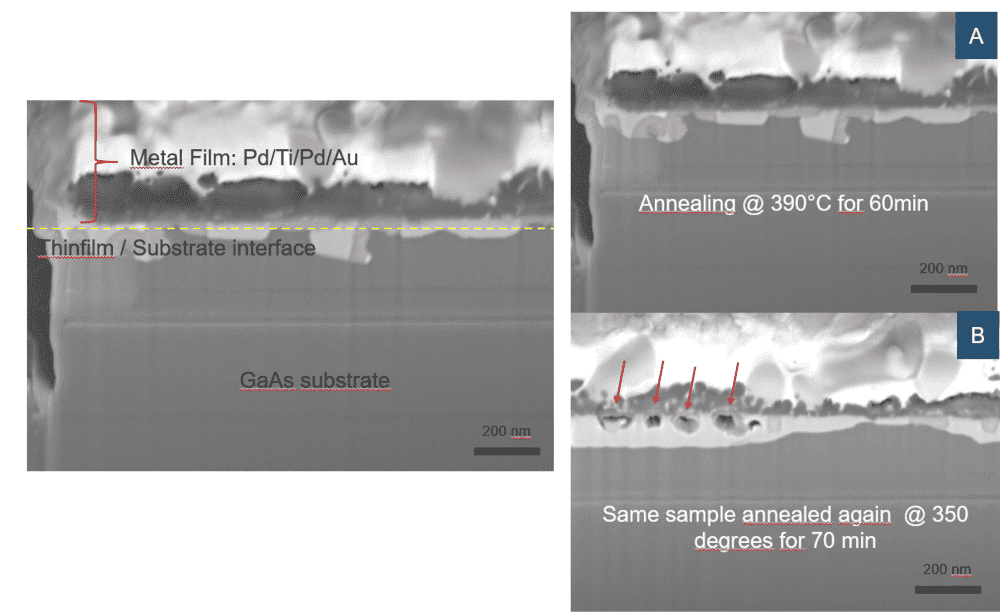
1613561469633.png
 
Physics news on Phys.org
What are the reasons for your choice of post-deposition annealing conditions (oxidizing atmosphere (air), prolonged annealing times in the range of 1 h). There could be many effects to explain the phenomenon of void forming: Oxidation, formation of new phases, Arsenic out diffusion etc.

The metal layers have thicknesses in the range of nanometers. In case of such metal-multilayer contacts, the post-deposition annealing to form good ohmic contacts is generally carried out by the rapid thermal annealing (RTA) process in a forming gas (N2/H2) atmosphere at temperatures between 300 ‒ 450 °C for 10 ‒100 sec.

See, for example: E. F. Chor and D. Zhang, “Electrical characterization, metallurgical investigation, and thermal stability studies of (Pd, Ti, Au)-based ohmic contacts”, Journal of Applied Physics 87, 2437 (2000)
 
  • Informative
Likes   Reactions: berkeman
Lord Jestocost said:
What are the reasons for your choice of post-deposition annealing conditions (oxidizing atmosphere (air), prolonged annealing times in the range of 1 h). There could be many effects to explain the phenomenon of void forming: Oxidation, formation of new phases, Arsenic out diffusion etc.

The metal layers have thicknesses in the range of nanometers. In case of such metal-multilayer contacts, the post-deposition annealing to form good ohmic contacts is generally carried out by the rapid thermal annealing (RTA) process in a forming gas (N2/H2) atmosphere at temperatures between 300 ‒ 450 °C for 10 ‒100 sec.

See, for example: E. F. Chor and D. Zhang, “Electrical characterization, metallurgical investigation, and thermal stability studies of (Pd, Ti, Au)-based ohmic contacts”, Journal of Applied Physics 87, 2437 (2000)
Thank you for your reply.
Using the Hot plate was only for test purposes. For the the long term i would move to a RTA tool as you suggested.
Lets say the process is carried out in an RTA und N2 atmosphere , what effect does a longer annealing tme ( ~ 60 min ) have on the metal layers ? Why is 10-100 sec optimal ?