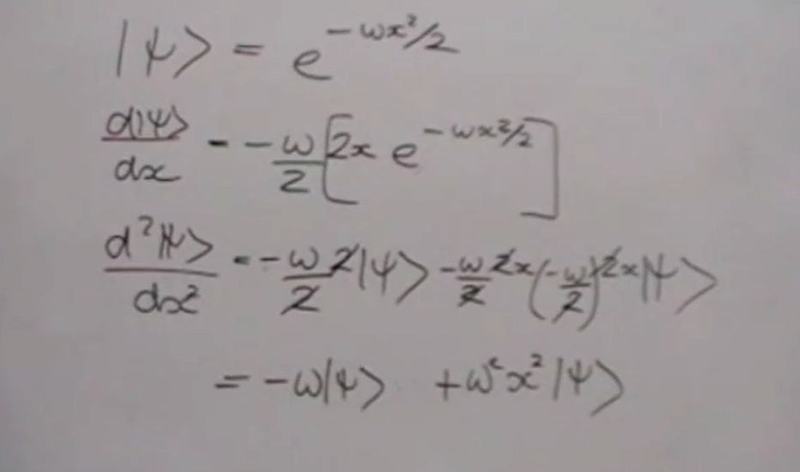
First of all, this is an abuse of notation. A state ket doesn't depend on ##x##. It's the wave function, i.e., the position representation of the state ket that depends on ##x##:
$$\psi(x)=\langle x|\psi \rangle.$$
Now you have the wave function
$$\psi(x)=\exp(-\omega x^2/2),$$
and you take derivatives as usual. Your first derivative is correct. Using the chain rule you get
$$\psi'(x)=-\omega x \exp(-\omega x^2/2)=-\omega x \psi(x).$$
The 2nd derivative is then given by the product rule
$$\psi''(x)=-\omega \psi(x)-\omega x \psi'(x)=-\omega \psi(x)+\omega^2 x^2\psi(x).$$
So also your 2nd derivative is correct. So where is your problem?
In this case the motivation to do differentiation is that in the position representation, the momentum is represented by derivatives, i.e., (when using units with ##\hbar=1##)
$$\hat{p} \psi(x)=-\mathrm{i} \psi'(x).$$
The Hamilton operator of the harmonic oscillator is given by
$$\hat{H}=\frac{\hat{p}^2}{2m}+\frac{m \omega^2}{2} \hat{x}^2.$$
In the position reprsentation the position operator is just multplication with ##x##. Thus you get
$$\hat{H} \psi(x)=-\frac{1}{2m} \psi''(x)+\frac{m \omega^2}{2} x^2 \psi(x).$$
Now instead of the above used wave function, use
$$\Psi_0(x)=\exp \left (-\frac{m \omega x^2}{2} \right).$$
then you get
$$\hat{H} \Psi_0(x)=-\frac{1}{2m} [-m \omega \Psi_0+m^2 \omega^2 \Psi_0]+\frac{m \omega^2 x^2}{2} \Psi_0(x)=\frac{\omega}{2} \Psi_0(x),$$
which shows you that ##\Psi_0## is an eigenfunction of the Hamiltonian with eigenvalue ##\omega/2##. In fact, it's the ground state of the harmonic oscillator!
 . I will be very grateful for any help with basic terms. Thank you !