Why do we have two brain areas responsible for speech?

  • Thread starter Thread starter Eagle9
  • Start date Start date
  • Tags Tags
    Area
Click For Summary
SUMMARY

Broca's area and the primary motor cortex are both essential for speech production in the human brain. Broca's area processes and integrates information about word formation and phonemic sequences, while the primary motor cortex executes the physical movements required for speech. These areas collaborate to facilitate complex language functions, reflecting the brain's evolutionary development where multiple structures contribute to a single function. Understanding this collaboration is crucial for grasping the intricacies of human speech processing.

PREREQUISITES
  • Basic understanding of neuroanatomy, specifically Broca's area and the primary motor cortex
  • Familiarity with language processing theories in cognitive neuroscience
  • Knowledge of evolutionary biology related to brain function
  • Awareness of phonemic sequences and their role in speech
NEXT STEPS
  • Research the role of the frontal cortex and temporal cortex in language processing
  • Explore the evolutionary development of the human brain and its impact on language
  • Study the relationship between olfaction and memory in cognitive neuroscience
  • Investigate the implications of dual brain areas for speech in clinical settings, such as aphasia
USEFUL FOR

Neuroscientists, linguists, cognitive psychologists, and educators interested in the complexities of speech production and brain function.
Eagle9
Messages
238
Reaction score
10
Broca's area is responsible for speech, right? It is well-known from the 19-th century.

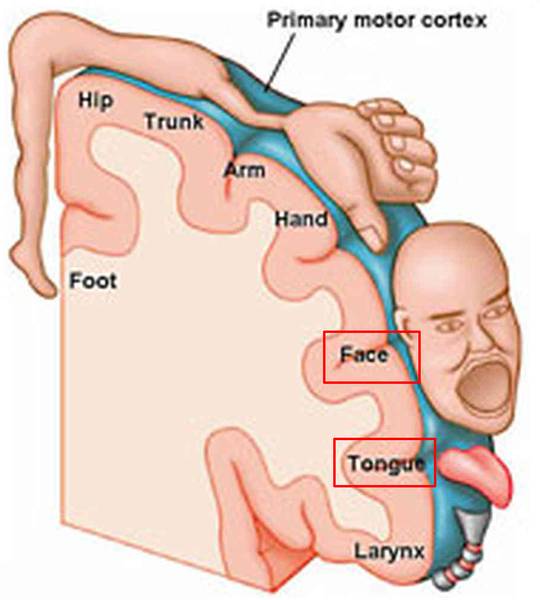
However, from the other hand human’s brain has the second area responsible for the same function - motor cortex:

klrTu7T.jpg


So please, tell me: why do we need two areas responsible for the same function? Do they collaborate? Or what? :rolleyes:
 
Biology news on Phys.org
Brain structures evolved over very long periods of time. You cannot always map a particular function to a single brain structure, often many parts of the brain work in tandem. Thinking of the brain as a computer with attached devices is sometimes useful, but in this case it gets you to confusion.

For a simple example: why would certain smells evoke very strong old memories for you? Answer: because olfaction (smell) is very old trait, and other functions in the brain evolved later on to be in the 'path' of interpreting smells and some functional areas branch off into special memory areas.

I like cartoons that get you to think - so what does this say about some older computer application (MS-DOS) that worked well? Can we still use it? Should we change it out only because it is old? (apply this to smell. Or speech -- which evolution added on top of existing functions and connections in the brain)

https://xkcd.com/1891/
 
  • Like
Likes   Reactions: SciencewithDrJ and 1oldman2
The primary motor cortex allows you to move your lips, tongue, etc.
Broca's area allows you to express language verbally.
 
The muscle execution of these speech patterns is the output - there's a lot of processing that happens before its turned into muscle movements.

Broca's area is currently thought to somehow process and integrate information about the way words are formed and how they work together - it negotiates with both the the frontal cortex and the temporal cortex that are associated with "phonemic sequences" - which are, to oversimplify, series of vocalized syllables.
 
jim mcnamara

.Scott

Pythagorean

Thanks, it is clear – more or less :smile:
 

Similar threads

  • · Replies 8 ·
Replies
8
Views
2K
Replies
2
Views
2K
  • · Replies 8 ·
Replies
8
Views
2K
Replies
1
Views
2K
  • · Replies 9 ·
Replies
9
Views
3K
  • · Replies 24 ·
Replies
24
Views
4K
Replies
2
Views
2K
  • · Replies 7 ·
Replies
7
Views
4K
Replies
2
Views
2K
  • · Replies 8 ·
Replies
8
Views
3K