Why Do Wheels Roll More Efficiently Than Other Shapes?

  • Thread starter Thread starter fog37
  • Start date Start date
  • Tags Tags
    Wheel Works
Click For Summary

Discussion Overview

The discussion centers on the efficiency of wheels compared to other shapes, exploring why circular wheels roll more effectively than polygonal shapes like squares or triangles. Participants consider various factors influencing rolling motion, including torque, contact points, and the impact of surface irregularities.

Discussion Character

  • Exploratory
  • Technical explanation
  • Conceptual clarification
  • Debate/contested

Main Points Raised

  • One participant suggests that the circular shape of the wheel minimizes the torque required for rotation compared to other shapes, implying that this contributes to its efficiency.
  • Another participant argues that the height change of a vehicle as wheels turn affects rolling efficiency, noting that triangular wheels would perform worse than square wheels.
  • A question is raised about whether a lever argument supports the wheel's superiority, emphasizing the importance of the contact patch being at rest during rolling.
  • Discussion includes the impact of wheel diameter on performance over irregular surfaces, with larger diameters reducing energy waste due to less deformation at the contact patch.
  • It is noted that other shapes would cause oscillations in the center of mass, leading to energy waste, while wheels maintain a more stable center of mass.
  • Some situations, such as climbing stairs or navigating rocky terrain, are mentioned where round wheels may not be ideal, and alternative shapes may be more efficient.

Areas of Agreement / Disagreement

Participants express various viewpoints on the efficiency of wheels versus other shapes, with no consensus reached on a definitive explanation or model. The discussion remains open with multiple competing ideas presented.

Contextual Notes

Participants reference the importance of the contact patch and the effects of surface irregularities, but do not resolve the complexities of these interactions or the mathematical implications involved.

Who May Find This Useful

This discussion may be of interest to those exploring mechanical engineering, physics of motion, or the design of transportation systems.

fog37
Messages
1,566
Reaction score
108
TL;DR
Understand why a wheel works so well and does what it does so wheel
Hello,

The invention of the wheel changed the world. I imagine pulling a cart with square shaped wheels and how difficult and bumpy it would be.The wheel is essentially a circle, a polygon with infinite small sides while the square has only four sides. I guess that, at both end of the spectrum, the square would be the worst shape and the circle the best shape.

Without complicated force diagrams, is it hard to provide a high level explanation of why the wheel, with its circular shape, can roll and move and translate so easily compared to other shapes? I assume a force applied to the center of the shape. This force causes a torque that tries to rotate the shape itself. I guess the torque to rotate the wheel is always smaller than the torque required to rotate and translate other shapes...Is that somewhat correct?

Thank you for any insight.
 
Engineering news on Phys.org
I think the answer comes from the height change of the vehicle as the wheels turn.
A triangular wheel would be worse than a square wheel.
If the polygon wheels were out of time, it would throw the vehicle from side to side.
The timing would change when going around a corner.
 
  • Like
Likes   Reactions: russ_watters and Lnewqban
Thank you Baluncore. I see your points.

Is there also some lever argument that makes the wheel better than other shapes? For a wheel, the ideal point of contact is simply a point that is at momentarily at rest (contact patch in real situations).
 
fog37 said:
... For a wheel, the ideal point of contact is simply a point that is at momentarily at rest (contact patch in real situations).
This tutorial is very good:
https://www.physicsforums.com/insights/explaining-rolling-motion/

What happens around the contact patch in real situations is very important.
For irregular surfaces (rocks) or deformable ones (sand), the bigger the diameter of the wheel, the better.
For flat solid surfaces, the lees deformation of the contact patch, the less energy is wasted.

Besides the lever effect against the area of dynamic friction (axis of the wheel), the capability of keeping the center of mass of the car more or less at a constant level, as mentioned in above post, is key in the success of the wheel.
Any other polygon rolling over a flat horizontal surface would create an up-down oscillation of the center of mass, with associated accelerations and forces and waste of energy.

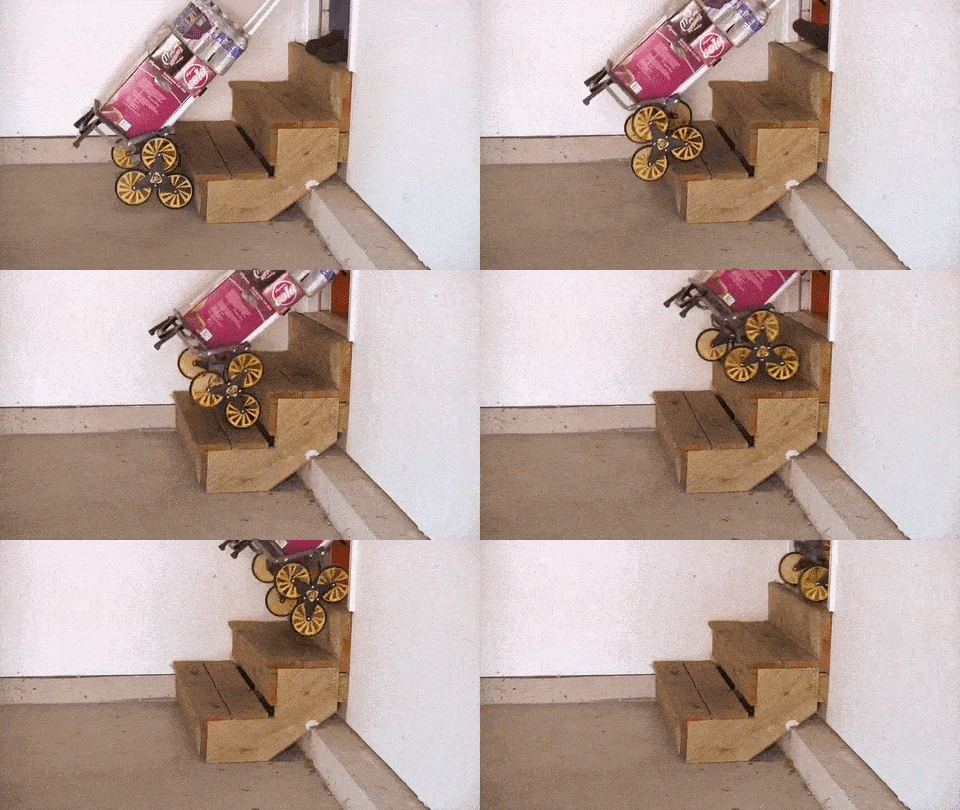
There are some situations for which a round wheel is not ideal, like climbing stairs or the side of a rocky mountain.
Legs or wheels that mimic the profile tends to work more efficiently in those cases, based on the principle of a more linear trajectory of the center of mass of the object.

1462980886-giphy-28.gif
 
Last edited:
  • Like
Likes   Reactions: fog37
Really cool. Thanks Lnewqban. Let me process all of that.
 
  • Like
Likes   Reactions: Lnewqban

Similar threads

  • · Replies 8 ·
Replies
8
Views
3K
  • · Replies 9 ·
Replies
9
Views
12K
  • · Replies 116 ·
4
Replies
116
Views
13K
  • · Replies 10 ·
Replies
10
Views
2K
Replies
6
Views
7K
  • · Replies 1 ·
Replies
1
Views
2K
  • · Replies 1 ·
Replies
1
Views
2K
  • · Replies 3 ·
Replies
3
Views
14K
Replies
1
Views
5K
  • · Replies 10 ·
Replies
10
Views
6K