Why does a diamagnetic rod align perpendicular to a magnetic field?

Click For Summary
SUMMARY

The discussion centers on the behavior of diamagnetic rods in a magnetic field, specifically why they align perpendicularly. Unlike ferromagnetic or paramagnetic materials, diamagnetic rods generate a magnetic field that opposes the applied field, resulting in a net decrease in magnetic field strength within the rod. The torque acting on the rod causes it to align perpendicularly, where net torque is minimized. The conversation also touches on the inverse square law and the potential energy of magnetic dipoles, emphasizing that while diamagnetic effects are weak, they are significant enough to influence alignment.

PREREQUISITES
  • Understanding of diamagnetism and its properties
  • Familiarity with magnetic dipoles and their potential energy
  • Knowledge of torque and its effects on objects in magnetic fields
  • Basic grasp of the inverse square law in physics
NEXT STEPS
  • Study the principles of diamagnetism in detail
  • Explore the mathematical formulation of magnetic dipole potential energy
  • Investigate the effects of torque on magnetic materials
  • Learn about the applications of diamagnetic materials in technology
USEFUL FOR

Physics students, educators, and researchers interested in magnetism, particularly those focusing on the properties and applications of diamagnetic materials.

vcsharp2003
Messages
913
Reaction score
179
Homework Statement
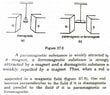
I have the following in my textbook, but can't explain why diamagnetic rod is becoming perpendicular to the magnetic field as shown in fig 37.6 (a).
Relevant Equations
None
I know that each material is made up of tiny magnets due to electrons orbiting the nucleus and also from electron spinning about its own axis. In ferromagnetic or paramagnetic rod these tiny magnets align with the applied field causing the net field in the rod to increase. But for diamagnetic rod, the tiny magnets align so that they oppose the applied magnetic field, which causes the net magnetic field to decrease in the rod.

From above facts, I cannot find an explanation of why rod becomes perpendicular for diamagnetic rod. Perhaps a torque acts on the rod and in perpendicular position there is no net torque and hence it comes to rest in that position.
 

Attachments

  • Screenshot_20221029-184458.jpg
    Screenshot_20221029-184458.jpg
    53.6 KB · Views: 149
Physics news on Phys.org
If something is repelled by objects on both sides, according to an inverse square law, where is the least PE?
 
  • Like
Likes   Reactions: vcsharp2003
I think the argument that the excerpt you posted is this. In the ferro 0r paramagnetic case (Figure b) the magnet poles attract the end of the rod that is closest to them and repel the end that is farthest from them. In that case the rod aligns parallel to them. In the ferromagnetic case, one can label the ends of the rod with N and S regardless of whether the external field is on or off. In the paramagnetic case, one can still label the ends of the rod N and S but only when the field is on. In either case the rod's N will be closer to the magnet's S and the rod's S closer to the magnet's N.

In the case of the paramegnet diamagnet there can be no such labeling of the rod's ends. There is repulsion between each magnet pole and each rod end which get stronger when the end moves closer to the pole. Thus, if the rod turns away from being perpendicular to the field, the stronger repulsive force at each end of the rod will restore it back to being perpendicular to the field lines.
 
Last edited:
  • Like
Likes   Reactions: vcsharp2003
haruspex said:
If something is repelled by objects on both sides, according to an inverse square law, where is the least PE?
Isn't inverse square law in electrostatics and gravitation? I don't know about an inverse square law in magnetism. I know that potential energy of a magnetic dipole in a uniform magnetic field is ##U =- \vec M \cdot \vec B = -|\vec M| |\vec B| cos \theta##.

OR maybe by inverse square law you meant that when two magnetic poles come closer then the magnetic force of attraction or repulsion becomes higher?
 
Last edited:
kuruman said:
In the case of the paramegnet there can be no such labeling of the rod's ends. There is repulsion between each magnet pole and each rod end which get stronger when the end moves closer to the pole. Thus, if the rod turns away from being perpendicular to the field, the stronger repulsive force at each end of the rod will restore it back to being perpendicular to the field lines.
Did you mean in the case of diamagnetic rather than paramegnet?

If there's repulsion in this case, then can't we say that the rod end closer to N pole of external magnet acts like a N pole of the rod and therefore, they repel? You said we cannot label the ends of the rod as N or S, but it seems we can since repulsion happens only between like poles and so the rod end closer to N pole must be acting as a N pole.
 
Last edited:
vcsharp2003 said:
when two magnetic poles come closer then the magnetic force of attraction or repulsion becomes higher?
Yes, and, roughly, according to an inverse square law. As with electric and gravitational fields, the field lines spread out in three dimensions. Since the field strength is proportional to the density of the field lines, it must fall off as the inverse square of distance from the source.
It is somewhat more complicated than in electrostatics since we do not have magnetic poles. But try treating each magnet as a dipole and see what you get for the minimum PE point. The whole system would look like
+====- -====+ +====-
Rotating the diamagnetic bar as in the book's diagram would make the central body shorter in my diagram, but the charges all stay the same.
 
  • Like
Likes   Reactions: vcsharp2003
haruspex said:
Rotating the diamagnetic bar as in the book's diagram would make the central body shorter in my diagram, but the charges all stay the same.
Ok, so even in the perpendicular position, if I applied the formula for PE of a magnetic dipole, I would get ## - | \vec M| |\vec B| cos 180 = -| \vec M| |\vec B| (-1)= | \vec M| |\vec B|##. Even in parallel position, the PE would be the same for a dipole.
 
vcsharp2003 said:
Ok, so even in the perpendicular position, if I applied the formula for PE of a magnetic dipole, I would get ## - | \vec M| |\vec B| cos 180 = -| \vec M| |\vec B| (-1)= | \vec M| |\vec B|##. Even in parallel position, the PE would be the same for a dipole.
The standard dipole formulae are approximations. They are derived from first principles of point charges. In the derivation, the first order terms cancel, so the dipole equation comes from the second order terms.
For the present problem the second order terms are likely to cancel too, so you would need to start from first principles again and keep the third order terms.
The diamagnetic effect is very weak.
 
  • Like
Likes   Reactions: PhDeezNutz and vcsharp2003
vcsharp2003 said:
Did you mean in the case of diamagnetic rather than paramegnet?
Yes, I meant diamagnet. I edited the post. Thanks for the catch.
vcsharp2003 said:
If there's repulsion in this case, then can't we say that the rod end closer to N pole of external magnet acts like a N pole of the rod and therefore, they repel? You said we cannot label the ends of the rod as N or S, but it seems we can since repulsion happens only between like poles and so the rod end closer to N pole must be acting as a N pole.
Correct. And if the same end of the rod is closer to the S pole, it acts as a S pole. The other end would, of course, do the opposite. So each end is neither "N" nor "S". You cannot label the ends in the sense of painting letters "N" and "S" on them like you can do with bar magnets.
 
  • Like
Likes   Reactions: PhDeezNutz and vcsharp2003

Similar threads

Replies
11
Views
3K
  • · Replies 7 ·
Replies
7
Views
2K
Replies
14
Views
3K
  • · Replies 1 ·
Replies
1
Views
2K
Replies
1
Views
2K
  • · Replies 1 ·
Replies
1
Views
548
Replies
1
Views
1K
Replies
2
Views
1K
  • · Replies 2 ·
Replies
2
Views
2K
  • · Replies 1 ·
Replies
1
Views
2K