Why does an electron have minimum kinetic energy when its momentum is 2h/λ?

  • Thread starter Thread starter blueberryRhyme
  • Start date Start date
  • Tags Tags
    Momentum Shift
Click For Summary

Homework Help Overview

The discussion revolves around the conditions under which an electron has minimum kinetic energy during photon scattering, specifically in the context of Compton scattering. Participants are examining the relationship between the scattering angle of the photon and the resulting momentum of the electron.

Discussion Character

  • Conceptual clarification, Assumption checking, Problem interpretation

Approaches and Questions Raised

  • Some participants question the validity of the original solution provided, suggesting it may address a different question than intended. Others explore the implications of momentum conservation in the context of the scattering angle and its effect on the electron's kinetic energy.

Discussion Status

The discussion is ongoing, with participants actively questioning assumptions and interpretations of the problem. There is a focus on clarifying the relationship between the angles involved and the resulting momenta, with some guidance offered regarding the implications of different scattering angles.

Contextual Notes

Participants note potential issues with the phrasing of the original question and the assumptions made about the scattering angles, particularly regarding the implications of a 180-degree scattering angle versus a 0-degree angle.

blueberryRhyme
Messages
7
Reaction score
0
Homework Statement
An X-ray beam of wavelength λ is directed along the x-axis in the positive x direc- tion and collides with carbon atoms. Electrons with a range of energies and veloc- ities are produced via the Compton Effect. The electrons with an x-component of momentum of nearly 2h/λ are produced by photons that are scattered at an angle closest to:
A. 0 radians B. π/4 radians C. π/2 radians D. 3π/4 radians E. π radians
Relevant Equations
Lambda = h/p, Compton shift = h/mc (1-cos theta)
Solution given:
The minimum kinetic energy electrons will arise from a change in photon energy on scattering that is a minimum and this will arise from the smallest wavelength change of the photon. The Compton scattering formula is
∆λ = (h/mc)(1 − cos φ) which is minimised when 1 = cos φ. This occurs for φ = 0-why electron would have minimum Kinetic energy when it’s momentum is 2h/lambda ?.
 

Attachments
  • FE47F542-04A4-4346-ADD2-662DB56F7FDE.jpeg
    FE47F542-04A4-4346-ADD2-662DB56F7FDE.jpeg
    18 KB · Views: 146
Last edited:
Physics news on Phys.org
Hi @blueberryRhyme. It looks like there is a mistake here.

The question asks what photon scattering angle (θ) results in the electron having an x-momentum of ‘nearly’ 2h/λ.

But the given solution appears to be the answer to a completely different question! (The question being “what value of θ results in the minimum kinetic energy of the electron?).

Are you sure you are looking at the solution to the correct problem?

Also, the original question seems poorly posed to me. However, note that if the electron’s x-momentum changes by ‘nearly’ 2h/λ, this means the photon’s x-momentum must have changed by ‘nearly’ -2h/ λ (conservation of momentum).

The photon’s initial x-momentum was h/λ, so you need to ask yourself what must have happened to the photon if its x-momentum has changed by (nearly) -2h/λ ?

You should be able to see how your answer relates to the Compton scattering equation ##Δλ= \frac h{m_ec}(1-cosθ )## though you don't need the equation to answer the question.
 
Last edited:
  • Like
Likes   Reactions: topsquark and PeroK
Steve4Physics said:
Hi @blueberryRhyme. It looks like there is a mistake here.

The question asks what photon scattering angle (θ) results in the electron having an x-momentum of ‘nearly’ 2h/λ.

But the given solution appears to be the answer to a completely different question! (The question being “what value of θ results in the minimum kinetic energy of the electron?).

Are you sure you are looking at the solution to the correct problem?

Also, the original question seems poorly posed to me. However, note that if the electron’s x-momentum changes by ‘nearly’ 2h/λ, this means the photon’s x-momentum must have changed by ‘nearly’ -2h/ λ (conservation of momentum).

The photon’s initial x-momentum was h/λ, so you need to ask yourself what must have happened to the photon if its x-momentum has changed by (nearly) -2h/λ ?

You should be able to see how your answer relates to the Compton scattering equation ##Δλ= \frac h{m_ec}(1-cosθ )## though you don't need the equation to answer the question.

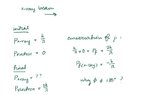
The solution is posted by my lecturer so I’m sure that it’s the solution for this question. My attempted solution assumed that the final photon momentum would be -h/ λ ( the photon scattering angle is 180). Is there anything wrong with my attempted solution?
 
The solution is posted by my lecturer so I’m sure that it’s the solution for this question. My attempted solution assumed that the final photon momentum would be -h/ λ ( the photon scattering angle is 180). Is there anything wrong with my attempted solution?
 
blueberryRhyme said:
Is there anything wrong with my attempted solution?
Your solution, if I understand it correctly, ends with a question. Namely, why ##0 \ne 180^\circ##?
 
PeroK said:
Your solution, if I understand it correctly, ends with a question. Namely, why ##0 \ne 180^\circ##?
my solution is 180 degree (pi radian) but the solution provided is 0 degree. That’s why I was asking why shouldnt it be 180 degree :)
 
blueberryRhyme said:
my solution is 180 degree (pi radian) but the solution provided is 0 degree. That’s why I was asking why shouldnt it be 180 degree :)
I think you have may a problem with the assumption that your lecturer is infallible to the point of not even handing out the solution to a different problem by mistake!
 
  • Like
Likes   Reactions: vela and Steve4Physics
PeroK said:
I think you have may a problem with the assumption that your lecturer is infallible to the point of not even handing out the solution to a different problem by mistake!
Ahhh alright. Just want to make sure that my solution is reasonable before I go to discuss with my lecturer about the wrong solution. Thanks for helping 😇
 
Just to add a little to what @PeroK has said:
180º is correct.
0º is incorrect.

And you should be aware that the magnitudes of the initial and final photon momenta can’t both be exactly h/λ. That would mean the photon energy (hc/λ) wouldn’t change - the scattered electron would have gotten it’s kinetic energy from nowhere!

For θ=180º, the wavelength of the scattered photon is slightly less than the wavelength of the incident photon. It should be clear that the difference is equal to ##2\frac h{m_ec}##. This quantity is small compared to λ. That’s why the question uses the word ‘nearly’.
 
  • Like
Likes   Reactions: PeroK and blueberryRhyme

Similar threads

  • · Replies 3 ·
Replies
3
Views
2K
  • · Replies 2 ·
Replies
2
Views
8K
Replies
1
Views
5K
  • · Replies 10 ·
Replies
10
Views
2K
  • · Replies 1 ·
Replies
1
Views
2K
Replies
1
Views
2K
  • · Replies 3 ·
Replies
3
Views
916
Replies
1
Views
2K
  • · Replies 2 ·
Replies
2
Views
1K
  • · Replies 8 ·
Replies
8
Views
4K