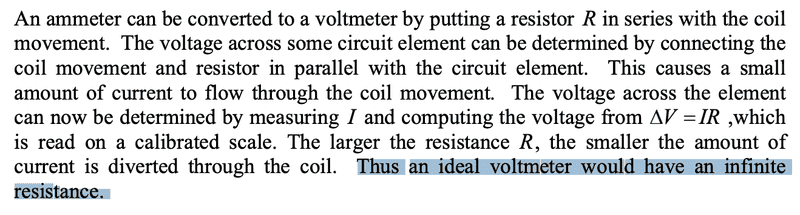
Why does an ideal voltmeter have infinite resistance?

Join the discussion
Ask a follow-up here, or get your own question answered by working scientists, mathematicians and engineers — people, not an autocomplete.
Real named experts · corrections over time · the nuance an AI answer skips
4 replies · 3K views
Leo Liu
Messages
353
Reaction score
156
Context:
1643602111468.png

What I don't understand is why the little current that flows through the converted voltmeter can affect the measurement when the resistance of the resistor added to the ammeter is not infinite. Can someone please explain this to me? Thanks.
 
Physics news on Phys.org
Leo Liu said:
Context:
View attachment 296294
What I don't understand is why the little current that flows through the converted voltmeter can affect the measurement when the resistance of the resistor added to the ammeter is not infinite. Can someone please explain this to me? Thanks.
I think it is simply a convenience so that we can discuss a voltage measurement that doesn't change the network it is connected to. You certainly can have a voltmeter with finite shunt resistance, but then the voltage you measure might not be the same as the voltage between those circuit nodes before or after the meter is connected. This is because the current that would flow through the voltmeter would change the result.
 
Reply
  • Like
Likes   Reactions: vanhees71 and sysprog
An analog voltmeter has an indicator needle that is driven by coils which have a finite resistance that is adjusted for in the calibration.
 
Oops, sorry, I didn't really answer your question. The short version is that whatever current flows through the voltmeter must also flow through the circuit network you are measuring. This will cause additional voltage drops and redistribute the various node voltages.

Consider this simple circuit, with the ammeter having zero resistance (not including R):

20220130_215728.jpg


The voltage across R2 will be 1V when R=∞, or when the voltmeter is disconnected. The current through R1, I1=1mA.
But if R=1KΩ, then that would be the same as if R2=500Ω, in which case the voltage across R2 is 0.556V with the current through R1 being 1.11mA, equally divided between R2 and the meter.
Then in the extreme case of R=0, the voltage is 0V, the current through R1 is 1.25mA and it all flows through the meter.
 
Reply
  • Like
  • Love
Likes   Reactions: vanhees71, Leo Liu and sysprog
DaveE said:
...
Ah I see. Thanks a lot!
 
Reply
  • Like
Likes   Reactions: berkeman and DaveE