Why does heat transfer away if the final temperature is above room temperature?

Join the discussion
Registration is free. Ask a follow-up in this thread, or start your own.
11 replies · 3K views
DarkEnergy890
Messages
14
Reaction score
3
Homework Statement
https://prnt.sc/hq2fs_81J1vp
Relevant Equations
mc(deltatheta)
ml
During the procedure, 30% of heat is lost. So that means that 70% of water+container is contributing to melting the ice, right? And the other 30% contributing melting the ice is down to, well, the "heat being lost to the surroundings" (not sure what this really means).

We compute the sum and the mass is 0.553kg. Then I try to calculate what would happen if no heat was lost to the surroundings. The total energy would be approx 14000J! My question is that how can heat be lost to the surroundings? If anything, surely heat is being gained by the ice from the surroundings.

The only way I can think of heat being lost to the surroundings is if the room temperature was below 0 degrees, however this doesn't make sense because the final temperature of the water is 14 degrees.

[Mentor Note: Image from web link has been attached to the post]

Many thanks!
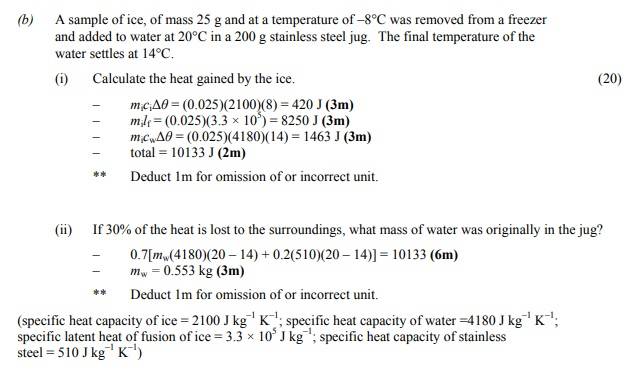
Ice Bath.jpg
 
Last edited by a moderator:
Physics news on Phys.org
DarkEnergy890 said:
The only way I can think of heat being lost to the surroundings is if the room temperature was below 0 degrees, however this doesn't make sense because the final temperature of the water is 14 degrees.
Not necessarily 0 degrees, but yes, colder than 20 degrees. A rather academic exercise indeed ...

##\ ##
 
  • Like
Likes   Reactions: DarkEnergy890 and erobz
Yeah, in reality its gaining heat from the surroundings, not losing it unless the surroundings are colder than the temperature of the mixture.

Good catch!
 
  • Like
Likes   Reactions: DarkEnergy890
However, another interpretation could be that the room temp is ##14 {}^{\circ} \rm{C}##, and the mixture temp warmer than it. it doesn't say that the water is "room temp" it states that it is ##20 {}^{\circ} \rm{C}##, so now I'm unsure... If you have ##~25 \rm{g}## ice in a large enough volume of initially ##20 {}^{\circ} \rm{C}## water in a reasonably thin stainless-steel jug, you could be losing heat to the environment at ##14 {}^{\circ} \rm{C}##. The fact that they say "the final temp is...., implies it comes into thermal equilibrium with its surroundings at ##14 {}^{\circ} \rm{C}##.

Sorry to flip flop on you, but do you agree?
 
  • Like
Likes   Reactions: DarkEnergy890
Question is, 30% of what heat?
Could be
  • 30% of the heat gained by the ice came from the surroundings
  • 30% of all the heat lost by the water went to the surroundings
  • 30% of the amount of heat the water lost to the ice was lost to the surroundings
 
  • Like
Likes   Reactions: DarkEnergy890 and erobz
erobz said:
However, another interpretation could be that the room temp is ##14 {}^{\circ} \rm{C}##, and the mixture temp warmer than it. it doesn't say that the water is "room temp" it states that it is ##20 {}^{\circ} \rm{C}##, so now I'm unsure... If you have ##~25 \rm{g}## ice in a large enough volume of initially ##20 {}^{\circ} \rm{C}## water in a reasonably thin stainless-steel jug, you could be losing heat to the environment at ##14 {}^{\circ} \rm{C}##. The fact that they say "the final temp is...., implies it comes into thermal equilibrium with its surroundings at ##14 {}^{\circ} \rm{C}##.

Sorry to flip flop on you, but do you agree?
Yes, this makes sense.
Heat gained by ice = Heat lost by water needed to melt the ice
If water is losing heat to the surroundings as well, then the TOTAL heat loss by water is greater than the heat lost by water needed to melt the ice. Therefore the heat loss by water needed to melt the ice is smaller. (x0.7)
Sorry for being too wordy, but yes, I agree with you.
 
haruspex said:
Question is, 30% of what heat?
Could be
  • 30% of the heat gained by the ice came from the surroundings
  • 30% of all the heat lost by the water went to the surroundings
  • 30% of the amount of heat the water lost to the ice was lost to the surroundings
Because in the previous part it mentioned the ice, when I was first doing the question I thought the ice had lost heat. After thinking through it, I don't really see how this is possible.
 
DarkEnergy890 said:
the heat loss by water needed to melt the ice is smaller. (x0.7)
Yes, with the interpretation in the second bullet of post #5. What about the third bullet?
 
haruspex said:
Yes, with the interpretation in the second bullet of post #5. What about the third bullet?
Then I think that
Total heat lost by water = 1.3*the amount of heat the water lost to the ice
 
DarkEnergy890 said:
Then I think that
Total heat lost by water = 1.3*the amount of heat the water lost to the ice
Yes, under that interpretation.
 
This is certainly a poorly imposed problem. But, in my judgment, they mean for you to assume that 30% of the heat Q flowing from the steel tank and the water is lost to the surroundings and 70 % flows to the ice. So $$0.7 Q=heat\ to\ ice=10133$$and $$Q=\frac{10133}{0.7}=14476\ J$$
 
  • Like
Likes   Reactions: SammyS, DarkEnergy890 and erobz
I forgot to mention, since it says the temperature settles at 14°C, it is likely that is the ambient temperature, so heat is more likely lost to the outside than gained from it.
 
  • Like
Likes   Reactions: Chestermiller and DarkEnergy890