Rain and Relativity
Hi Torrent Fans...
Well, you are all right to some extent but no one, I think, is right to the full extent (nor to be fair, will anyone be once I have finished this post...). I preface this all with the fact that I am an anthropologist, not a physicist, nor even a meteorologist, and in the main I simply observe things and try to sort out what is going on. And I have done a couple of observations of this phenomenon which might prove interesting, though the truth is I have more questions than answers to contribute.
First, clearly - as all agree - the rain is not moving (sideways) past you at the speed it appears, you are moving past the rain at that speed. But the thing about being in a vehicle is it is like Einstein's train - inside the vehicle you do not feel you are moving because, relative to the vehicle, you are not. It is only the bystander who sees that you are moving. The rain is, to some extent, a bystander.
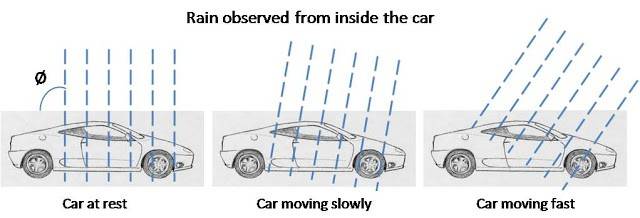
Ok. Fine. I am good to that point. The thing that interests me is this. I have noted that if the rain is coming down virtually horizontally - perpendicular to the ground - when I am at rest, then as I speed up in my vehicle the rain increasingly appears to be deflected in the angle it is passing my window. Now I get - as several have said - that the speed the rain appears to be moving by my window to the rear is equivalent to the speed I am actually moving forward in my car.
But my interest is not so much the apparent speed of the rain - it is the angle. I have made some fairly careful observations, though certainly not rigorous, and have found the following. At about 20 kilometres an hour (hey, give me a break, I am a Yank but I live in Papua New Guinea, so it is kilometres - and yes, the r comes before the e at the end in these parts...) the rain is no longer vertical, but appears to be coming down at an angle to the vertical of about 30 degrees. When I speed up to 40 kilometres per hour the angle increases to just about 45 degrees. So I have doubled my speed for only a 50% or so increase in angle. But then I have to speed up to right around 80 kilometres per hour to get the rain to appear to subtend an angle of 60 degrees – another doubling of speed to attain, this time, about a 30% increase in angle.
These figures may not be - are not - accurate, but I think the pattern is clear. If you plot the speed on the y-axis and the apparent angle on the x axis, then the curve is asymptotic. Drakkith was right, the rain appears to be coming at an "ever increasing" angle the faster you go. But two refinements here. First, the angle does not change at a constant rate with speed (though what happens with constant acceleration is a question I will broach below). Second, the implication that if you are going 1500 mph (say 2414.016 kph) in a jet trying to evade the IRS the rain will appear to be coming "straight at you" is, I think, not accurate (and I know Drakkith was only speaking loosely here). The truth is, I am pretty certain, that as the rain goes by the window of the aircraft it will be close to horizontal, but the angle will actually only be something like 88.5 degrees or 89.15 or 89.62 to the horizontal. It will not be 90 degrees.
So that is my question. Or therein resides the nexus of my questions. What is going on here? A couple of specific questions, interlaced with some observations.
First, Why is it that the curve relating speed to angle is asymptotic? I am sure the answer is simple, but I do not know it. Second, how fast do you have to go in order for the rain to appear at a true 90 degrees to the horizon? My gut feeling is that the latter answer gets back to Einstein and the speed of light. Indeed, the whole thing feels instinctively like some relation between special and general relativity. The special relativistic aspect is that all motion is relative, and the distinct frames of reference of the stationary bystander (or the rain, were it sentient) and the person in a moving vehicle result in different perceptions. Then there is the general relativistic aspect which introduces the relation between acceleration and the angle of the rain (not to mention mass, which I just did). Under a constant acceleration what happens to the angle of the rain in equal time periods? Does acceleration at a certain rate introduce the possibility of change of angle a steady rate, as opposed to the relationship between speed and angle? In that case increased acceleration would approach, but not reach the speed of light in direct relation to the angle of the rain which would approach but not reach the horizontal.
Finally, though the rain appears to change angle as speed changes, the same cannot be said for other features in the environment. For example, houses simply appear to pass at a speed equivalent to the actual speed of the vehicle but they do not appear distorted in the vertical dimension. I have also noted when it is raining hard that strong flows of water coming off the roof of a house appear to pass rapidly, but do not appear to be distorted in the vertical. I had a lot of trouble seeing the fundamental difference between a spout of water dropping to the ground and raindrops dropping to the ground. But as I thought about this in the past few days it came to me that part of this might be a matter of distance. Could it be that if I drove past a fount of water coming off a roof at close range - say ten feet distant - that the angular effect might be apparent? I have not been able to do so without serious risk to myself and others, so the hypothesis remains untested. Perhaps someone out there in a less highly traveled area can conduct the experiment. It also occurred to me it might somehow be a matter of field and ground - does the house somehow constitute a ground that prevents the optical illusion from manifesting?
And with respect to the house, that led ineluctably to another couple of thought experiments. For instance, what would happen if we had a series of houses falling straight down from the sky at a regular rate ? Would hey would appear - as our speed increased - to be falling at an angle (again I feel instinctively that this would not happen at distance, but am less certain about if they were very close to my window). And what the the houses were suspended in the sky, say fifteen houses, one levitated on top of the other in a line perpendicular to the ground,but immobile (well, relatively...). Would they also appear to describe a slanted line if you passed them at speed? Does distance affect this?
And a final question - I note that when I look at the individual raindrops as they pass my window at speed it is not a series of horizontal raindrops arranged at an angle in relation to one another, but that, instead, each raindrop, which is actually an elongated drop of water perhaps half an inch or more in length, appears at an angle. That is, the individual drops are distorted at the same angle as the row of drops. It is the difference between A and B below (hope this comes out in the text, but I think you know what I mean...
A. I B. /
I /
I /
So the question is would those houses appear each to be distorted at an angle to the horizontal as well? And why not??
Sorry for going on, but I find this interesting and I have been thinking about this over the past few days because we have had torrential rain with plenty of time for observation. I then googled "why does the rain appear to change angles when you speed up in a car" and found this site. It has been a good discovery. Hope I haven't overstayed my welcome, but I would be interested in any reactions...
Cheers
Lizard