Why does the expression equal the reciprocal of its logarithm?

terryds
Messages
392
Reaction score
13
I encountered this in http://calcchat.com/book/Calculus-10e/8/4/7/
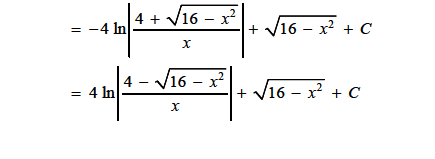
Capture.PNG
How come the above expression equals the below?
What I know it should be 4 ln(x/(4+sqrt(16-x^2))) which means the -1 becomes the power of that thing inside ln.

Please help me. I really don't get it.
 
  • Like
Likes   Reactions: mfb
on Phys.org
Provided ##x\in[-4,0)\cup (0,4]## we have
$$\left|\frac{4+\sqrt{16-x^2}}x\right|=\frac{4+\sqrt{16-x^2}}{|x|}$$
and
$$\left|\frac{4-\sqrt{16-x^2}}x\right|=\frac{4-\sqrt{16-x^2}}{|x|}$$
and that multiplying the two right-hand sides together gives 1. So they are reciprocals, hence their logs are additive inverses.
 
  • Like
Likes   Reactions: FactChecker and terryds

Similar threads

  • · Replies 10 ·
Replies
10
Views
2K
  • · Replies 14 ·
Replies
14
Views
4K
  • · Replies 7 ·
Replies
7
Views
2K
  • · Replies 1 ·
Replies
1
Views
2K
  • · Replies 3 ·
Replies
3
Views
1K
  • · Replies 24 ·
Replies
24
Views
8K
  • · Replies 3 ·
Replies
3
Views
3K
  • · Replies 17 ·
Replies
17
Views
6K
  • · Replies 4 ·
Replies
4
Views
2K
  • · Replies 13 ·
Replies
13
Views
3K