Faraz Murtaza
- 32
- 0
why does the monopoles not exist
Vorde said:To rephrase: Even though there are theories that predict the existence of magnetic monopoles, the mainstream particle theories do not. Physically there is nothing wrong with their existence, but there is no reason for them to exist, either.
Vorde said:I meant theories that are considered 'true' now, like QED and EWT (is that how it's called?), not GUTs. I was under the impression that currently verified theories do not predict monopoles, and the existence of monopoles in speculative TOEs and GUTs are one of their experimental testing points.
Though I see how that point of view did not get across in my earlier post.
Though I am confused as to how magnetic monopoles led to inflation theory?
cronanster said:What kind of monopoles are we talking about?
Vorde said:Electric Monopoles do exist, like Gordianus said. Assuming the OP is talking about Magnetic monopoles, why should they exist?
To rephrase: Even though there are theories that predict the existence of magnetic monopoles, the mainstream particle theories do not. Physically there is nothing wrong with their existence, but there is no reason for them to exist, either.
sophiecentaur said:You don't actually need to 'have' magnetic fields at all. The force that we call magnetism can be accounted for by the relativistic effects on moving charges. None of it's real- it's just models and we choose the one that suits a situation best.
sophiecentaur said:My point was that an argument based on fields need not be totally valid (sufficient?) once you realize that the field concept is only a concept. I know that post of yours is a great way to show that monopoles "can't" exist, based on the model that field lines have no 'ends'. But field lines are only a construct to model what we observe. The question of the existence of the monopole may require more than a field line argument.
Vanadium 50 said:The statement that field lines have no ends is identical to the statement that there are no monopoles. It's not an explanation.
Furthermore, all at Tris_d has shown is that in the situation he describes there are no monopoles, not that there are no monopoles anywhere.
tris_d said:Actually, magnetic field due to moving charge looks like monopole to me. I see only one pole there and it certainly does not look like a dipole. I've been saying that for quite a few years now, but people are dismissing it and I never got any reasonable response. Could it be too simple to be believed, right under everyone's nose?
What do you think it is, a dipole?
ZapperZ said:What does it mean that it looks like a monopole to you? Do you mean that you can show that the magnetic field here has a non-zero divergence?
Note that we have already seen situations that mimic a magnetic monopole from a spin ice system.
http://news.sciencemag.org/sciencenow/2009/09/04-01.html
So we do know what it should look like if it occurs.
Zz.
tris_d said:It means that it does not look like a dipole, so what else could it be? Why would you expect anything, why not simply count? Just tell me, if you mean to say that it is not monopole, what is it then, is it a dipole?
tris_d said:Field lines have no ends?
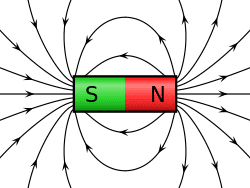
Do you see field lines start at north pole and end at south pole?