Why does the monopoles not exist

  • Context: Undergrad 
  • Thread starter Thread starter Faraz Murtaza
  • Start date Start date
Click For Summary

Discussion Overview

The discussion revolves around the existence of monopoles, particularly focusing on magnetic monopoles. Participants explore theoretical predictions, the implications of existing theories, and the relationship between monopoles and established physics concepts. The conversation includes both conceptual and technical aspects, with references to various theories in physics.

Discussion Character

  • Debate/contested
  • Conceptual clarification
  • Technical explanation

Main Points Raised

  • Some participants question why monopoles should exist, while others assert that they do exist, particularly in theoretical frameworks.
  • There is a distinction made between electric monopoles, which are acknowledged to exist, and magnetic monopoles, which are debated.
  • Some argue that while theories predict magnetic monopoles, mainstream particle physics does not currently support their existence.
  • A participant mentions that monopoles are a prediction of grand unified theories (GUTs) and highlights a conflict between theory and observation due to the lack of detected monopoles.
  • Concerns are raised about how the existence of magnetic monopoles relates to inflation theory and the implications of their predicted density.
  • Some participants discuss the nature of magnetic fields and the concept of field lines, questioning the validity of arguments against monopoles based on these models.
  • There is a suggestion that the existence of monopoles may require more than just field line arguments, indicating a need for experimental evidence.
  • One participant expresses the view that the magnetic field due to moving charges appears monopole-like, challenging the conventional dipole interpretation.

Areas of Agreement / Disagreement

Participants do not reach a consensus on the existence of magnetic monopoles. There are multiple competing views, with some asserting their theoretical existence while others argue against it based on current mainstream physics.

Contextual Notes

Participants reference various theories, including quantum electrodynamics (QED), electroweak theory (EWT), and grand unified theories (GUTs), noting that the predictions and implications of these theories regarding monopoles are not universally accepted or experimentally verified.

Faraz Murtaza
Messages
32
Reaction score
0
why does the monopoles not exist
 
Physics news on Phys.org


why should they exist?


Monopoles do exist


What kind of monopoles are we talking about?


Electric monopoles do exist. Somehow, I feel the O:P asked about magnetic monopoles; a very common question.


Electric Monopoles do exist, like Gordianus said. Assuming the OP is talking about Magnetic monopoles, why should they exist?

To rephrase: Even though there are theories that predict the existence of magnetic monopoles, the mainstream particle theories do not. Physically there is nothing wrong with their existence, but there is no reason for them to exist, either.


Vorde said:
To rephrase: Even though there are theories that predict the existence of magnetic monopoles, the mainstream particle theories do not. Physically there is nothing wrong with their existence, but there is no reason for them to exist, either.

Huh? Monopoles are actually a fairly generic prediction of grand unified theories, from what I understand. It's actually a large conflict between theory and observation, since obviously we don't see any. This led, in part, to the development of inflation theory, which is more or less the standard paradigm for early universe cosmology (in one incarnation or another).


I meant theories that are considered 'true' now, like QED and EWT (is that how it's called?), not GUTs. I was under the impression that currently verified theories do not predict monopoles, and the existence of monopoles in speculative TOEs and GUTs are one of their experimental testing points.

I see how that point of view did not get across in my earlier post.

Though I am confused as to how magnetic monopoles led to inflation theory?
 
Last edited:


Vorde said:
I meant theories that are considered 'true' now, like QED and EWT (is that how it's called?), not GUTs. I was under the impression that currently verified theories do not predict monopoles, and the existence of monopoles in speculative TOEs and GUTs are one of their experimental testing points.

Though I see how that point of view did not get across in my earlier post.

Though I am confused as to how magnetic monopoles led to inflation theory?

Well while it's true that we have no direct experimental verification of GUT scale physics, and likely never will, my point is that it seems a fairly generic prediction of what must be going on at those scales. This could be false, as I obviously haven't surveyed all theories claiming to describe these energy ranges, but I think it's fairly universal.

The reason this motivated inflation theory is precisely what I stated before. If you predict a monopole density which is much larger than the observed bounds (we do have some bounds), then that's obviously a contradiction. Either the theory is wrong, or the observations are flawed (not likely, given the magnitude of the discrepency). Now, as I've mentioned monopoles seem to be a fairly straightforward prediction of what's going on at GUT energies, so there's no clear way to get around producing them. The only way to lower the density, then, is to dilute them over a larger volume; this is precisely what inflation does.
 
  • #10


cronanster said:
What kind of monopoles are we talking about?

we are talking about magnet poles
 
  • #11


Vorde said:
Electric Monopoles do exist, like Gordianus said. Assuming the OP is talking about Magnetic monopoles, why should they exist?

To rephrase: Even though there are theories that predict the existence of magnetic monopoles, the mainstream particle theories do not. Physically there is nothing wrong with their existence, but there is no reason for them to exist, either.

what is OP?
CAN YOU PLEASE TELL
 
  • #12


Original Post or Original Poster. The first post in a thread or the person who made it.
 
  • #13


http://en.wikipedia.org/wiki/Amperes_Law
220px-Electromagnetism.svg.png


Magnetic field due to moving charge. Count the poles, and point out where is the north and where is the south pole.
 
  • #14


You don't actually need to 'have' magnetic fields at all. The force that we call magnetism can be accounted for by the relativistic effects on moving charges. None of it's real- it's just models and we choose the one that suits a situation best.
 
  • #15


sophiecentaur said:
You don't actually need to 'have' magnetic fields at all. The force that we call magnetism can be accounted for by the relativistic effects on moving charges. None of it's real- it's just models and we choose the one that suits a situation best.

How's that relevant to whether magnetic monopoles exist or not? Whatever is the way you account it for you still can measure what is called sink and source, positive and negative, or north and south pole. The question I have for you is how many poles can you count on that image above of magnetic field due to moving charge, and can you point where is the south and where is the north pole?
 
  • #16


My point was that an argument based on fields need not be totally valid (sufficient?) once you realize that the field concept is only a concept. I know that post of yours is a great way to show that monopoles "can't" exist, based on the model that field lines have no 'ends'. But field lines are only a construct to model what we observe. The question of the existence of the monopole may require more than a field line argument.
 
  • #17


sophiecentaur said:
My point was that an argument based on fields need not be totally valid (sufficient?) once you realize that the field concept is only a concept. I know that post of yours is a great way to show that monopoles "can't" exist, based on the model that field lines have no 'ends'. But field lines are only a construct to model what we observe. The question of the existence of the monopole may require more than a field line argument.

I'm not talking about "models" or "constructs". This is real.
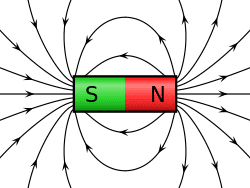
Take a permanent magnet in your hand and you can measure it. Field lines have no ends?

250px-VFPt_cylindrical_magnet_thumb.svg.png
200px-VFPt_dipole_electric.svg.png

http://en.wikipedia.org/wiki/Magnetic_field

Do you see field lines start at north pole and end at south pole?Is this picture below of magnetic dipole?
Can you point where is north and south pole?

220px-Electromagnetism.svg.png
 
  • #18


The statement that field lines have no ends is identical to the statement that there are no monopoles. It's not an explanation.

Furthermore, all at Tris_d has shown is that in the situation he describes there are no monopoles, not that there are no monopoles anywhere.
 
  • #19


Ultimately the question is an experimental one. We can construct theories in which magnetic monopoles and monopole-type magnetic fields exist (for which ##\nabla \cdot \vec B \ne 0##). However, to date nobody has actually found such particles or fields. Maybe next http://www.nature.com/nature/journal/v429/n6987/full/429010a.html someone will actually detect them convincingly, and then we will have to rewrite Maxwell's equations etc.
 
Last edited by a moderator:
  • #20


Vanadium 50 said:
The statement that field lines have no ends is identical to the statement that there are no monopoles. It's not an explanation.

Furthermore, all at Tris_d has shown is that in the situation he describes there are no monopoles, not that there are no monopoles anywhere.

Actually, magnetic field due to moving charge looks like monopole to me. I see only one pole there and it certainly does not look like a dipole. I've been saying that for quite a few years now, but people are dismissing it and I never got any reasonable response. Could it be too simple to be believed, right under everyone's nose?

What do you think it is, a dipole?
 
  • #21


tris_d said:
Actually, magnetic field due to moving charge looks like monopole to me. I see only one pole there and it certainly does not look like a dipole. I've been saying that for quite a few years now, but people are dismissing it and I never got any reasonable response. Could it be too simple to be believed, right under everyone's nose?

What do you think it is, a dipole?

What does it mean that it looks like a monopole to you? Do you mean that you can show that the magnetic field here has a non-zero divergence?

Note that we have already seen situations that mimic a magnetic monopole from a spin ice system.

http://news.sciencemag.org/sciencenow/2009/09/04-01.html

So we do know what it should look like if it occurs.

Zz.
 
Last edited by a moderator:
  • #22


ZapperZ said:
What does it mean that it looks like a monopole to you? Do you mean that you can show that the magnetic field here has a non-zero divergence?

Note that we have already seen situations that mimic a magnetic monopole from a spin ice system.

http://news.sciencemag.org/sciencenow/2009/09/04-01.html

So we do know what it should look like if it occurs.

Zz.

It means that it does not look like a dipole, so what else could it be? Why would you expect anything, why not simply count? Just tell me, if you mean to say that it is not monopole, what is it then, is it a dipole?
 
Last edited by a moderator:
  • #23


tris_d said:
It means that it does not look like a dipole, so what else could it be? Why would you expect anything, why not simply count? Just tell me, if you mean to say that it is not monopole, what is it then, is it a dipole?

Er... This isn't based on a matter of TASTES! The distinction of something being a monopole will require a non zero divergence. You simply can't argue "oh it looks like a monopole to me". That is NOT a physics reason.

So I take it from your response that you had NEVER checked if the magnetic field divergence is zero? That is a very simple question that will say a lot.

Zz.
 
  • #24


tris_d said:
Field lines have no ends?

250px-VFPt_cylindrical_magnet_thumb.svg.png


Do you see field lines start at north pole and end at south pole?

The field lines continue through the magnet to form closed loops. See for example Fig. 27.13(a) here:

http://www.physics.sjsu.edu/becker/physics51/mag_field.htm

http://www.physics.sjsu.edu/becker/physics51/images/28_09_Magnetic_filed_lines.jpg
 
Last edited:

Similar threads

  • · Replies 7 ·
Replies
7
Views
2K
  • · Replies 2 ·
Replies
2
Views
2K
  • · Replies 10 ·
Replies
10
Views
3K
  • · Replies 12 ·
Replies
12
Views
3K
  • · Replies 13 ·
Replies
13
Views
3K
  • · Replies 12 ·
Replies
12
Views
3K
  • · Replies 5 ·
Replies
5
Views
2K
  • · Replies 6 ·
Replies
6
Views
3K
  • · Replies 4 ·
Replies
4
Views
3K
Replies
1
Views
2K