Why Does the Order of Transformations Affect the Graph of a Function?

Click For Summary
The discussion centers on understanding the order of transformations for functions in precalculus. A student is confused about why their graph differs from the teacher's, particularly regarding the sequence of reflecting and shifting transformations. The teacher suggests reflecting last, while another participant argues that the order depends on whether transformations are applied inside or outside the function. The correct approach involves applying transformations in a specific order, following standard mathematical operations. Ultimately, mastering this order is crucial for accurately graphing transformed functions.
modonnell121
Messages
2
Reaction score
0
Okay so I've done very well in college so far, and I thought I was at least decent at math, but I just started this precalculus class and I'm having an issue.

I basically don't know, and can't get a straight answer about how to handle functions that have multiple transformations going on. This is not a homework question, but it is a perfect example of my issue, so I'm posting it.
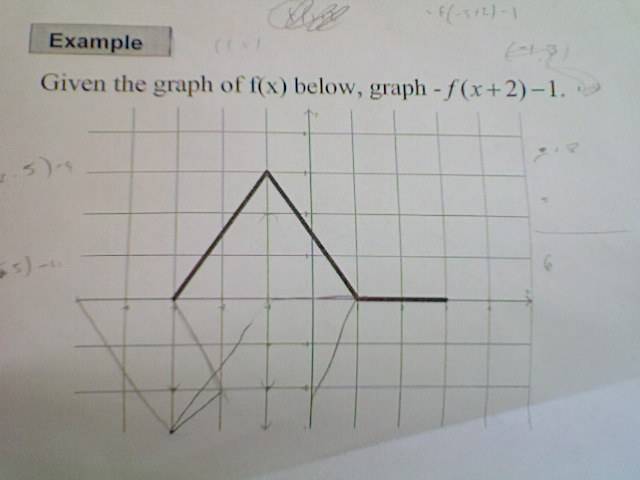
Photo%2520on%25202012-01-31%2520at%252012.16.jpg


My answer is the function sketched below and to the left of the printed one, except I would have shifted it down one but there is no room on the graph, as you can see. I must be that far off, huh? The teacher's answer is like mine but shifted up one unit. This is apparently because he reflected it after shifting, while I reflected first. In his email explaining why he did this he told me "It's always best to do the reflecting last as it is the last thing that happended to the function in the transformation process." WHAT?

How do I know the order, what do I DO? Please someone help me.
 
Mathematics news on Phys.org
I believe your teacher is wrong, and you are correct (unless I'm suffering from brain failure).

In the case of y= -f(x+2) -1 you must "reflect" f(x+2) before subtracting 1! This graph should be 1 below y= -f(x+2)!

If it was y= - [f(x+2) -1] you would "reflect" afterwords like your teacher did (ultimately shifting up 1, because y = - [f(x+2) -1] = -f(x+2) + 1).
 
Cool, I thought I was right. But can you explain how I determine the order to do the transformations in general?
 
modonnell121 said:
Cool, I thought I was right. But can you explain how I determine the order to do the transformations in general?

Sorry, didn't see your reply until today. There is a specific order of operations, with a few different rules to get used to.

For functions (such as f(x) or g(x)), you apply the function to whatever is within the parenthesis in the function declaration.

f(x) you apply the function f to x

f(x+2) you apply the function f to x+2. in other words you replace the value for x with x+2

IF f(x) = 2x THEN f(x+2) = 2(x+2)

IF f(x) = 2x+1 THEN f(x+2) = 2(x+2) + 1 etc.

Then you follow the standard order of operations.

IF y=f(x) + 1 you calculate f(x) then add in 1 to calculate y.

IF y=-f(x) + 1 you calculate -f(x) then add in 1 to calculate y.

IF y=-[f(x) + 1] you calculate f(x), add in 1, and THEN flip the sign to determine your y value.
 
Here is a little puzzle from the book 100 Geometric Games by Pierre Berloquin. The side of a small square is one meter long and the side of a larger square one and a half meters long. One vertex of the large square is at the center of the small square. The side of the large square cuts two sides of the small square into one- third parts and two-thirds parts. What is the area where the squares overlap?

Similar threads

  • · Replies 5 ·
Replies
5
Views
2K
  • · Replies 3 ·
Replies
3
Views
2K
  • · Replies 2 ·
Replies
2
Views
5K
  • · Replies 2 ·
Replies
2
Views
1K
  • · Replies 9 ·
Replies
9
Views
4K
  • · Replies 4 ·
Replies
4
Views
3K
  • · Replies 5 ·
Replies
5
Views
4K
  • · Replies 1 ·
Replies
1
Views
10K
  • · Replies 11 ·
Replies
11
Views
2K
  • · Replies 8 ·
Replies
8
Views
2K