Why does the radius lose its exponent in dE conversion to cylindrical coordinates?

3 replies · 2K views · last reply
Allenman
Messages
58
Reaction score
0
This isn't actually a homework problem. I just had a question about the solution they provided.
Homework Statement


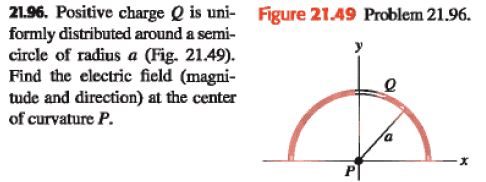
Textbook problem 21.96 with a diagram of a semicircle of radius a, uniformly charged with positive charge Q, centre of curvature P at the origin on the x and y axes.


2. Solution given in solutions manual
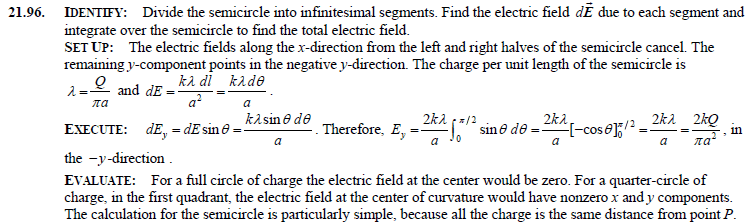
Textbook solution to problem 21.96 finding the electric field at the center of a semicircle of charge: steps IDENTIFY, SET UP, EXECUTE with dE and integration of sin theta to give Ey = 2kQ/(pi a squared) in the negative y-direction, and EVALUATE.


3. My question

When they convert dE into cylindrical coordinates why does the radius "a" lose its exponent?

dE = [itex]\frac{\kappa\lambda\delta l}{a^{2}}[/itex] = [itex]\frac{\kappa\lambda\delta\theta}{a}[/itex]

I have to be missing something simple, I just know it...
 
Allenman said:
This isn't actually a homework problem. I just had a question about the solution they provided.

Homework Statement


Textbook figure 21.49 for Problem 21.96: a semicircular arc of radius a, uniformly charged with total charge Q, centred at point P on the x-axis, with a radius line drawn to the arc and labelled a, and axes x and y.


2. Solution given in solutions manual
Textbook solution page for problem 21.96 computing the electric field at the center of a semicircle of charge, showing the linear charge density, the field element dE = k dl / a^2, and the integral giving E_y = 2k lambda/a, directed in the negative y-direction.


3. My question

When they convert dE into cylindrical coordinates why does the radius "a" lose its exponent?

dE = [itex]\frac{\kappa\lambda\delta l}{a^{2}}[/itex] = [itex]\frac{\kappa\lambda\delta\theta}{a}[/itex]

I have to be missing something simple, I just know it...
It's because [itex]d\ell=a\cdot d\theta\,.[/itex]
 
Does that come from the arc length formula?

Thank you