Why does the series Taylor expand as e^-nx?

  • Context: Graduate 
  • Thread starter Thread starter unscientific
  • Start date Start date
  • Tags Tags
    Expansion
Click For Summary
SUMMARY

The discussion focuses on the derivation of the Taylor series expansion for the function \(\frac{1}{(1+e^x)^2}\), which simplifies to \(e^{-nx}\) through various mathematical transformations. The participants clarify that by expressing \(\frac{1}{(1+e^x)^2}\) as \(\frac{e^{-2x}}{(1+e^{-x})^2}\) and applying the binomial series expansion, one can derive the necessary terms. The final expression is confirmed as \(\sum_{n=0}^{\infty} e^{-x} [(n+1)(-1)^{n+1} e^{-nx}]\), demonstrating the relationship between the geometric series and differentiation.

PREREQUISITES
  • Understanding of Taylor series expansion
  • Familiarity with geometric series and binomial series
  • Knowledge of differentiation techniques
  • Basic concepts of exponential functions
NEXT STEPS
  • Study the derivation of the binomial series expansion
  • Learn about the properties of geometric series
  • Explore differentiation of series with respect to variables
  • Investigate applications of Taylor series in mathematical analysis
USEFUL FOR

Mathematicians, students studying calculus, and anyone interested in series expansions and their applications in mathematical analysis.

unscientific
Messages
1,728
Reaction score
13
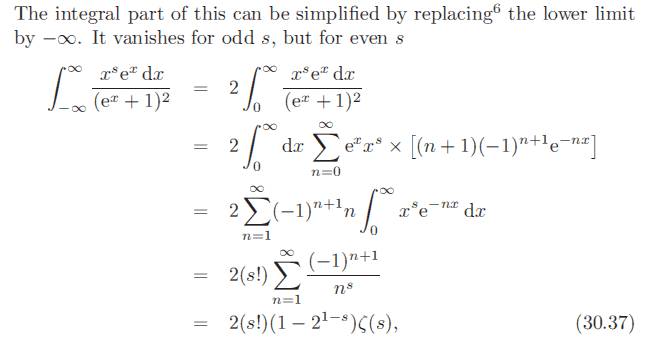
In this section, they derive the Sommerfeld formula.

In the first step it seems like they have expanded ##\frac{1}{(1+e^x))^2}##. I'm not sure why does the series taylor expand as ##e^{-nx}##?

Also how did they get from the 2nd to the 3rd step?

Simply by comparing terms we see they are different:

For 2nd step we get terms of ##x^se^x(-1 + 2e^{-x} - 3e^{-2x} + ...)##.
For 3rd step we get terms of ##e^{-x} - 2e^{-2x} + 3e^{-3x} - ...##
11j2jwi.jpg
 
Physics news on Phys.org
Yeah in the second step it needs to be multiplied by -1 and the e^x should be e^(-x) instead.

To get the expansion, you could write \frac{1}{(1+e^x)^2} as \frac{e^{-2x}}{(1+e^{-x})^2}. Then you could do the binomial series expansion on it, or you could write it out using the geometric series formula, which gives \frac{e^{-2x}}{(1+e^{-x})^2}=e^{-2x}(1-e^{-x}+e^{-2x}-e^{-3x}+...)^2. Collecting the terms that come from squaring it, you get the appropriate formula.
 
chingel said:
... \frac{e^{-2x}}{(1+e^{-x})^2}=e^{-2x}(1-e^{-x}+e^{-2x}-e^{-3x}+...)^2. Collecting the terms that come from squaring it, you get the appropriate formula.

Collecting the terms give the right terms, but how did they obtain a general expression ##\sum_{n=0}^{\infty} e^{-x} [(n+1)(-1)^{n+1} e^{-nx}]##?
 
To expand ##\frac{1}{(1 + e^{-x})^2}##, do it in terms of ##y = e^{-x}##.
\frac{1}{1 + y} = \sum{(-1)^n y^n}
Differentiate both sides wrt ##y##:
- \frac{1}{(1 + y)^2} = \sum{(-1)^n n y^{n-1}} = \sum{(-1)^{n+1} (n+1) y^n}
 
Last edited by a moderator:
  • Like
Likes   Reactions: 1 person
Bill_K said:
To expand ##\frac{1}{(1 + e^{-x})^2}##, do it in terms of ##y = e^{-x}##.
\frac{1}{1 + y} = \sum{(-1)^n y^n}
Differentiate both sides wrt ##y##:
- \frac{1}{(1 + y)^2} = \sum{(-1)^n n y^{n-1}} = \sum{(-1)^{n+1} (n+1) y^n}

Actually I think it's ##e^x## instead:

Starting, LHS is simply geometric series with factor ##e^{-x}##:

\frac{1}{1+e^x} = \sum (-1)^n e^{-nx}

Differentiating both sides with respect to x,

-\frac{e^x}{(1+e^x)^2} = -\sum (-1)^{n+1} n e^{-nx}

\frac{e^x}{(1+e^x)^2} = \sum (-1)^{n+1} n e^{-nx}

This leads to the answer immediately.
 

Similar threads

  • · Replies 3 ·
Replies
3
Views
2K
  • · Replies 3 ·
Replies
3
Views
2K
  • · Replies 5 ·
Replies
5
Views
2K
  • · Replies 5 ·
Replies
5
Views
729
  • · Replies 11 ·
Replies
11
Views
2K
  • · Replies 1 ·
Replies
1
Views
1K
  • · Replies 9 ·
Replies
9
Views
2K
  • · Replies 15 ·
Replies
15
Views
2K
  • · Replies 17 ·
Replies
17
Views
4K
  • · Replies 16 ·
Replies
16
Views
3K