Discussion Overview
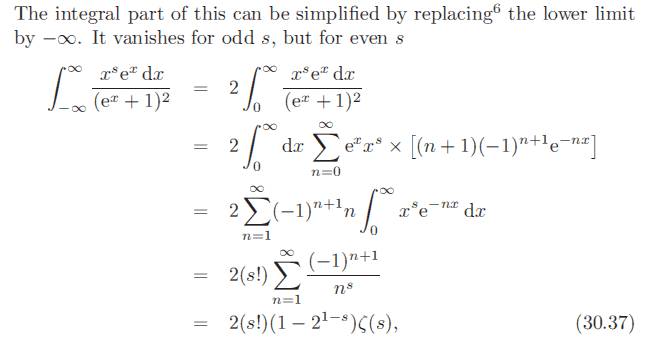
The discussion centers around the Taylor expansion of the series related to the Sommerfeld formula, specifically examining why the series expands as \( e^{-nx} \). Participants explore the steps involved in deriving the expansion and the transformations applied to the expression \( \frac{1}{(1+e^x)^2} \).
Discussion Character
- Technical explanation
- Mathematical reasoning
- Debate/contested
Main Points Raised
- One participant questions the transition from the second to the third step in the derivation, noting differences in the terms generated.
- Another participant suggests that the second step requires a multiplication by -1 and a correction of \( e^x \) to \( e^{-x} \) for proper expansion.
- A different approach is proposed involving rewriting \( \frac{1}{(1+e^x)^2} \) as \( \frac{e^{-2x}}{(1+e^{-x})^2} \) and applying the binomial series expansion or geometric series formula.
- One participant seeks clarification on how a general expression \( \sum_{n=0}^{\infty} e^{-x} [(n+1)(-1)^{n+1} e^{-nx}] \) is derived from the collected terms.
- Another participant reiterates the differentiation of the geometric series expansion in terms of \( y = e^{-x} \) to derive \( \frac{1}{(1 + e^{-x})^2} \) and its implications.
- There is a suggestion that the left-hand side should be treated as a geometric series with a factor of \( e^{-x} \), leading to a different interpretation of the series expansion.
Areas of Agreement / Disagreement
Participants express differing views on the correct transformations and interpretations of the series expansion, indicating that multiple competing views remain without a consensus on the correct approach.
Contextual Notes
Some participants' arguments depend on specific assumptions about the series and transformations used, which are not universally agreed upon. The discussion includes unresolved mathematical steps and varying interpretations of the series expansion process.