Discussion Overview
The discussion revolves around the reasoning behind the use of reference angles in trigonometry, particularly for obtuse angles. Participants explore the relationship between the sine of obtuse angles and their reference angles, questioning how this concept is derived and applied in the context of unit triangles and the unit circle.
Discussion Character
- Exploratory
- Technical explanation
- Conceptual clarification
- Debate/contested
Main Points Raised
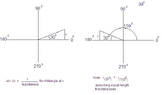
- Some participants inquire about the rationale behind why the sine of obtuse angles, such as sin 150 degrees, is equal to the sine of their reference angles, like sin 30 degrees.
- There is a question regarding the definition of sine as the ratio of opposite to hypotenuse, particularly for angles greater than 90 degrees, where traditional definitions seem inadequate.
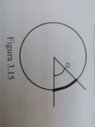
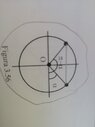
- One participant suggests that the definition of sine must be generalized beyond acute angles, proposing that sine can be understood as the y-coordinate on the unit circle.
- Another participant mentions that using reference angles is a practical method that leverages the symmetry of the quadrants to simplify calculations.
- Some participants express a desire for a clearer explanation of how the relationship between sine and reference angles is established, emphasizing the need for a foundational understanding.
- There are mentions of alternative definitions and approaches, including the use of radians and the concept of complementary angles.
- One participant notes that calculating sine based on the y-axis would yield a different function, highlighting the importance of the current definition.
- Analytical derivations of the relationship between sine values for obtuse angles and their reference angles are also suggested.
Areas of Agreement / Disagreement
Participants generally express curiosity and seek clarification on the topic, but there is no consensus on the best way to explain or understand the use of reference angles in trigonometry for obtuse angles. Multiple viewpoints and methods of explanation are presented without resolution.
Contextual Notes
Some participants acknowledge that the basic definition of sine may not fully encompass its application to obtuse angles, suggesting that a more advanced understanding is necessary. There is also mention of the need to consider the unit circle for a comprehensive grasp of the concept.