Why does the trigonometry of obtuse angles use ref angles?

  • Context: High School 
  • Thread starter Thread starter shirozack
  • Start date Start date
  • Tags Tags
    Angles Trigonometry
Join the discussion
Ask a follow-up here, or get your own question answered by working scientists, mathematicians and engineers — people, not an autocomplete.
Real named experts · corrections over time · the nuance an AI answer skips
10 replies · 3K views
shirozack
Messages
37
Reaction score
3
TL;DR
Why does the trigo of obtuse angles use ref angles?
I would like to know the "why" of trigo of non acute angles in a unit triangle. why is it equals to the reference angle? how did it even come about?

For example, sin 150 degrees. why is it equal to sin 30?

i understand sin 30 because there is a right angle triangle of opposite and hypoteneuse etc.

but how did we resolve sin 150? how did answer became calculating the reference angle to the x-axis? why not calculate it based on the y-axis? if sin is defined as the ratio of the opposite to the hypo, then where is the opposite and hypo of a 150 angle? why is sin150 = sin30?

thanks
 
Mathematics news on Phys.org
Hi, @shirozack

shirozack said:
TL;DR Summary: Why does the trigo of obtuse angles use ref angles?
https://en.wikipedia.org/wiki/Unit_circle

shirozack said:
I would like to know the "why" of trigo of non acute angles in a unit triangle. why is it equals to the reference angle? how did it even come about?

For example, sin 150 degrees. why is it equal to sin 30?
I prefer radians: https://en.wikipedia.org/wiki/Radian


shirozack said:
i understand sin 30 because there is a right angle triangle of opposite and hypoteneuse etc.

but how did we resolve sin 150? how did answer became calculating the reference angle to the x-axis? why not calculate it based on the y-axis? if sin is defined as the ratio of the opposite to the hypo, then where is the opposite and hypo of a 150 angle? why is sin150 = sin30?

thanks
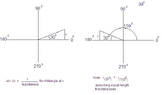
PBxoETPMTReyKSj5MqnQ_sin-30-150.png

Hope it helps. At any nearby library you will for sure find basic trigonometry bibliography. I recommend you not to get messed with the links. Just stare at them for a while, and no more.

Best wishes!

PBxoETPMTReyKSj5MqnQ_sin-30-150.png
 
Last edited by a moderator:
Reply
  • Like
Likes   Reactions: PeroK, DrClaude and Lnewqban
thanks for the reply but i would like to know the 'why'?

please explain simply if possible:

How did we conclude that sin150 is equal to sin30? there is no opposite or hypotenuse in a 150degree triangle.

*i know the reference angle technique and all that good stuff later on, i am not asking about those. i want to know specifically, if sin is defined as opposite/hypotenuse, then how are we using it for obtuse angles? how can we just add a reference angle in and use it?
 
shirozack said:
thanks for the reply but i would like to know the 'why'?

please explain simply if possible:

How did we conclude that sin150 is equal to sin30? there is no opposite or hypotenuse in a 150degree triangle.

*i know the reference angle technique and all that good stuff later on, i am not asking about those. i want to know specifically, if sin is defined as opposite/hypotenuse, then how are we using it for obtuse angles? how can we just add a reference angle in and use it?
That definition of sine (as opposite/hypotenuse) is only a basic definition to get you started at high school. To go beyond acute angles, you need to generalise your definition of sine. Almost all of mathematics is like this.

The basic definition of sine you would use at undergraduate level is the ##y## coordinate on a unit circle, as linked to above.

To develop the concept further and define the sine of a complex number, you might advance your definition of sine to a power series.

PS for some people this illustrates the power, beauty and excitement of mathematics!
 
Last edited:
Reply
  • Informative
Likes   Reactions: mcastillo356
shirozack said:
TL;DR Summary: Why does the trigo of obtuse angles use ref angles?

I would like to know the "why" of trigo of non acute angles in a unit triangle. why is it equals to the reference angle? how did it even come about?
It is a practical way to simplify calculations taking advantage of the symmetry nature of the quadrants.

Would this help?:
https://courses.lumenlearning.com/csn-precalculus/chapter/reference-angles/
 
Reply
  • Informative
Likes   Reactions: mcastillo356
Hi, @shirozack

A circumference is the set of points of the plane that are distant to another point ##O##, called center of the circumference, a constant amount ##r## called radius of the circumference

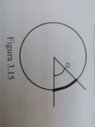
Provided any angle ##\alpha##, we consider a circumference of radius 1 and with center the vertex of the angle; then, we will measure the angle as the length of the arc of circumference equal to the radius:


IMG_20240821_170516.jpg

The aim is now in measure the length of the arc of a circumference. The expression that allows us to compute the length of a circumference of radius ##r## is ##2\pi\,r##, and, as we have taken ##r=1##, then the measure of the whole radius is ##2\pi##. This unit of measure is a radian, i.e, the whole angle sizes ##2\pi## radians.

(...)

So an angle of ##g## degrees sizes ##\frac{g}{360}\cdot{2\pi}=g\cdot{\frac{\pi}{180}}## radians.

(...)

Then one radian is ##\frac{180}{\pi}## degrees

An important theorem of plane geometry that for sure the reader will know, asserts that the sum of the sizes of any triangle is ##\pi##

@shirozack, I will show you a reasoning for this very simple, if you want. Now I leave this in your hands, and go straight to the question:

Two angles are complementary if their sum is ##\frac{\pi}{2}##

IMG_20240821_185912.jpg

So ##\sin{(\pi-\alpha)}= \sin\alpha##

Best wishes!
 
Simply, the answer to the "why" is that the sine function is defined that way. If you calculate it based on the y-axis, it would be a different function.

Here is ##\sin(x)## graphed together with ##\cos(x)##.

##\sin(x)##, with the current definition, has very useful applications in physics and applied mathematics.

Screenshot 2024-08-21 at 1.47.56 PM.png
 
Reply
  • Informative
Likes   Reactions: mcastillo356
PeroK said:
The basic definition of sine you would use at undergraduate level is the x coordinate on a unit circle, as linked to above.
That's how cosine is defined; i.e., as the x coordinate. For the sine, it's defined as the y coordinate. More specifically, the y coordinate of the terminating ray of the angle where it intersects the unit circle.
 
Reply
  • Like
Likes   Reactions: PeroK