mishima
- 576
- 43
Hi, my high school students enjoy using the applet found here (http://pages.jh.edu/~virtlab/bridge/truss.htm) to design model (basswood) bridges for our annual regional contest. It seems to require firefox these days.
Recently, some designs have been causing extremely large forces to be reported. For example, a 200 load causing forces of 500+ in multiple members. A screenshot of the design which causes this is below.
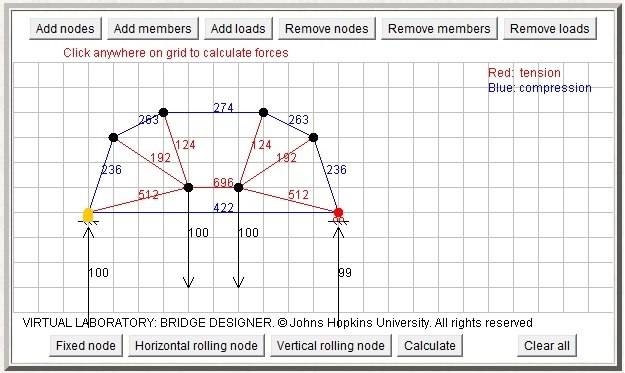
So naturally both myself and my students are curious why some designs cause this. I am familiar with truss analysis using the method of joints, but the software appears to use some kind of matrix to do the calculations all at once. I was wondering if anyone had insight into how this software might do its calculations.
My guess is that it can only accurately handle simple trusses.
Recently, some designs have been causing extremely large forces to be reported. For example, a 200 load causing forces of 500+ in multiple members. A screenshot of the design which causes this is below.
So naturally both myself and my students are curious why some designs cause this. I am familiar with truss analysis using the method of joints, but the software appears to use some kind of matrix to do the calculations all at once. I was wondering if anyone had insight into how this software might do its calculations.
My guess is that it can only accurately handle simple trusses.