Why doesn't Rubidium decay to Strontium?

Click For Summary
SUMMARY

Rubidium-87 (87Rb) beta decays to Strontium-87 (87Sr) with a half-life of approximately 4.8 x 10¹⁰ years, indicating its stability despite being a naturally occurring isobar. The most stable atomic number (Z) for a given mass number (A) is calculated as Z0 = (2γA)/(4γ + εA2/3), yielding Z0 = 38 for A = 87. This stability is attributed to the balance of nuclear forces and the pairing energy, which influences decay rates.

PREREQUISITES
  • Understanding of nuclear physics concepts, specifically beta decay.
  • Familiarity with the stability of isotopes and the concept of half-life.
  • Knowledge of nuclear binding energy and its calculation.
  • Basic comprehension of isobars and their significance in nuclear reactions.
NEXT STEPS
  • Research the nuclear decay processes of other isotopes, such as Uranium-235 and Vanadium-50.
  • Study the calculations of nuclear binding energy and its implications on stability.
  • Explore the role of pairing energy in nuclear stability and decay rates.
  • Investigate the applications of beta decay in radiometric dating and nuclear medicine.
USEFUL FOR

Physicists, nuclear engineers, and students studying nuclear chemistry who seek to understand the stability and decay processes of isotopes like Rubidium-87 and their implications in various scientific fields.

unscientific
Messages
1,728
Reaction score
13
Both ##^{87}_{37}Rb## and ##^{87}_{38}Sr## are odd-even nuclei, so we can ignore the pairing term ##\delta##. I tried to calculate the most stable Z for a given A by finding ##\frac{\partial B}{\partial Z} = 0##. That gives the most Z-stable value of ##Z_0 = \frac{2\gamma A}{4\gamma + \epsilon A^{\frac{2}{3}}}## which is ##38## for ##A=87##.
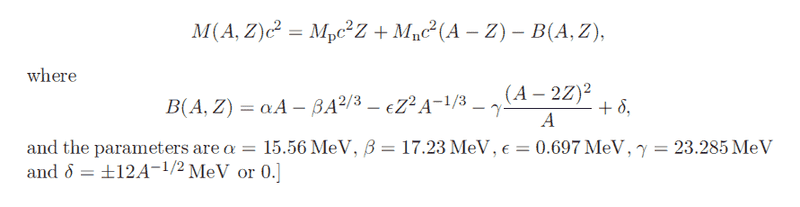
image.png


If that's the case, then why wouldn't Rb beta decay to Strontium as these are naturally occurring isobars.
 
Physics news on Phys.org
unscientific said:
why wouldn't Rb beta decay to Strontium

87Rb does, in fact, beta-decay with a half-life of about 4.8 x 10¹⁰ years. See e.g. http://www.nndc.bnl.gov/chart/
 
jtbell said:
87Rb does, in fact, beta-decay with a half-life of about 4.8 x 10¹⁰ years. See e.g. http://www.nndc.bnl.gov/chart/

Then why is it so stable with such a long half-life?
 
unscientific said:
Then why is it so stable with such a long half-life?

What do you think it's half life should be?
 
Vanadium 50 said:
What do you think it's half life should be?

My question is since it is more stable to undergo beta decay, why doesn't it undergo decay quicker? For example uranium 235's half life is 10 times shorter.
 
unscientific said:
For example uranium 235's half life is 10 times shorter.

And Vanadium-50's is a million times longer. What do you think it's half life should be?
 
  • Like
Likes   Reactions: unscientific
Vanadium 50 said:
And Vanadium-50's is a million times longer. What do you think it's half life should be?
I get your point.
 

Similar threads

  • · Replies 20 ·
Replies
20
Views
3K
  • · Replies 3 ·
Replies
3
Views
4K
  • · Replies 1 ·
Replies
1
Views
2K
  • · Replies 5 ·
Replies
5
Views
3K
  • · Replies 23 ·
Replies
23
Views
3K
  • · Replies 7 ·
Replies
7
Views
2K
Replies
1
Views
4K
  • · Replies 1 ·
Replies
1
Views
2K
  • · Replies 2 ·
Replies
2
Views
6K
  • · Replies 3 ·
Replies
3
Views
4K