Appliances Why Doesn't the M6 Knob Tighten Properly?

  • Thread starter Thread starter tirelessphoenix
  • Start date Start date
  • Tags Tags
    Screw
Click For Summary
SUMMARY

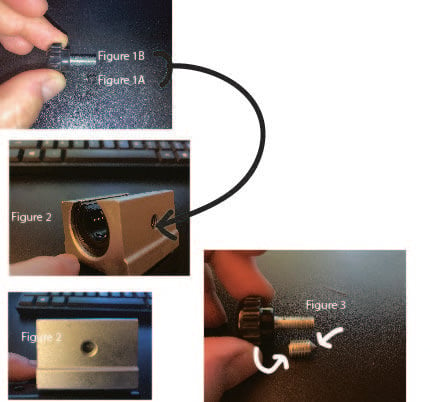
The discussion centers on the difficulties encountered when replacing an M6 knob screw (Figure 1B) with an original M6 screw (Figure 1A) that tightens effectively. Users identified that the threads of the replacement knob may not match the original, potentially due to differences in thread pitch or quality. Suggestions include grinding the end of the knob to create a pointy tip, using tools such as a Dremel or angle grinder, and verifying thread compatibility. Additionally, it was noted that specialized pointed M6 setscrews are available from suppliers like McMaster-Carr.

PREREQUISITES
  • Understanding of screw thread types and pitches, specifically M6 and imperial threads.
  • Familiarity with basic machining tools such as grinders, Dremel tools, and taps/dies.
  • Knowledge of materials used in screws and their applications.
  • Ability to assess thread compatibility between different screws.
NEXT STEPS
  • Research the specifications and availability of pointed M6 setscrews from suppliers like McMaster-Carr.
  • Learn about thread pitch measurement and compatibility checking techniques.
  • Explore grinding techniques for small screws using tools like Dremel or bench grinders.
  • Investigate the properties of materials used in screws to determine appropriate applications.
USEFUL FOR

This discussion is beneficial for DIY enthusiasts, machinists, and engineers who are dealing with screw replacements, particularly in precision applications where thread compatibility and screw design are critical.

tirelessphoenix
Messages
36
Reaction score
7
TL;DR
help with knob screws
hi, I am having an issue with a knob-like screw. the original screw, seen in figure 1 A tigthens the hole in the figure 2 very good, but I tried to replace it with a knob like the one in Figure 1B, but it does not tighten right. both are an M6 type. I tried similar knobs like Figure 1B in sizes M5, M4 but are too thin. Does anyone know why Figure 1A screw tightens good but not the one shown in Figure1B? even both appear to be from same size and get into the whole ok?
Does anyone know if a knob of M6 size with a pointy ending like shown in Figure 3 exists? I don't know how to search it...what name to use...
thank you
TP
Figure.jpg
 
Last edited by a moderator:
Physics news on Phys.org
tirelessphoenix said:
TL;DR Summary: help with knob screws

Does anyone know if a knob of M6 size with a pointy ending like shown in Figure 3 exists?
There is no special name, and the knobs are not commonly available with special ends. You will need to grind a point onto the end of the thread.

The knobs tend to have a poorly formed thread at the end. They have a hollow in the end because the thread is rolled, not cut. That makes the thread easy to start, but a sloppy fit. Grind, or cut off, maybe the five end threads, then grind or file a shallow point or ball onto the end.
 
  • Like
Likes Rive and sysprog1
I understand. Which machine does the grinding best?
 
Angle grinder?
 
Take care while grinding the thread, if holding the knob by hand.

If you only need to grind one, use a grindstone or a linishing machine.
Another possibility would be an angle grinder, or a Dremel tool.

If you do not have the tools, find a local car mechanic who should be able to do the job quickly.

A hand held file would do the job if it was all you had.
 
Yes, but a Dremel tool would be more use and less cost for other small jobs.

You might attach the knob to a solid structure before using the grinder, or attach the grinder before holding and controlling the knob by hand.
 
ok
 
tirelessphoenix said:
the original screw, seen in figure 1 A tigthens the hole in the figure 2 very good, but I tried to replace it with a knob like the one in Figure 1B, but it does not tighten right. both are an M6 type.
Could be possible that the original screw is 1/4"-28 crests per inch rather than M6-1.0 mm?
 
  • Like
Likes BillTre and Tom.G
  • #10
Lnewqban said:
Could be possible that the original screw is 1/4"-28 crests per inch rather than M6-1.0 mm?
Here is how to tell.

Hold onto the knobs, hold the original in one hand and the replacement in the other.
Bring them together side by side so the full length of the threads of one mesh with the threads of the other one.

If the threads do not mesh perfectly uniform over their full length, then they are different threads.

The other possibility is that the item with the female thread is damaged and the original threaded knob is worn enough to mostly work.

Cheers,
Tom

p.s. Differing male+female threads often mate 1/8 to 1 turn then stop, that is another clue.
 
  • Like
Likes BillTre and Lnewqban
  • #11
tirelessphoenix said:
I understand. Which machine does the grinding best?
Filer/sandpaper and electric drill/screwdriver. Fix your knob into the drill and set it to (very) low speed.
Put a nut on the knob first, so you can fix the thread just by removing it.

Baluncore said:
The knobs tend to have a poorly formed thread at the end.
Also, that plastic 'knob' part just makes it convenient to be used by hand, but usually not really helpful with torque and precision.
 
  • #13
perfect
 
  • #14
jack action said:
Grinding small screws:
I think the point needs to be precisely centered for this role.
 
  • #15
What does "precisely" mean quantitatively? How good is your handiwork? If you can rotate the piece while grinding this can be quite precise.... or touch it up at the finish somehow by rotation.
 
  • #16
Rive said:
I think the point needs to be precisely centered for this role.
My bench grinder has a guide for grinding drill bits. You can see it in the image from my previous post, but you see it better in this next image.

It might be more difficult to use with a short screw - especially with a large head - but I'm sure a resourceful person will manage to find a way to make it work.

fb5bfbfc80fa7cf61d7f4c44e6e7b3b1.jpg
 
  • Like
  • Informative
Likes berkeman, Tom.G and BillTre
  • #17
Rive said:
I think the point needs to be precisely centered for this role.
You can chuck it into a drill and turn it while against the grind stone. Thread a nut on to improve the grip.
 
  • Like
Likes jack action
  • #18
tirelessphoenix said:
TL;DR Summary: help with knob screws

but it does not tighten right. both are an M6 type.
Are you sure that the pitch of the threads is the same / appropriate for the thread in the hole? (Sorry, this has been said already but it could be highly relevant!)

If you want to make sure of threads matching (or just cleaning up) then why not get hold of the right size and pitch die and tap (Cheap versions will do).

Why not contact the manufacturer and find out the actual thread dimensions. Are you absolutely sure that the thread is metric? There are many other alternatives (especially in US) and some threads are still used for specialist purposes. Do some homework before further machining effort.
 
  • #19
IMG_1628.jpg
IMG_1627.jpg

thank you for all the comments, but I tried the angle grinder and is not effective. Does anyone know if there is a special tool to create this pointy thing in a reproducible manner? Any tool or cap that would insert into the end of the tip and make it pointy grinding it? thank you
 
  • #20
Possibly you could reconfigure a valve grinder to do something like that.
 
  • #21
but does anyone know whoever did this point thread, what machine they might have used? its very symmetrical.
 
  • #22
You can buy metric setscrews with pointed ends:

Setscrews.jpg


And you can buy knobs in a variety of sizes and shapes to fit the metric setscrew:

Knobs.jpg

Buy a setscrew and a knob, put some Loctite or 5 minute epoxy into the knob, and screw in the setscrew. McMaster-Carr has pointed tip M6 setscrews in lengths from 6 to 60 mm, so you should be able to find a length that works.

The above images are screenshots from the McMaster-Carr catalog: https://www.mcmaster.com/. McMaster-Carr is THE best source for DIY people looking for small parts. They are an industrial supplier that specialize in small orders, and do not care if the customer is a big company or an individual.
 
  • Like
  • Informative
Likes Nik_2213, hutchphd, berkeman and 1 other person
  • #23
thank you. this might be helpful. I really appreciate the input. But still: how they make the cone-point screws?
 
  • #24
Averagesupernova said:
You can chuck it into a drill and turn it while against the grind stone. Thread a nut on to improve the grip.
Something like I described in the above quote I would assume except properly fixtured similar to a valve grinder.
 
  • #25
You can likely purchase them at any local Hardware store. Are you certain the set screw is faulty and not the (tapped) hole into which it threads?? Check each for stripped threads.
 
  • #26
  • #27
tirelessphoenix said:
but does anyone know whoever did this point thread, what machine they might have used? its very symmetrical.
Because it has a socket head, it cannot be produced from a long bar in a repetition lathe. It will need to have the hex socket formed hot, then the thread rolled and material heat treated.

I would lock a couple of hexagonal nuts onto the thread, then hold it by those nuts in the three-jaw chuck of a lathe. I would then cut the conical point in the hardened material with a carbide cutter.

An alternative would be to use a cylindrical grinder, rather than a lathe.

How many do you need?
 
  • #28
tirelessphoenix said:
TL;DR Summary: help with knob screws

the original screw, seen in figure 1 A tigthens the hole in the figure 2 very good, but I tried to replace it with a knob like the one in Figure 1B, but it does not tighten right.
Why do you need to replace the short M6 grub screw with a knob? Is it just for convenience? The fact that they use a grub screw in the clamp(?) could imply:
1. that it shouldn't need frequent adjusting or
2. that a strong clamping force is needed to bite into the tube(?)
What material does the 'pointy' screw bite into? The block appears to be cast alloy and its U shape implies that not great clamping force is involved. Are there any marks on the part that the screw bites into?

I appreciate that many of the solutions proposed on the thread may be daunting or even dangerous without safety goggles (!!!). What are you using to tighten the grub screw at present? If it's an L shaped allen key then that can be fiddly. Hex drivers of all sizes are available with screwdriver type handles. It looks like a 3mm drive is what your screw needs. Pop down to your local hardware store (or auto repair) store and , at least partially, solve your prob.
 
  • #29
tirelessphoenix said:
Does anyone know if there is a special tool to create this pointy thing in a reproducible manner?
If you don't like the jig I've shown in post #16, make a better one:

 
  • #30
jack action said:
If you don't like the jig I've shown in post #16, make a better one:
Set screws of all shapes and sizes are available cheaply so why bother to try making one? The problem seems to be in putting a point on a plastic headed bolt. (did I get that right?). Despite all these posts, I am not clear about what's actually needed and what is going wrong. IS there really a need for a pointed screw? What materials ar involved (hard / soft metal?). Would a small pellet of plastic / lead / alloy, at the bottom of the hole, do a sufficient gripping job?
Do the threads actually match between the working (?) set screw and the candidate replacement that's been tried. Do they mate perfectly when laid next to each other? Imperial threads can often mimic metric threads. They ought not to be allowed these days in non specialist applications Napoleon would turn in his grave.
I appreciate that the OP is not as familiar with these things as some of the PF helpers but the manufacturers and small local engineering firms will know exactly what's needed.
 

Similar threads

  • · Replies 15 ·
Replies
15
Views
10K
  • · Replies 1 ·
Replies
1
Views
3K
  • · Replies 2 ·
Replies
2
Views
3K
Replies
2
Views
9K
  • · Replies 2 ·
Replies
2
Views
10K
  • · Replies 2 ·
Replies
2
Views
2K
  • · Replies 1 ·
Replies
1
Views
7K
Replies
28
Views
4K
Replies
1
Views
4K
  • · Replies 2 ·
Replies
2
Views
4K