Why don't humans glow in the dark?

Click For Summary
SUMMARY

Humans emit energy at a rate of 762 J/s according to the Stefan-Boltzmann Law, primarily in the far infrared (IR) range, which is invisible to the human eye. While the metabolic energy produced by humans is typically below 100 J/s, the body does emit energy that is detectable by specialized infrared cameras. Additionally, nocturnal animals can perceive this emission, suggesting that humans do "glow" in the dark, albeit in a spectrum not visible to us. The surrounding environment's temperature also affects the perception of this emission.

PREREQUISITES
  • Understanding of the Stefan-Boltzmann Law
  • Knowledge of infrared radiation and its properties
  • Basic principles of human metabolism and energy emission
  • Familiarity with the concept of emissivity
NEXT STEPS
  • Research the Stefan-Boltzmann Law and its applications in thermodynamics
  • Explore the properties of infrared radiation and its detection methods
  • Study human metabolic rates and energy balance
  • Investigate the sensory capabilities of nocturnal animals and their perception of infrared emissions
USEFUL FOR

Physicists, biologists, and anyone interested in the principles of thermodynamics, human physiology, and animal sensory perception.

blizzardof96
Messages
21
Reaction score
0
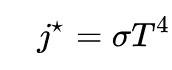
Lets assume:
emissivity of a human=0.91
T=310K
Surface area body: 1.60 m^2

If we use the Stefan-Boltzmann Law we can find a value for the rate of emission of light by a human.
Screen Shot 2018-09-27 at 4.20.48 PM.png


Rate emission=762 J/s

Given this rate of emission, why don't humans glow in the dark?
 

Attachments

  • Screen Shot 2018-09-27 at 4.20.48 PM.png
    Screen Shot 2018-09-27 at 4.20.48 PM.png
    726 bytes · Views: 856
Physics news on Phys.org
blizzardof96 said:
Given this rate of emission, why don't humans glow in the dark?

The EM radiation emitted by humans is almost entirely in the far IR range. Hence we can't see it except on special IR cameras.
 
  • Like
Likes   Reactions: davenn
blizzardof96 said:
Rate emission=762 J/s
That looks a bit high. The energy produced by human metabolism is if I recall properly typically somewhere a bit below 100 J/s, and at equilibrium (that is, not on the way to heatstroke or hypothermia) the energy ou has to equal the energy generated.

But in any case, @Drakkith has the answer. The human body emits energy, and we don't glow in the dark because we're aren't hot enough to radiate visible light - it's all infrared, which our eyes don't pick up.
 
  • Like
Likes   Reactions: tech99
Nugatory said:
That looks a bit high. The energy produced by human metabolism is if I recall properly typically somewhere a bit below 100 J/s, and at equilibrium (that is, not on the way to heatstroke or hypothermia) the energy ou has to equal the energy generated.

Does this take into account the fact that we're surrounded by an environment of approximately equal temperature that's radiating back at us, so we're not actually losing that much energy?
 
  • Like
Likes   Reactions: russ_watters
And of course the body also radiates microwaves, especially my brain, I found. It has been suggested that our own microwave emission exceeds safety limits!
 
  • Like
Likes   Reactions: berkeman
Drakkith said:
Does this take into account the fact that we're surrounded by an environment of approximately equal temperature that's radiating back at us, so we're not actually losing that much energy?
Ah - you're right - thx.
 
blizzardof96 said:
Given this rate of emission, why don't humans glow in the dark?

They do! Your eye is a poor detector that cannot detect this "glow".

And oh, wait till you find out that the human body, on average, also emits about 0.3 mSv per year from the radionuclides in our bodies. We definitely "glow in the dark"!

Zz.
 
+1
And a number of nocturnal animals can 'see' the bodies of mammals under conditions that humans would describe as darkness. See this link about various snakes that hunt at night. As far as these snakes re concerned, we "glow".
 
  • Like
Likes   Reactions: pinball1970

Similar threads

  • · Replies 16 ·
Replies
16
Views
6K
  • · Replies 3 ·
Replies
3
Views
2K
  • · Replies 3 ·
Replies
3
Views
969
  • · Replies 17 ·
Replies
17
Views
4K
  • · Replies 14 ·
Replies
14
Views
2K
  • · Replies 7 ·
Replies
7
Views
827
  • · Replies 5 ·
Replies
5
Views
2K
  • · Replies 10 ·
Replies
10
Views
3K
  • · Replies 4 ·
Replies
4
Views
3K
  • · Replies 10 ·
Replies
10
Views
3K