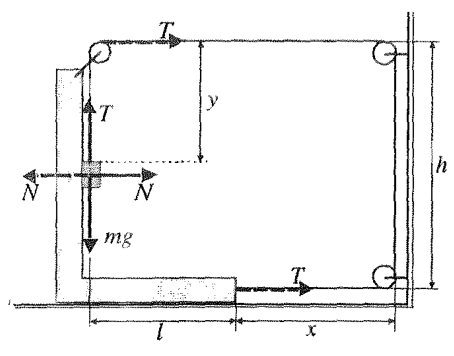
Why is 2Δx = Δy in this problem?

  • Thread starter Thread starter UniqUnicJohni
  • Start date Start date
Click For Summary
SUMMARY

The discussion focuses on the relationship between the displacements in a pulley system, specifically why 2Δx = Δy. Participants emphasize the importance of visualizing the setup and identifying which segments of the rope change length when the system is altered by Δx. They highlight that some pulleys function solely to change the direction of the rope, while others reduce the effort required to lift a load, effectively doubling the length of rope needed to achieve a certain vertical displacement.

PREREQUISITES
  • Understanding of basic pulley mechanics
  • Familiarity with displacement notation (Δx and Δy)
  • Knowledge of vector directionality in physics
  • Ability to draw and interpret free-body diagrams
NEXT STEPS
  • Study the mechanics of different types of pulleys
  • Learn how to draw and analyze free-body diagrams in pulley systems
  • Explore the principles of mechanical advantage in simple machines
  • Investigate the role of tension in rope systems
USEFUL FOR

Students preparing for physics competitions, educators teaching mechanics, and anyone interested in understanding the dynamics of pulley systems.

UniqUnicJohni
Messages
1
Reaction score
0
Homework Statement
Find accelerations of the two bodies.
Relevant Equations
Constant rope length.
Hi, I've been practicing some physics for my competition and the pulley problems seemed the hardest to me. This one seemed similar to the others I have already done, but I can't seem to find the reason why 2Δx = Δy. Can you please explain why?

Sorry for the poor English.
screen.png
 
Physics news on Phys.org
What happens if you draw another picture showing the situation after the system has changed by ##\Delta x##?
 
Hello johni, :welcome: !

UniqUnicJohni said:
Can you please explain why?
Yes.
What I do is draw the setup with a visible ##\Delta x## (e.g. half-way to the wall) and then I check which pieces of rope have changed length.

You also have to worry about signs. Which way is positive in x and y ?

[edit] slower than @PeroK but it's good to see that great minds think alike :wink:
 
UniqUnicJohni said:
... This one seemed similar to the others I have already done, but I can't seem to find the reason why 2Δx = Δy.
All pulleys look alike, but some serve only for changing the direction of the rope/cable/chain, while others act as levers, reducing the pulling effort in half and doubling the length of rope to pull.
Try identifying what type each of the pulleys in your diagram is.

pully4a.gif
 
  • Like
Likes bagasme and vanhees71
Very nice picture !
 
  • Like
Likes Lnewqban
The book claims the answer is that all the magnitudes are the same because "the gravitational force on the penguin is the same". I'm having trouble understanding this. I thought the buoyant force was equal to the weight of the fluid displaced. Weight depends on mass which depends on density. Therefore, due to the differing densities the buoyant force will be different in each case? Is this incorrect?

Similar threads

  • · Replies 4 ·
Replies
4
Views
2K
  • · Replies 7 ·
Replies
7
Views
847
  • · Replies 6 ·
Replies
6
Views
2K
Replies
7
Views
2K
  • · Replies 2 ·
Replies
2
Views
2K
Replies
3
Views
944
Replies
2
Views
1K
  • · Replies 3 ·
Replies
3
Views
3K
  • · Replies 10 ·
Replies
10
Views
2K
Replies
3
Views
1K