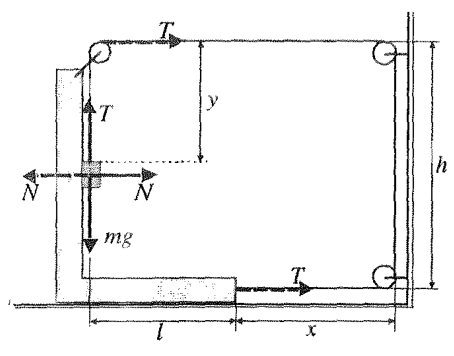
Why is 2Δx = Δy in this problem?

  • Thread starter Thread starter UniqUnicJohni
  • Start date Start date
Join the discussion
Ask a follow-up here, or get your own question answered by working scientists, mathematicians and engineers — people, not an autocomplete.
Real named experts · corrections over time · the nuance an AI answer skips
4 replies · 1K views
UniqUnicJohni
Messages
1
Reaction score
0
Homework Statement
Find accelerations of the two bodies.
Relevant Equations
Constant rope length.
Hi, I've been practicing some physics for my competition and the pulley problems seemed the hardest to me. This one seemed similar to the others I have already done, but I can't seem to find the reason why 2Δx = Δy. Can you please explain why?

Sorry for the poor English.
screen.png
 
Physics news on Phys.org
Hello johni, :welcome: !

UniqUnicJohni said:
Can you please explain why?
Yes.
What I do is draw the setup with a visible ##\Delta x## (e.g. half-way to the wall) and then I check which pieces of rope have changed length.

You also have to worry about signs. Which way is positive in x and y ?

[edit] slower than @PeroK but it's good to see that great minds think alike :wink:
 
UniqUnicJohni said:
... This one seemed similar to the others I have already done, but I can't seem to find the reason why 2Δx = Δy.
All pulleys look alike, but some serve only for changing the direction of the rope/cable/chain, while others act as levers, reducing the pulling effort in half and doubling the length of rope to pull.
Try identifying what type each of the pulleys in your diagram is.

pully4a.gif
 
  • Like
Likes   Reactions: bagasme and vanhees71
