Discussion Overview
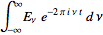
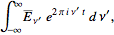
The discussion centers on the application of Plancherel's Theorem in the context of Fourier Transforms, specifically addressing the multiplication of the function E(t) by e^(-ix) in the proof. Participants explore the implications of this multiplication and its relation to complex conjugates, as well as the properties of integrals in the context of variable changes.
Discussion Character
- Technical explanation
- Mathematical reasoning
- Debate/contested
Main Points Raised
- One participant questions why E(t) is multiplied by e^(-ix), suggesting it may relate to the conjugate of e^(ix) but expresses uncertainty.
- Another participant explains that the first equation in the proof derives from the definition of Fourier Transform pairs and mentions the theorem regarding the inverse Fourier transform.
- A different participant presents a counterexample involving a change of variables in integrals, indicating confusion about the application of the integral equality suggested by the previous participant.
- A subsequent reply clarifies that the equation discussed is meant for definite integrals and acknowledges an inaccuracy in the initial statement regarding variable changes in integrals.
Areas of Agreement / Disagreement
Participants express differing views on the application of integral properties and the implications of variable changes, indicating that the discussion remains unresolved regarding the specific mathematical interpretations and applications.
Contextual Notes
Limitations include potential misunderstandings of integral properties, the need for clarity on variable changes, and the specific conditions under which the equations apply.