Why is it that cocaine crystals aren't transparent

Click For Summary
SUMMARY

The discussion centers on the transparency of cocaine crystals in relation to their purity. High-purity cocaine, often appearing as shiny, pearly flakes, is not transparent, which contradicts the assumption that pure crystals are always transparent. Participants clarify that "high purity" in chemistry typically refers to purity levels above 99%, and factors such as light absorption, reflection, and the presence of small, loosely connected crystals can affect transparency. The conversation also highlights that the visual appearance of substances, including gemstones, can be influenced by inclusions and other characteristics, which do not necessarily correlate with purity.

PREREQUISITES
  • Understanding of organic chemistry concepts, particularly recrystallization.
  • Knowledge of crystal structures and properties, including light interaction.
  • Familiarity with purity measurements in chemistry, specifically >99% purity standards.
  • Basic awareness of gemstones and their clarity factors, such as inclusions.
NEXT STEPS
  • Research the principles of recrystallization in organic chemistry.
  • Study the optical properties of crystals, focusing on light absorption and reflection.
  • Explore the significance of purity levels in various substances, including drugs and gemstones.
  • Investigate the effects of crystal size and structure on transparency and appearance.
USEFUL FOR

This discussion is beneficial for chemistry students, organic chemists, and individuals interested in the physical properties of substances, particularly in relation to purity and appearance in both drugs and gemstones.

Siber
Messages
2
Reaction score
0
So I admittedly was a former cocaine user. I've since cleaned up and am back in school and my life is going in the right direction for once. I took a class in organic chemistry this previous semester and we did a lab on recrystallization. I think it was boric acid that I recrystallized, but I remember reading before that transparent crystals tend to be the purest.

Anyway, one thing about cocaine is that when it is of very high quality (high purity), it is composed of pearly flakes which are not transparent at all. They look silverish, like aluminum. Very shiny. Why is it that cocaine crystals, when they're of high purity, aren't transparent but other crystals are? This seems counter-intuitive to me.
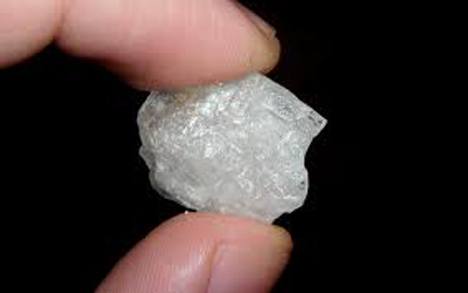
Crystal1.jpg
 
Last edited by a moderator:
Chemistry news on Phys.org
Siber said:
before that transparent crystals tend to be the purest.
... and, your question is what? Physiological effects are unrelated to "purity/quality" as you seem to think. "Quality" does not imply purity.
 
Bystander said:
... and, your question is what? Physiological effects are unrelated to "purity/quality" as you seem to think. "Quality" does not imply purity.

You seem to be saying that just because a user thinks the product is high quality, doesn't mean its purity is high. This may be correct, but drug seizures easily reach into the high 80%'s to lower 90%'s for purity, yet the product is still pearl flakes. This still leaves me asking, why aren't these high purity crystals transparent, like high purity crystals of other substances?

EDIT: I'm actually looking at pictures right now of crystals of substances (like gemstones for example), which are pure, but aren't transparent. Am I incorrect in my assumption that a pure crystal must be a transparent one?
 
Siber said:
Am I incorrect in my assumption that a pure crystal must be a transparent one?

Yes. Metals are composed of tiny crystals, for example.

Also, while 90% may be 'high purity' to a junkie, it's not to a chemist. >99% is not uncommon.
 
"High purity" in chemistry is more like 99.999%.

Even with 100% purity, there are two things that can make the material intransparent:
- the crystal itself can absorb or reflect visible light. Every metal is an example.
- the material can be made out of many small crystals that are loosely connected. Light can be scattered at every border between those crystals, and the material looks white. Snow is an example: the individual ice crystals are transparent, but you have to many surfaces that scatter light that snow does not look clear. Compressed to solid ice with larger and more compact crystals it gets transparent again.
 
  • Like
Likes   Reactions: Ygggdrasil
Material also can include impurities with other refractive index.
 
This brings to my mind something else that is expensive, namely gemstones. Rubies should be very clear and transparent when without any fractures in them, but almost always there are so called "inclusions", which are small fractures inside the stone and make it less transparent:

V_Q1.jpg


Of course, the expensiveness of those gemstones can vary greatly depending on the clearness of their appearance. In the case of drugs, the appearance of the material doesn't usually matter much, though.
 
You should try to recrystallize it and cool it very slowly.
 

Similar threads

Replies
1
Views
2K
  • · Replies 8 ·
Replies
8
Views
4K
  • · Replies 1 ·
Replies
1
Views
7K
  • · Replies 2 ·
Replies
2
Views
4K
  • · Replies 32 ·
2
Replies
32
Views
7K
  • · Replies 13 ·
Replies
13
Views
3K
  • · Replies 12 ·
Replies
12
Views
6K
  • · Replies 4 ·
Replies
4
Views
3K