Why Is Tension Equal in a Frictionless and Massless Pulley System?

Click For Summary
SUMMARY

The tension in a frictionless and massless pulley system is constant throughout the rope, meaning the tension T pulling both masses m and M is equal. This equality arises from Newton's third law, which states that the force exerted by mass m on mass M is equal in magnitude and opposite in direction to the force exerted by mass M on mass m. If the pulley has mass or a moment of inertia, the tensions will differ. Thus, in ideal conditions, T remains the same regardless of the weights of m and M.

PREREQUISITES
  • Understanding of Newton's Third Law of Motion
  • Basic principles of tension in physics
  • Concept of frictionless systems
  • Knowledge of mass and weight relationships
NEXT STEPS
  • Study the effects of pulley mass on tension differences
  • Explore real-world applications of frictionless pulley systems
  • Learn about the dynamics of non-frictionless pulleys
  • Investigate the role of mass moment of inertia in pulley systems
USEFUL FOR

Physics students, educators, and anyone interested in understanding the mechanics of pulley systems and tension forces in classical mechanics.

jasonpeng
Messages
19
Reaction score
0
I've got a problem with understanding the pulley system.

In a basic pulley, if the force pulling M upwards is T, and the force pulling m upwards is also T, why is it that T is equal for both m & M? For some reason I feel inclined to believe that the T pulling m upwards is equal to the weight of M, and the T pulling M upwards is equal to the weight of m. Is that right or wrong? Why?
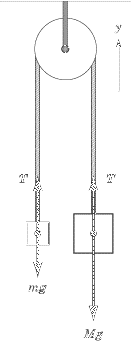
pulleyFBD.gif
 
Physics news on Phys.org
I believe this relates to Newton's third law. If mass m is pulling on mass M with a certain force, M must be pulling on m with the same magnitude since the tension in the rope must be constant (ignoring friction).

Imagine an object hanging from the ceiling. The mass of the object itself would influence the magnitude of the upward force which is being exerted on the mass by the rope (the tension). This is because the magnitude of the force which the mass applies on the ceiling is the same as that which the ceiling applies on the mass. The same should hold true for the pulley (the force which m applies on M is the same magnitude as that which M applies on m).

I hope all of this was both correct and clear.
 
Last edited:
jasonpeng said:
I've got a problem with understanding the pulley system.

In a basic pulley, if the force pulling M upwards is T, and the force pulling m upwards is also T, why is it that T is equal for both m & M? For some reason I feel inclined to believe that the T pulling m upwards is equal to the weight of M, and the T pulling M upwards is equal to the weight of m. Is that right or wrong? Why?
View attachment 205103

If you fixed the top of the string, then you would have equilibrium. The tension on the right would support mass M and the tension on the left would suppose mass m.

However, if the string is not attached to anything (and there is no friction on the pulley), then the tension must be constant throughout. In this case, assuming mass M is larger, it will fall and pull the lower mass m upwards.
 
  • Like
Likes   Reactions: vanhees71
PeroK said:
However, if the string is not attached to anything (and there is no friction on the pulley), then the tension must be constant throughout. In this case, assuming mass M is larger, it will fall and pull the lower mass m upwards.

This is correct, provided that the pulley is massless. If there is mass, and more specifically a mass moment of inertia for the pulley, the tensions will not be equal on both sides.
 
  • Like
Likes   Reactions: vanhees71, person123 and PeroK

Similar threads

  • · Replies 18 ·
Replies
18
Views
2K
  • · Replies 31 ·
2
Replies
31
Views
5K
  • · Replies 16 ·
Replies
16
Views
3K
  • · Replies 4 ·
Replies
4
Views
3K
  • · Replies 5 ·
Replies
5
Views
3K
  • · Replies 20 ·
Replies
20
Views
869
  • · Replies 9 ·
Replies
9
Views
717
  • · Replies 3 ·
Replies
3
Views
2K
  • · Replies 9 ·
Replies
9
Views
3K
  • · Replies 38 ·
2
Replies
38
Views
2K