Why Is Tension Equal in a Frictionless and Massless Pulley System?

Click For Summary

Discussion Overview

The discussion revolves around the mechanics of a frictionless and massless pulley system, specifically addressing why the tension is equal for both masses involved. Participants explore the implications of Newton's laws and the conditions under which tension remains constant.

Discussion Character

  • Technical explanation, Conceptual clarification, Debate/contested

Main Points Raised

  • One participant questions why the tension T is equal for both masses m and M, suggesting a belief that T might equal the weight of the opposing mass.
  • Another participant relates the situation to Newton's third law, asserting that the forces between the two masses must be equal, thus implying constant tension in the rope.
  • A later reply reiterates the need for constant tension in a frictionless scenario, noting that if the pulley has mass, the tensions would not be equal.
  • Participants discuss the implications of attaching the string to a fixed point, suggesting that equilibrium would change the dynamics of tension.

Areas of Agreement / Disagreement

There is no consensus on the understanding of tension in the pulley system, with some participants agreeing on the principle of constant tension in a frictionless and massless scenario, while others introduce conditions that could alter this conclusion.

Contextual Notes

Participants express uncertainty regarding the effects of mass and friction on the tension in the system, and the discussion includes assumptions about the conditions of the pulley and the masses involved.

jasonpeng
Messages
19
Reaction score
0
I've got a problem with understanding the pulley system.

In a basic pulley, if the force pulling M upwards is T, and the force pulling m upwards is also T, why is it that T is equal for both m & M? For some reason I feel inclined to believe that the T pulling m upwards is equal to the weight of M, and the T pulling M upwards is equal to the weight of m. Is that right or wrong? Why?
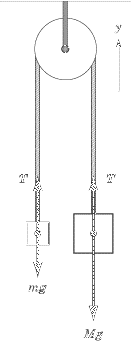
pulleyFBD.gif
 
Physics news on Phys.org
I believe this relates to Newton's third law. If mass m is pulling on mass M with a certain force, M must be pulling on m with the same magnitude since the tension in the rope must be constant (ignoring friction).

Imagine an object hanging from the ceiling. The mass of the object itself would influence the magnitude of the upward force which is being exerted on the mass by the rope (the tension). This is because the magnitude of the force which the mass applies on the ceiling is the same as that which the ceiling applies on the mass. The same should hold true for the pulley (the force which m applies on M is the same magnitude as that which M applies on m).

I hope all of this was both correct and clear.
 
Last edited:
jasonpeng said:
I've got a problem with understanding the pulley system.

In a basic pulley, if the force pulling M upwards is T, and the force pulling m upwards is also T, why is it that T is equal for both m & M? For some reason I feel inclined to believe that the T pulling m upwards is equal to the weight of M, and the T pulling M upwards is equal to the weight of m. Is that right or wrong? Why?
View attachment 205103

If you fixed the top of the string, then you would have equilibrium. The tension on the right would support mass M and the tension on the left would suppose mass m.

However, if the string is not attached to anything (and there is no friction on the pulley), then the tension must be constant throughout. In this case, assuming mass M is larger, it will fall and pull the lower mass m upwards.
 
  • Like
Likes   Reactions: vanhees71
PeroK said:
However, if the string is not attached to anything (and there is no friction on the pulley), then the tension must be constant throughout. In this case, assuming mass M is larger, it will fall and pull the lower mass m upwards.

This is correct, provided that the pulley is massless. If there is mass, and more specifically a mass moment of inertia for the pulley, the tensions will not be equal on both sides.
 
  • Like
Likes   Reactions: vanhees71, person123 and PeroK

Similar threads

  • · Replies 18 ·
Replies
18
Views
2K
  • · Replies 31 ·
2
Replies
31
Views
5K
  • · Replies 16 ·
Replies
16
Views
3K
  • · Replies 4 ·
Replies
4
Views
3K
  • · Replies 5 ·
Replies
5
Views
3K
  • · Replies 20 ·
Replies
20
Views
2K
  • · Replies 9 ·
Replies
9
Views
1K
  • · Replies 3 ·
Replies
3
Views
2K
  • · Replies 9 ·
Replies
9
Views
3K
  • · Replies 38 ·
2
Replies
38
Views
2K