Why is the area of a circular cap on a sphere not equal to πr^2?

  • Context: Undergrad 
  • Thread starter Thread starter JohnnyGui
  • Start date Start date
  • Tags Tags
    Area Circular Sphere
Click For Summary
SUMMARY

The area of a circular cap on a sphere is calculated using the formula A = 2πr²(1 - cos(θ/2)), where r is the radius of the cap and θ is the angle in radians. This differs from the area of a flat circle, A = πr², due to the curvature of the sphere, which causes the spherical cap to have a smaller area than its planar counterpart. The discussion emphasizes that the intrinsic curvature of the sphere affects the area measurement, making it less than expected when compared to a flat circle of the same radius. Understanding this concept is crucial for those studying spherical geometry and its applications.

PREREQUISITES
  • Spherical geometry fundamentals
  • Trigonometric functions and their applications
  • Understanding of intrinsic vs. extrinsic curvature
  • Basic calculus for area derivation
NEXT STEPS
  • Study the derivation of the area formula for spherical caps
  • Explore the concept of intrinsic curvature in differential geometry
  • Learn about hyperbolic geometry and its area relationships
  • Investigate applications of spherical geometry in physics and engineering
USEFUL FOR

Mathematicians, physics students, and anyone interested in the properties of spherical surfaces and their geometric implications.

JohnnyGui
Messages
802
Reaction score
51
I had a question regarding calculating the area of a circular cap on a sphere. From what I’ve read, the area should be calculated according to;
$$A = 2πr^2 \cdot (1 – cos (\frac{θ}{2} )$$
However, I have another way but I don’t understand why this isn’t correct.
The circular area can be considered as a bulging base of a cone. The top of the cone emerging from the center of the sphere. Like this:
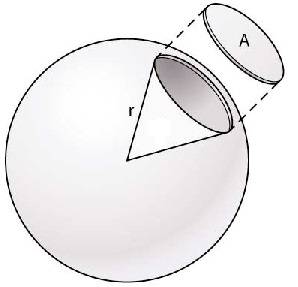
A5steradian5.jpg

If we cut this cone in the middle, we’d get this in a 2D plane:
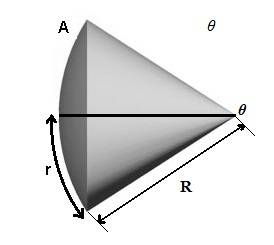
Steradian.jpg

Here, ##r## doesn't have to be equal to ##R##, and ##θ## is in radians. If I divide the angle ##θ## of the cone by 2 and then multiply it by ##R##, I’d get the radius ##r## of the circle cap on the sphere, thus: ##\frac{θR}{2} = r##. And with that radius ##r## of that circle cap, I should be able to calculate its area. What I don’t get now is why the area of that circular cap is then not equal to:
$$π \cdot (\frac{θR}{2})^2$$
Is there a way to explain and prove why a circular cap on a sphere doesn’t have an area equal to ##πr^2##, even though it's a circle?
 
Physics news on Phys.org
JohnnyGui said:
I’d get the radius ##r## of the circle cap on the sphere
It's not a circle (it is not flat).
 
JohnnyGui said:
Is there a way to explain and prove why a circular cap on a sphere doesn’t have an area equal to ##πr^2##, even though it's a circle?
You've correctly calculated the "radius" of a "circle" drawn on the surface of a sphere. If this "circle" were drawn on a flat sheet of paper, this would immediately give us the circumference of the circle as 2 pi times the radius. We could then compute the area of the circle by dividing it up into a bunch of triangles and adding their areas. Ultimately, this means multiplying radius by circumference and dividing by two. That is one way to derive the formula ##a=\pi r^2##.

But this is not a flat sheet of paper. This is the surface of a sphere. If you try to lay a flat piece of paper on top of a sphere, you'll find that the edges of the paper start wrinkling. The circumference of a spherical "circle" is smaller than the circumference of the corresponding planar circle of equal radius. The derivation of the formula for the area of a planar circle no longer works to derive the area of a spherical "circle".
 
JohnnyGui said:
Is there a way to explain and prove why a circular cap on a sphere doesn’t have an area equal to πr2πr^2, even though it's a circle?
Hi Johnny:

I suggest you think about a "cap" that is a whole hemisphere. If the radius of the sphere is R, the the curved radius on the cap is 1/4 of the circumference of the sphere. That is
r = (1/4) ⋅ 2 ⋅ π ⋅ R = (1/2) ⋅ π ⋅ R.

if you use A = π ⋅ r2, you get A = (1/4) π2 ⋅ R2.
As you know the area of the hemisphere is A = 2 ⋅ π R2.

The formula for area A = π ⋅ r2 is valid only for circles on a plane surface. It gives the wrong answer on a curved surface.

Regards,
Buzz
 
jbriggs444 said:
You've correctly calculated the "radius" of a "circle" drawn on the surface of a sphere. If this "circle" were drawn on a flat sheet of paper, this would immediately give us the circumference of the circle as 2 pi times the radius. We could then compute the area of the circle by dividing it up into a bunch of triangles and adding their areas. Ultimately, this means multiplying radius by circumference and dividing by two. That is one way to derive the formula ##a=\pi r^2##.

But this is not a flat sheet of paper. This is the surface of a sphere. If you try to lay a flat piece of paper on top of a sphere, you'll find that the edges of the paper start wrinkling. The circumference of a spherical "circle" is smaller than the circumference of the corresponding planar circle of equal radius. The derivation of the formula for the area of a planar circle no longer works to derive the area of a spherical "circle".

Thanks for your reply. I've indeed imagined the scenario in which if I try to push a circular cap flat, it would tear. Thus, the area of the circular cap with radius ##r## should be smaller than a flat circle with the same radius ##r##, correct?

Buzz Bloom said:
Hi Johnny:

I suggest you think about a "cap" that is a whole hemisphere. If the radius of the sphere is R, the the curved radius on the cap is 1/4 of the circumference of the sphere. That is
r = (1/4) ⋅ 2 ⋅ π ⋅ R = (1/2) ⋅ π ⋅ R.

if you use A = π ⋅ r2, you get A = (1/4) π2 ⋅ R2.
As you know the area of the hemisphere is A = 2 ⋅ π R2.

The formula for area A = π ⋅ r2 is valid only for circles on a plane surface. It gives the wrong answer on a curved surface.

Regards,
Buzz

Thanks, this had made me think outside of the box. I see that in this case the factor between the 2 calculated areas is 4. I take it that factor is not constant between a flat circle with any radius ##r## and a circular cap with a same radius ##r##? Is there a certain relationship that can be formulated between the two, that you know of?
 
JohnnyGui said:
Thus, the area of the circular cap with radius r should be smaller than a flat circle with the same radius r, correct?
Correct.

This is one way of measuring the curvature of a space. If the area of a "circle" is smaller than expected, the space has positive curvature. This is the case for spherical geometries. If the area of a "circle" is larger than expected, the space has negative curvature. This is the case for hyperbolic geometries (saddle shapes).
 
JohnnyGui said:
I see that in this case the factor between the 2 calculated areas is 4
##\pi r^2## (area of flat circle)and ##2 \pi r^2## (surface area of hemisphere) differ by a factor of 2.

Edit: *doh*. Scratch that. I mixed up the r's.

##\pi \frac{\pi r}{2}^2## and ##2 \pi r^2## would be the relevant ratio where r is the radius of the sphere.

JohnnyGui said:
Is there a certain relationship that can be formulated between the two?
Your original post gave a formula for the area of a circular cap. ##a=\pi r^2## is the area for a flat circle. That gives a relationship between the two.
 
jbriggs444 said:
Correct.

This is one way of measuring the curvature of a space. If the area of a "circle" is smaller than expected, the space has positive curvature. This is the case for spherical geometries. If the area of a "circle" is larger than expected, the space has negative curvature. This is the case for hyperbolic geometries (saddle shapes).

This is interesting. Does this mean that the "other" side of the circular cap on the sphere, as if you're looking at it from the inside of the sphere, has a larger surface than when you're looking at it from the outside?

jbriggs444 said:
Your original post gave a formula for the area of a circular cap. a=πr2a=πr2a=\pi r^2 is the area for a flat circle. That gives a relationship between the two.

Wow, ofcourse. I totally had a black out when I asked this question.
 
JohnnyGui said:
This is very interesting. Does this mean that the "other" side of the circular cap on the sphere, as if you're looking at it from the inside of the sphere, has a larger surface than when you're looking at it from the outside?
We are talking about "intrinsic curvature". Intrinsic curvature is an innate part of the geometry. Whether you look at a patch on the surface of a sphere from the inside or the outside, the innate properties of the patch do not change. The intrinsic curvature (as objectively measured by the relationship between area and radius) is positive regardless.

Suppose, for instance, that you draw a circle on a flat piece of paper. Then you roll that piece of paper up into a tube (you can do that without wrinkling or tearing the paper). The area of the circle is unchanged. The intrinsic curvature of the paper is unchanged. Rolling it into a tube changed the extrinsic curvature only.

Extrinsic curvature relates to a particular "embedding" of one geometry in another (for instance, representing a two dimensional geometry on the surface of a three dimensional sphere, on the surface of a three dimensional cylinder or on the surface of a three dimensional saddle shape). Such embeddings can be useful as visualization aids or proof that a geometry is possible. But they are not necessary to work with the geometry. So mathematicians generally consider intrinsic curvature as important and extrinsic curvature as pretty much irrelevant. (Hopefully that's not a false generalization).
 
  • #10
jbriggs444 said:
We are talking about "intrinsic curvature". Intrinsic curvature is an innate part of the geometry. Whether you look at a patch on the surface of a sphere from the inside or the outside, the innate properties of the patch do not change. The intrinsic curvature (as objectively measured by the relationship between area and radius) is positive regardless.

Suppose, for instance, that you draw a circle on a flat piece of paper. Then you roll that piece of paper up into a tube (you can do that without wrinkling or tearing the paper). The area of the circle is unchanged. The intrinsic curvature of the paper is unchanged. Rolling it into a tube changed the extrinsic curvature only.

Extrinsic curvature relates to a particular "embedding" of one geometry in another (for instance, representing a two dimensional geometry on the surface of a three dimensional sphere, on the surface of a three dimensional cylinder or on the surface of a three dimensional saddle shape). Such embeddings can be useful as visualization aids or proof that a geometry is possible. But they are not necessary to work with the geometry. So mathematicians generally consider intrinsic curvature as important and extrinsic curvature as pretty much irrelevant. (Hopefully that's not a false generalization).
Just to make sure I understand. So looking at the circular patch from the inside of the sphere would also give a smaller area compared to pi x r^2 intrinsically? Just like you said that it's intrinsically smaller when looked at it from the outside?
 
  • #11
JohnnyGui said:
Just to make sure I understand. So looking at the circular patch from the inside of the sphere would also give a smaller area compared to pi x r^2 intrinsically?
Yes.

If you measure the surface area of a small "circular" patch on the inside surface of a thin balloon and measure the surface area of the same patch on the outside surface, the two measurements should be the same. Both are less than ##\pi r^2## where r is the "radius" of the patch as measured along the surface of the balloon.

[Assume the balloon is of negligible thickness].
 
  • #12
jbriggs444 said:
Yes.

If you measure the surface area of a small "circular" patch on the inside surface of a thin balloon and measure the surface area of the same patch on the outside surface, the two measurements should be the same. Both are less than ##\pi r^2## where r is the "radius" of the patch as measured along the surface of the balloon.

[Assume the balloon is of negligible thickness].

Ah, ok. I got confused and thought that negative curvature meant looking at the patch from the inside. So to make a circular patch area have a larger area than πr2, it has to be bent in a saddle shape which is obviously not the same as "bending" a circular patch the other way.
 
  • Like
Likes   Reactions: jbriggs444

Similar threads

  • · Replies 3 ·
Replies
3
Views
2K
  • · Replies 4 ·
Replies
4
Views
2K
  • · Replies 7 ·
Replies
7
Views
2K
  • · Replies 2 ·
Replies
2
Views
2K
Replies
3
Views
3K
  • · Replies 4 ·
Replies
4
Views
2K
  • · Replies 8 ·
Replies
8
Views
3K
  • · Replies 7 ·
Replies
7
Views
5K
  • · Replies 2 ·
Replies
2
Views
3K
  • · Replies 4 ·
Replies
4
Views
2K