Why is the driven gear's torque's direction clockwise?

  • Context: Undergrad 
  • Thread starter Thread starter annamal
  • Start date Start date
  • Tags Tags
    Gears Torque
Join the discussion
Ask a follow-up here, or get your own question answered by working scientists, mathematicians and engineers — people, not an autocomplete.
Real named experts · corrections over time · the nuance an AI answer skips
6 replies · 2K views
annamal
Messages
393
Reaction score
33
TL;DR
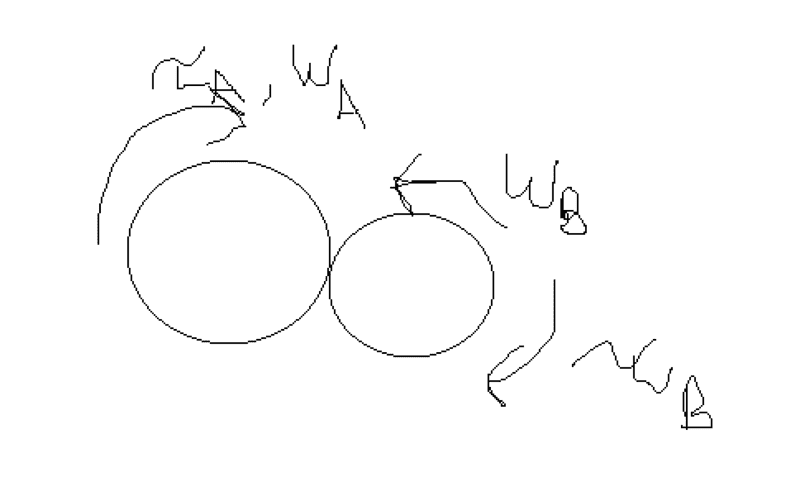
Two gears (A and B) are spinning with their centers fixed with the left one being the driver driving the left gear clockwise. Why is the driven gear (gear B to the right) torque clockwise as well?
We have two gears A and B (left and right). Gear A is driven with a clockwise torque. Why is gear B's torque also clockwise? I would say that if gear B is driven to turn counterclockwise, the torque should be in the counterclockwise direction.
Screenshot 2023-09-12 at 7.09.39 PM.png
 
Physics news on Phys.org
If the left gear is turning clockwise, the right gear will turn counterclockwise. Is the torque you are applying to A against the rotation or something?
 
berkeman said:
If the left gear is turning clockwise, the right gear will turn counterclockwise. Is the torque you are applying to A against the rotation or something?
No. I am applying a torque just to gear A. And apparently the torque for gear B is in the opposite direction because it is some reaction torque to gear A.
 
I assume what's being described is the force applied by gear B to gear A. If gear A applies a force downwards at the point of contact, gear B must be applying a force back against it upwards per Newton's 3rd law.
 
Reply
  • Like
Likes   Reactions: Lnewqban
annamal said:
No. I am applying a torque just to gear A. And apparently the torque for gear B is in the opposite direction because it is some reaction torque to gear A.
Sure, just use the Right-Hand Rule for torques to help you see what is going on. Draw the force and torque vectors for each gear...
$$\vec \tau = \vec R \times \vec F$$
 
Ah. I figured it out. The torque for the right gear is drawn as the load's torque.
 
annamal said:
Ah. I figured it out. The torque for the right gear is drawn as the load's torque.
Correct.
Consider that the magnitude of each torque depends on the diameter (or number of teeth) of each gear.
Only the tangential contact forces mentioned in post #4 are of equal magnitude and opposite directions.

Force (or torque) and resistance to it are always a pair.
We can't talk about a driving torque, unless we have a resisting torque.
In the same way, we can't exert any weight on the floor of a free-falling elevator.

FREE-BODY-DIAGRAM-OF-TWO-GEAR.png