Why is the Velocity Too Fast in My Fluids Momentum Conservation Calculation?

Click For Summary
SUMMARY

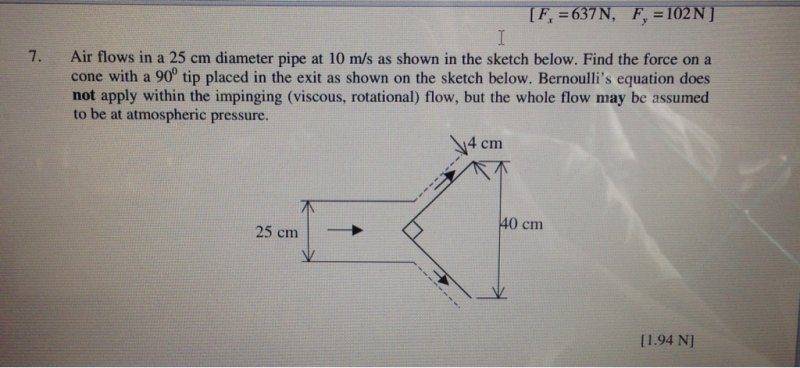
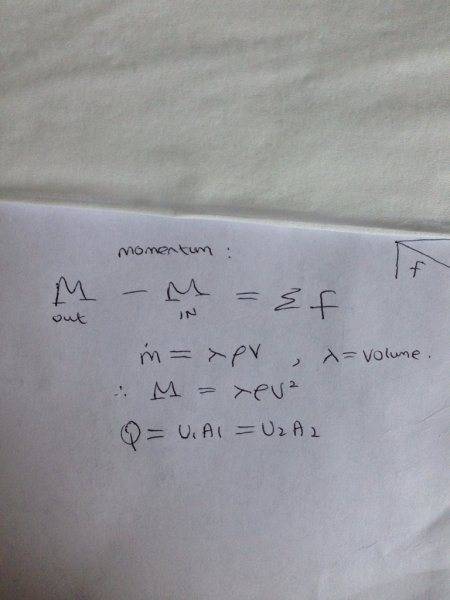
The discussion centers on the calculation of fluid velocity using momentum conservation principles, specifically questioning the validity of the equation Q=A1U1 = A2U2 in a scenario involving a cone with a 40 cm diameter. The user, Jay, reports an unusually high velocity of U2 = 195 m/s, suggesting a potential error in applying momentum conservation in both x and y directions. Chet further prompts for calculations regarding the perimeter of the cone and the channel's cross-sectional area, emphasizing the importance of understanding these dimensions for accurate fluid dynamics analysis.

PREREQUISITES
  • Understanding of fluid dynamics principles, particularly momentum conservation.
  • Familiarity with the equation of continuity Q=A1U1 = A2U2.
  • Basic knowledge of trigonometry for calculating resultant forces.
  • Ability to calculate the perimeter and area of geometric shapes, specifically cones.
NEXT STEPS
  • Research the application of the continuity equation in fluid dynamics.
  • Learn how to calculate the perimeter and cross-sectional area of a cone.
  • Study the principles of momentum conservation in both x and y directions in fluid systems.
  • Explore the implications of velocity calculations in confined flow scenarios.
USEFUL FOR

Students and professionals in fluid mechanics, engineers working on fluid dynamics problems, and anyone involved in calculating forces and velocities in fluid systems.

Jaydude
Messages
3
Reaction score
0
Question with diagram:

ImageUploadedByPhysics Forums1430313597.414676.jpg


Relevant equations:

ImageUploadedByPhysics Forums1430313713.658776.jpg


Attempt :

ImageUploadedByPhysics Forums1430313911.008830.jpg


My question:

Using my method I got the wrong force , not sure if in this situation I can use Q=A1U1 = A2U2, hence maybe that's why U2 = 195 m/s looks wrong/too fast?

I continue to use momentum conservation in the x and y directions. Lastly I just used trig to get the resultant force on the cone. I have no idea why we need the 40cm dimension...

Please point me in the right direction!

Thanks and regards,

Jay
 
Physics news on Phys.org
What is the perimeter of the cone at the location where the diameter is 40 cm. What is the channel cross sectional area at that location if all the flow is contained within the 4 cm channel height? What is the velocity normal to the channel cross section at that location?

Chet
 

Similar threads

  • · Replies 18 ·
Replies
18
Views
2K
  • · Replies 17 ·
Replies
17
Views
1K
  • · Replies 9 ·
Replies
9
Views
2K
Replies
4
Views
1K
  • · Replies 13 ·
Replies
13
Views
1K
  • · Replies 71 ·
3
Replies
71
Views
5K
  • · Replies 8 ·
Replies
8
Views
2K
  • · Replies 9 ·
Replies
9
Views
3K
  • · Replies 7 ·
Replies
7
Views
3K
Replies
28
Views
2K