Why is there a vertical force on the pin in this static equilibrium setup?

Click For Summary

Homework Help Overview

The discussion revolves around a static equilibrium problem involving a board supported by a pin and a string. The setup includes a mass at a distance from the pin, and participants are exploring the forces acting on the pin, particularly the vertical force component.

Discussion Character

  • Exploratory, Assumption checking, Conceptual clarification

Approaches and Questions Raised

  • Participants are questioning the necessity of the vertical force on the pin, particularly in relation to the vertical component of the tension in the string. Some suggest considering moments and torque to understand the forces better.

Discussion Status

There are various lines of reasoning being explored, including practical experimentation and theoretical analysis using Newton's laws. Some participants are suggesting that the vertical force may be necessary for rotational equilibrium, while others are questioning the role of the pin in maintaining static equilibrium.

Contextual Notes

Participants are considering the implications of different placements of the mass and the role of friction in the setup. The discussion includes references to free body diagrams and the effects of removing the pin from the scenario.

15ongm
Messages
7
Reaction score
0
Q: Why does the pin have a vertical force in this diagram (Static equilibrium)?

The diagram depicts as follows:
A mass (M) sits a a distance (d) away from the end of a board of length L. The board has a mass of m and is held to a wall by a pin and string. The string has a tension (T) and is at angle θ to the board. The pin is frictionless. The entire set-up is in static equilibrium.
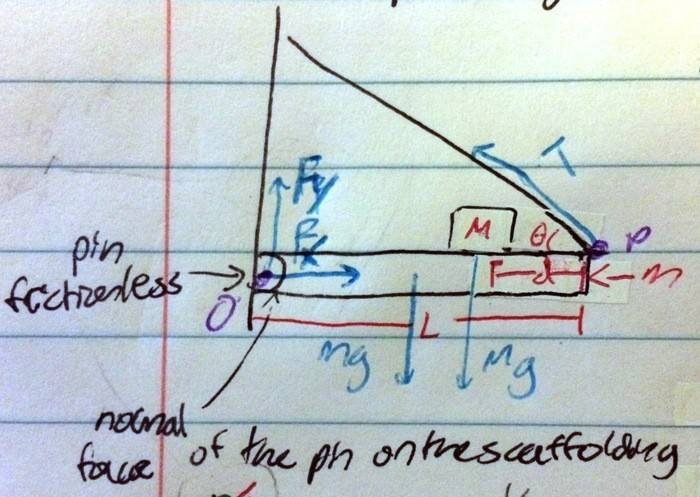
2573hno.jpg

Side note: In the diagram I called the board the scaffolding.

What I don't understand is why the pin has forces (Fy & Fx). I sort of understand why the pin must have a horizontal force (Fx) b/c otherwise there would be no other force to oppose the horizontal competent of tension. What I don't understand is why Fy must exist. To be honest, I don't even understand what Fy really is. Shouldn't the vertical component of the tension be enough to oppose the weight of the block and board? If so, there's no need for another upward vertical force.

I'd be really grateful if anyone could help me on this!
 
Physics news on Phys.org
Is the pin stuck to the wall?
 
15ongm said:
What I don't understand is why Fy must exist
Consider moments about some point (that is not on a vertical line through the pin).
 
Why not experiment? A short length of timber, a piece of rope tied to one end, and a brick. Is the free end of the plank happy to rest against the wall, or do you need to provide vertical supprt to keep it horizontal?

Once you know what happens in reality you can look for the theory that confirms it.
 
What about the torque produced by Tsinθ ? What if we look at the net torque about the centre of mass of the plank ? We may need Fy for rotational equilibrium of the plank.
 
The pin is like a hinge and the name for such forces is Hinge reaction forces.
The vertical component of T might be enough. You have to find it by using Newton's laws.
The hinge reaction plays a very important role when the string is burnt. In such a case, Fx provides centripetal force, while Fy opposes the weight.
 
AdityaDev said:
The pin is like a hinge and the name for such forces is Hinge reaction forces.
The vertical component of T might be enough. You have to find it by using Newton's laws.
The hinge reaction plays a very important role when the string is burnt. In such a case, Fx provides centripetal force, while Fy opposes the weight.
Could we establish static equilibrium without the pin ? I mean just the plank , and the thread ?
 
Ananya0107 said:
Could we establish static equilibrium without the pin ? I mean just the plank , and the thread ?
Yes. When you have friction. That is why I said you need to apply Newton's laws. Draw the FBD for the plank.
 
15ongm said:
Shouldn't the vertical component of the tension be enough to oppose the weight of the block and board?

Would you think the same if the mass m was at the pin end of the board?
 

Similar threads

Replies
6
Views
3K
  • · Replies 7 ·
Replies
7
Views
4K
Replies
16
Views
3K
  • · Replies 12 ·
Replies
12
Views
1K
  • · Replies 4 ·
Replies
4
Views
4K
  • · Replies 3 ·
Replies
3
Views
2K
Replies
2
Views
4K
  • · Replies 7 ·
Replies
7
Views
2K
  • · Replies 8 ·
Replies
8
Views
3K
  • · Replies 9 ·
Replies
9
Views
4K