Why must the Gibbs Free Energy be proportional to N?

Click For Summary
SUMMARY

The Gibbs Free Energy (G) must be proportional to the number of particles (N) because it is an extensive property. In the discussion, a counterexample using G(T, P, N) = (TPN)^{1/3} illustrates that while G can be extensive, it does not satisfy the proportionality to N under certain transformations. The distinction between extensive and intensive variables is crucial; extensive variables scale with the system size, while intensive variables like temperature (T) and pressure (P) do not. Thus, for G to be extensive, it must depend on extensive variables only.

PREREQUISITES
  • Understanding of thermodynamic concepts, specifically extensive and intensive properties.
  • Familiarity with Gibbs Free Energy and its significance in thermodynamics.
  • Basic knowledge of mathematical functions and scaling laws.
  • Proficiency in interpreting thermodynamic equations and their implications.
NEXT STEPS
  • Study the definitions and examples of extensive and intensive properties in thermodynamics.
  • Explore the implications of Gibbs Free Energy in chemical reactions and phase transitions.
  • Learn about the mathematical derivation of Gibbs Free Energy and its dependence on state variables.
  • Investigate the role of temperature and pressure in thermodynamic systems and their effects on extensive properties.
USEFUL FOR

Students and professionals in physics, chemistry, and engineering who are studying thermodynamics, particularly those focusing on the properties of systems and the behavior of Gibbs Free Energy.
aliens123
Messages
75
Reaction score
5
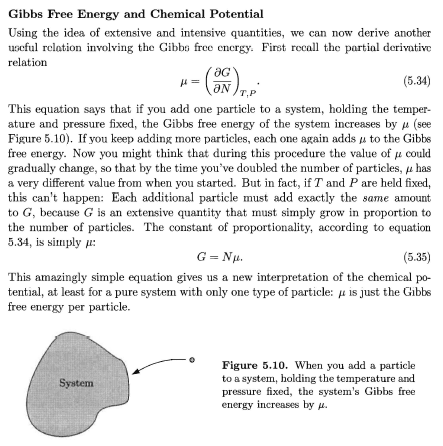
In the textbook Thermal Physics by Daniel Schroeder he says the following:
5.35.PNG


However, I don't follow this argument. Let's say that G was the following:
$$G(T, P, N) = (TPN)^{1/3}$$
Then
$$G(\lambda T, \lambda P, \lambda N) = \lambda G$$
So $$G$$ is extensive, but $$G \not \propto N.$$
 
Science news on Phys.org
aliens123 said:
Let's say that G was the following:
$$G(T, P, N) = (TPN)^{1/3}$$
Then
$$G(\lambda T, \lambda P, \lambda N) = \lambda G$$
So $$G$$ is extensive, but $$G \not \propto N.$$
In this example ##G## is not extensive since ##G(T,P,\lambda N)\ne \lambda G(T,P,N)##
 
Dale said:
In this example ##G## is not extensive since ##G(T,P,\lambda N)\ne \lambda G(T,P,N)##
Isn't the definition of extensive
$$Q(\lambda q_1, \lambda q_2, ..., \lambda q_n ) = \lambda Q(q_1, q_2, ..., q_n)?$$
 
aliens123 said:
Isn't the definition of extensive
$$Q(\lambda q_1, \lambda q_2, ..., \lambda q_n ) = \lambda Q(q_1, q_2, ..., q_n)?$$
The ##q_i## need to be extensive here. You are looking at ##P## and ##T## which are intensive. If you double the amount of stuff, temperature and pressure don't double. Have a look at the rabbits on the page before the excerpt you used in the OP.
 
  • Like
Likes   Reactions: Dale
No, you have to multiply only the extensive variables with ##\lambda##. The intensive variables don't change when scaling the "system size". That's the definition of extensive vs. intensive variables.
 

Similar threads

  • · Replies 3 ·
Replies
3
Views
2K
  • · Replies 16 ·
Replies
16
Views
3K
  • · Replies 10 ·
Replies
10
Views
3K
  • · Replies 5 ·
Replies
5
Views
1K
  • · Replies 10 ·
Replies
10
Views
2K
  • · Replies 2 ·
Replies
2
Views
2K
  • · Replies 12 ·
Replies
12
Views
1K
  • · Replies 1 ·
Replies
1
Views
15K
  • · Replies 4 ·
Replies
4
Views
2K
  • · Replies 4 ·
Replies
4
Views
3K