jaumzaum
- 433
- 33
I was taught that the only radiation that we can properly "feel" is infrared, while UV is not properly absorbed by the molecules of our body in the form of thermal energy.
But then I I saw the following picture which shows the water absorption spectrum:
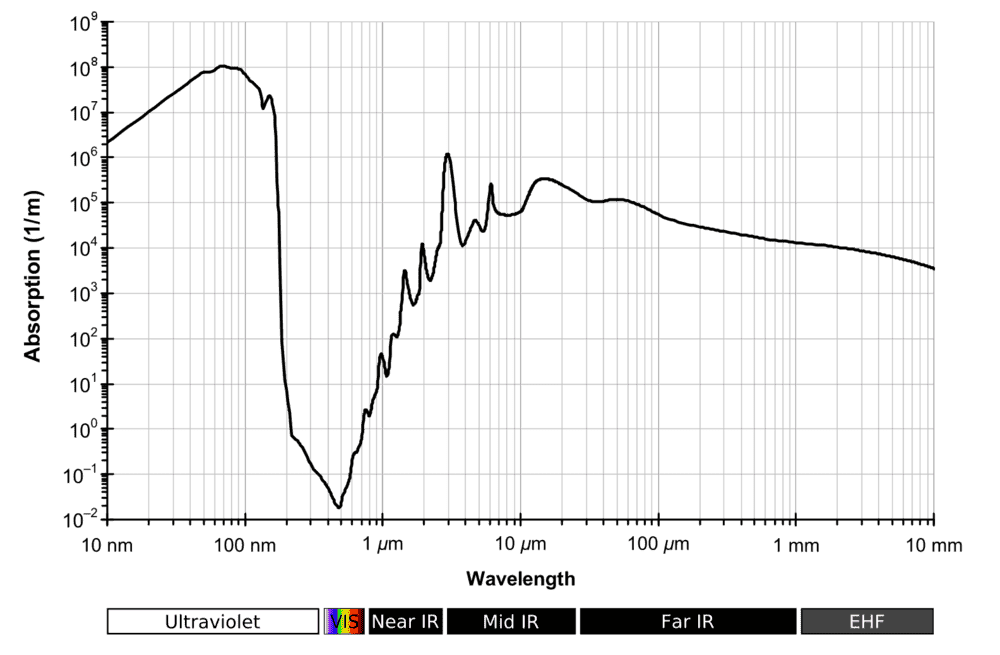
We can clearly see there that the UV radiation is indeed greatly absorbed by water molecules, so what is the correct explanation for these? Can UV really heat our bodies greatly than IR? Was I taught wrong? I could have some explanation to that, but I'm not sure if they make sense:
We know our bodies are composed mainly by water, but the radiation gets first to the skin, which contains some pigments, such as melonin. It is possible that some of the molecules in the skin act first as a barrier that blocks the UV radiation from reaching the water molecules.
Also, we know the majority of high frequency radiation is blocked by our atmosphere, such as the picture (the blue line is radiation in the Eath surfface) below:
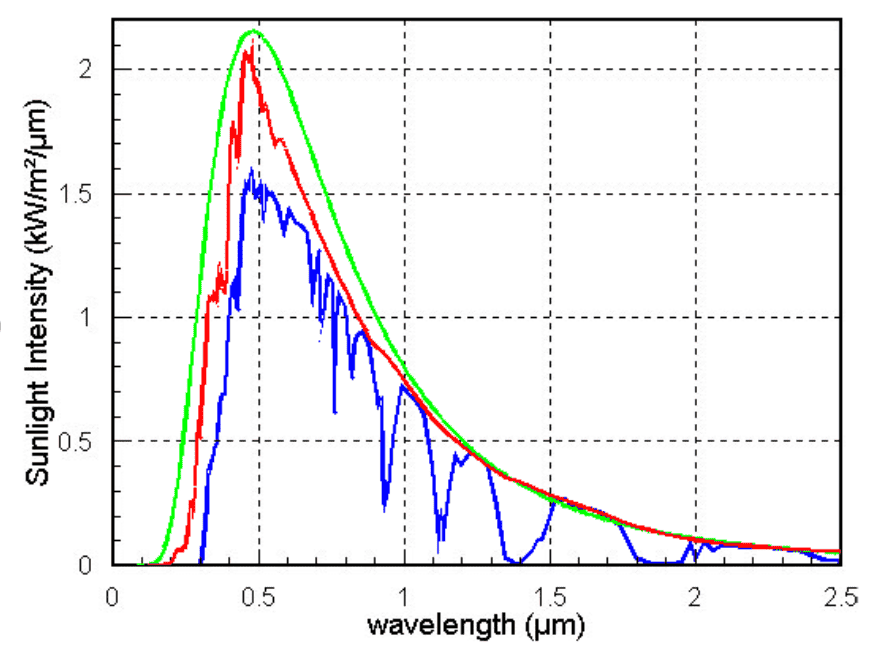
Radiation with a wavelength smaller than 300nm is almost not absorbed, so it does not get to our bodies, and so we can't feel it.
But what if it got here in the same intensity as IR does, what would happen? Would we feel it as heat or we would feel nothing and just develop some cancer in a few days after that?
But then I I saw the following picture which shows the water absorption spectrum:
We can clearly see there that the UV radiation is indeed greatly absorbed by water molecules, so what is the correct explanation for these? Can UV really heat our bodies greatly than IR? Was I taught wrong? I could have some explanation to that, but I'm not sure if they make sense:
We know our bodies are composed mainly by water, but the radiation gets first to the skin, which contains some pigments, such as melonin. It is possible that some of the molecules in the skin act first as a barrier that blocks the UV radiation from reaching the water molecules.
Also, we know the majority of high frequency radiation is blocked by our atmosphere, such as the picture (the blue line is radiation in the Eath surfface) below:
Radiation with a wavelength smaller than 300nm is almost not absorbed, so it does not get to our bodies, and so we can't feel it.
But what if it got here in the same intensity as IR does, what would happen? Would we feel it as heat or we would feel nothing and just develop some cancer in a few days after that?