Why Use Two Arbitrary Constants in Circle Parametrization for PDEs?

  • Context: Graduate 
  • Thread starter Thread starter kingwinner
  • Start date Start date
  • Tags Tags
    First order Pde
Click For Summary

Discussion Overview

The discussion revolves around the parametrization of circles in the context of solving quasilinear first order partial differential equations (PDEs). Participants explore the necessity of using two arbitrary constants in the parametrization, questioning the approach taken in a specific example.

Discussion Character

  • Debate/contested
  • Technical explanation
  • Mathematical reasoning

Main Points Raised

  • One participant questions the need for two arbitrary constants in the parametrization of a circle, suggesting that a single constant could suffice.
  • Another participant points out that the system of equations derived from the PDE leads to a second-order differential equation, which has a general solution involving two constants.
  • A participant expresses confusion about the author's method of combining the equations and seeks clarification on its purpose in solving the system.
  • Another participant notes that eliminating parameters can lead to a loss of information, implying that a two-parameter family of solutions is expected from the system of differential equations.

Areas of Agreement / Disagreement

Participants express differing views on the necessity of two arbitrary constants in the parametrization. While some find the author's approach valid, others advocate for a simpler method with one constant, indicating that the discussion remains unresolved.

Contextual Notes

The discussion highlights potential limitations in understanding the implications of eliminating parameters and the resulting loss of information in the context of the problem.

kingwinner
Messages
1,266
Reaction score
0
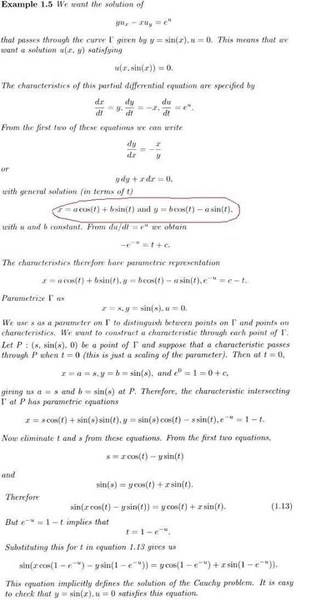
I am confused by the following example about solving quasilinear first order PDEs.
pde1.JPG


For the part I circled, the solution is just x^2 + y^2 = k where k is an arbitrary constant. To parametrize it in terms of t, can't we just put x = a cos(t), y = a sin(t) ? Here we only have one arbitrary constant a.
But in the example, they used a weird parametrization of a circle that includes TWO arbitary constants a and b. So my point is: why introduce another extra arbitrary constant when it is completely unnecessary to do so?

Can someone please explain why it is absolutely necessary to parametrize the circle in the way they do?

Any help is greatly appreciated! :)

[note: also under discussion in S.O.S. math cyberboard]
 
Last edited:
Physics news on Phys.org
If you look a couple of lines above what you circled you will see you need to solve the system:

x'(t) = y(t), y'(t) = -x(t)

So x''(t) = y'(t) = -x(t) giving x''(t) + x(t) = 0. This has the general solution:

x(t) = a cos(t) + b sin(t)
y(t) = -x'(t) = a sin(t) - b cos(t)
 
Hi LCKurtz,

OK, now I see why the circled part is correct by using your method. Your way actually makes more sense to me :)

But why is the author trying to combine the two equations dx/dt = y, dy/dt = -x ? How is this going to help us to solve the system?
Combining these two, we get dy/dx = -x/y, the general solution is just x^2 + y^2 = k where k is an arbitrary constant. To parametrize this general solution it in terms of t, just put x = a cos(t), y = a sin(t), right? This parametrization satisfies the equation x^2 + y^2 = k, so it must be a correct parametrization. What is wrong with this approach? Can you please point out where this line of logic fails?

Thank you!
 
I don't know why your author eliminates the parameter. I wouldn't have, but then I also don't write PDE books or notes.

The problem generally with eliminating parameters is that you lose information. In your case, you have a system of 2 DE's and would expect a two parameter family of trajectories. That fact disappears when you eliminate the parameter.
 

Similar threads

  • · Replies 0 ·
Replies
0
Views
3K
  • · Replies 3 ·
Replies
3
Views
3K
  • · Replies 2 ·
Replies
2
Views
2K
  • · Replies 3 ·
Replies
3
Views
2K
  • · Replies 2 ·
Replies
2
Views
2K
  • · Replies 4 ·
Replies
4
Views
4K
  • · Replies 3 ·
Replies
3
Views
8K
  • · Replies 2 ·
Replies
2
Views
3K
  • · Replies 3 ·
Replies
3
Views
2K
  • · Replies 8 ·
Replies
8
Views
4K