Wikipedia electric charge page confusion

Click For Summary
SUMMARY

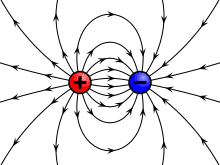
The discussion clarifies the representation of electric field lines on Wikipedia's electric charge page, emphasizing that these lines illustrate the electric field direction from positive to negative charges, not the flow of electrons. The arrows on the field lines are a convention that indicates the direction of force experienced by a positive test charge. The density of the lines correlates with the strength of the electric field, with closer lines indicating a stronger field. Understanding these concepts is crucial for interpreting electric fields and their effects on charged objects.

PREREQUISITES
  • Understanding of electric charge concepts
  • Familiarity with electric field theory
  • Knowledge of equipotential surfaces
  • Basic principles of force on charged particles
NEXT STEPS
  • Research the concept of electric field lines and their significance
  • Study equipotential surfaces and their relationship to electric fields
  • Learn about the behavior of positive and negative charges in electric fields
  • Explore the mathematical representation of electric fields and forces on charges
USEFUL FOR

Students of physics, educators explaining electric charge concepts, and anyone interested in understanding the fundamentals of electric fields and their implications in electrostatics.
Cash Fulton
Messages
24
Reaction score
1
Why does Wikipedia's page on electrical charge have a picture of a positivity charged object with arrows going to a negatively charged object? Doesn’t electrons flow from a negatively charged object to a positively charged object? Or is the picture just showing conventional current?

220px-VFPt_charges_plus_minus_thumb.svg.png

Thanks.
 
Physics news on Phys.org
Those lines are just the electric field lines, it has nothing to do with electron current. The significance of drawing electric field lines comes out, for example if one wants to draw equipotential surfaces, which is a surface on which every electric field line must pierce through perpendicularly.
 
  • Like
Likes   Reactions: Cash Fulton
blue_leaf77 said:
Those lines are just the electric field lines, it has nothing to do with electron current. The significance of drawing electric field lines comes out, for example if one wants to draw equipotential surfaces, which is a surface on which every electric field line must pierce through perpendicularly.
So an electric field goes from positive to negative?
 
Giving an arrow to the electric field lines is just a convention, it's not like the positive charge acts as an electric field emitter and the negative charge as the receiver. Electric field lines can also indicate the electric field strength dependence on position, the denser the lines the stronger the field there. In your picture, we can infer that the electric field strength is stronger around either charges and gets weaker as one goes farther from both of them.
 
  • Like
Likes   Reactions: Cash Fulton
blue_leaf77 said:
Giving an arrow to the electric field lines is just a convention, it's not like the positive charge acts as an electric field emitter and the negative charge as the receiver. Electric field lines can also indicate the electric field strength dependence on position, the denser the lines the stronger the field there. In your picture, we can infer that the electric field strength is stronger around either charges and gets weaker as one goes farther from both of them.
Ah, so you could say that it would be a better representation to put arrows going in both directions on those lines.
 
Cash Fulton said:
Ah, so you could say that it would be a better representation to put arrows going in both directions on those lines.
No matter how you look at it, assigning one arrow (either direction) to each line is better than two arrows of opposite directions because this way you don't always need to draw the charge type on all existing charges in the system.
 
  • Like
Likes   Reactions: Cash Fulton
blue_leaf77 said:
No matter how you look at it, assigning one arrow (either direction) to each line is better than two arrows of opposite directions because this way you don't always need to draw the charge type on all existing charges in the system.
Appreciate you helping dude.
 
No. Positive and negative charges will experience opposite forces from any given electric field. The arrows give us a way of visualizing this. A positive charge will feel a force in the direction of the arrows while a negative charge will feel a force in the direction opposite that of the arrows. So in your picture the positive charge is pulled towards the negative charge, which is with the arrows, while the negative charge is pulled towards the positive charge, or against the arrows. Both end up meeting in the middle, assuming they were free to move.
 
  • Like
Likes   Reactions: Cash Fulton and vanhees71
Cash Fulton said:
So an electric field goes from positive to negative?
Yes!
 
  • Like
Likes   Reactions: Cash Fulton
  • #10
The direction of the electric field at any point is (by definition) the direction of the force experienced by a small, positive probe charge placed in the field at the given point.
It could have been defined based on a negative probe but it just wasn't.
 
  • Like
Likes   Reactions: Cash Fulton

Similar threads

  • · Replies 3 ·
Replies
3
Views
587
  • · Replies 7 ·
Replies
7
Views
2K
  • · Replies 8 ·
Replies
8
Views
2K
  • · Replies 20 ·
Replies
20
Views
2K
  • · Replies 4 ·
Replies
4
Views
2K
  • · Replies 16 ·
Replies
16
Views
1K
  • · Replies 5 ·
Replies
5
Views
1K
  • · Replies 20 ·
Replies
20
Views
2K
  • · Replies 11 ·
Replies
11
Views
2K
  • · Replies 58 ·
2
Replies
58
Views
5K