Will a feather fly inside a free-falling elevator ?

  • Context: Undergrad 
  • Thread starter Thread starter Basimalasi
  • Start date Start date
  • Tags Tags
    Elevator
Click For Summary
SUMMARY

The discussion centers on the physics of a feather inside a free-falling elevator, concluding that both the feather and the elevator experience the same acceleration due to gravity, resulting in the feather remaining in contact with the elevator floor. The conversation references Newton's laws, specifically the second law (F=ma) and the law of universal gravitation, to explain that mass does not affect the rate of fall in a vacuum. Even with theoretical considerations of a massive elevator, the feather and elevator would still fall together without separation.

PREREQUISITES
  • Understanding of Newton's laws of motion
  • Basic knowledge of gravitational force and acceleration
  • Familiarity with concepts of free fall and relative motion
  • Awareness of air pressure effects in a falling environment
NEXT STEPS
  • Explore Newton's laws of motion in depth
  • Research gravitational force calculations and their implications
  • Study the effects of air pressure on falling objects
  • Investigate theoretical scenarios involving massive bodies in free fall
USEFUL FOR

Students of physics, educators explaining gravitational concepts, and anyone interested in the principles of motion and free fall dynamics.

Basimalasi
Messages
45
Reaction score
0
My friend and I had this question and after physics-fighting each other we came to a conclusion that the feather inside the elevator would not fly and it will stay in contact with the floor because they both have the same acceleration downwards and if we imagine that the feather was on a scale and initially has a mass of let's say 1 gram, it would point to zero when it's free-falling with the elevator .because the scale, elevator, and that feather are all free falling under the acceleration of the Earth and that mass has no effect whatsoever on the acceleration... BUT!

Would the results change if we take into consideration Newton's law of universal gravitation
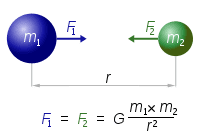
200px-NewtonsLawOfUniversalGravitation.svg.png


Imagine that the elevator is heading towards the Earth but has a very large mass and it's free-falling (no other acceleration or any other forces, other than gravity that is) wouldn't it's large mass cause it to have larger gravitational force and thus have more acceleration than a feather inside it?
 
Physics news on Phys.org
Basimalasi said:
Imagine that the elevator is heading towards the Earth but has a very large mass and it's free-falling (no other acceleration or any other forces, other than gravity that is) wouldn't it's large mass cause it to have larger gravitational force and thus have more acceleration than a feather inside it?

No. There's a FAQ on this: https://www.physicsforums.com/showthread.php?t=511172

(the problem is a bit more complicated if you assume that the mass of the elevator is large enough that the gravitational force also moves the Earth noticeably, but I don't think that's what we're considering here)
 
Last edited by a moderator:
(the problem is a bit more complicated if you assume that the mass of the elevator is large enough that the gravitational force also moves the Earth noticeably, but I don't think that's what we're considering here)[/QUOTE]

It's ridiculously theoretical I know ... but what would the mass of the elevator be, in order to make an acceleration difference between itself and the feather to eventually make the feather lose contact with the floor ..even a lil bit..and you could assume that the elevator has a mass of a moon
 
Even if the elevator is large enough to attract the Earth significantly, the effect does not matter. The resulting motion of the Earth is irrelevant. It moves just as rapidly toward the feather as toward the elevator and does not affect their separation.

If you are trying to account for second order effects then you might consider that the air at the bottom of the elevator (before it starts falling) is compressed relative to the air at the top. When the elevator starts falling, the pressure gradient disappears and the expanding air at the bottom carries the effectively weightless feather very slightly aloft.

Or you might consider the tidal force that tends to pull the feather at the bottom of the elevator more strongly downward than the average force on the elevator. This assumes that the center of mass of the elevator is somewhere above floor level and that third order effects do not intrude.
 
Basimalasi said:
but what would the mass of the elevator be, in order to make an acceleration difference between itself and the feather to eventually make the feather lose contact with the floor ..even a lil bit..and you could assume that the elevator has a mass of a moon

They'll still fall together, as long as you can keep them all neatly lined up: no sideways velocity and you can draw a straight line through the center of mass of all three objects.
 
alrighty then :/
 
Yeah, drag aside, all objects fall at the same rate no matter what their mass is.

  • Let's consider a feather of mass m.
  • Let's consider a mass-less scale.
  • Let's consider an elevator that is not a hollow cube, but consists of just the floor (as massive as the moon, if you will).

If you place the feather on top of the scale right on the ground, the scale is being squeezed between the feather and the ground, the weight reported is due to gravitational attraction between feather and earth.

If you place the feather on top of the scale on top of the elevator at the top floor, for as long as nobody is moving, the weight reported is due to gravitational attraction between feather and elevator/earth combination.

If now all three feather, scale and elevator are free falling on Earth's gravitational field, we can ignore the Earth and the scale is being squeezed only due to the gravitational attraction between feather and elevator.
 
Basimalasi said:
Imagine that the elevator is heading towards the Earth but has a very large mass and it's free-falling ... wouldn't it's large mass cause it to have larger gravitational force and thus have more acceleration than a feather inside it?

Remember Newton's second law, which boils down to the equation F =ma. Plug this into the left hand side of your equation, see that for both feather & lift m cancels out. See that the acceleration of both is exactly the same.
 

Similar threads

  • · Replies 22 ·
Replies
22
Views
997
  • · Replies 11 ·
Replies
11
Views
4K
  • · Replies 10 ·
Replies
10
Views
2K
  • · Replies 14 ·
Replies
14
Views
2K
  • · Replies 25 ·
Replies
25
Views
4K
  • · Replies 38 ·
2
Replies
38
Views
6K
  • · Replies 10 ·
Replies
10
Views
2K
  • · Replies 24 ·
Replies
24
Views
3K
  • · Replies 15 ·
Replies
15
Views
2K
  • · Replies 30 ·
2
Replies
30
Views
6K