Discussion Overview
The discussion revolves around the potential limits of multi-core processors, specifically in relation to Intel's new Ivy Bridge architecture. Participants explore the implications of core counts, architectural changes, and the future of CPU performance in various applications.
Discussion Character
- Debate/contested
- Technical explanation
- Conceptual clarification
Main Points Raised
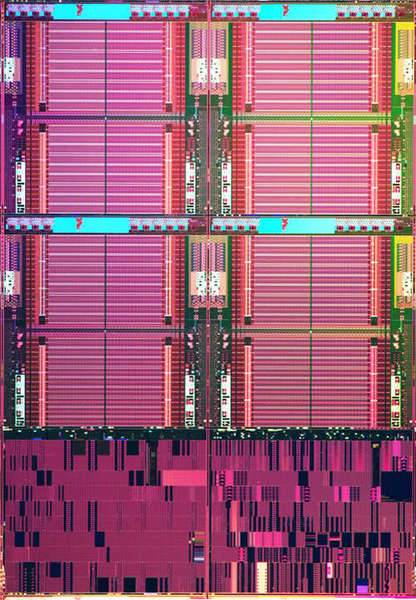
- Some participants question the authenticity of an alleged die shot of the Ivy Bridge processor.
- There is a consensus among some that Ivy Bridge is primarily a shrink of the Sandy Bridge architecture from 32nm to 22nm.
- Others express uncertainty about whether Ivy Bridge represents an entirely new micro-architecture, raising questions about the roles of Haswell and Rockwell.
- One participant suggests that the industry may be reaching a limit similar to the pre-dual core era, where increasing clock speeds became unsustainable.
- Concerns are raised about the practical utility of 16-core processors, with some arguing that most applications, like PC games, may not effectively utilize such power.
- Another participant notes that tasks such as HD video encoding and CAD could benefit from high core counts, but emphasizes the growing role of GPUs in handling computational tasks.
Areas of Agreement / Disagreement
Participants express differing views on the nature of the Ivy Bridge architecture and the future of multi-core processors. There is no clear consensus on whether the industry is approaching a performance limit or how effectively higher core counts will be utilized in practical applications.
Contextual Notes
Some participants rely on assumptions about the capabilities of future architectures and the applicability of multi-core designs in various fields, which remain unresolved.